
자가접착 레진시멘트를 이용한 섬유강화형 포스트-치아 접착 계면의 음향방출 분석과 결합 강도

초록
본 연구의 목적은 자가접착 레진시멘트를 이용한 섬유강화형 포스트의 근관 내 접착 시, 접착 방법에 따른 접착 계면의 음향방출 특성을 분석하고 push-out 결합 강도 및 접착 분리 양상을 비교하고자 하였다. 발치된 사람의 단일 근관 치아 24개를 근관 충전하고 포스트 공간을 형성한 후, 다음과 같이 8개씩 3개의 그룹으로 나누었다. (1) Group 1: 자가접착 레진시멘트 RelyX Universal Resin Cement만 적용 후 포스트 삽입, (2) Group 2: Scotchbond Universal Plus Adhesive 도포 후 RelyX Universal Resin Cement를 적용하고 포스트 삽입, (3) Group 3: Etchant로 산부식, Scotchbond Universal Plus Adhesive 도포 후, RelyX Universal Resin Cement를 적용하고 포스트 삽입. 광중합 개시부터 2000초 동안 포스트-치아 접착 계면 분리에 의해 발생한 음향방출 신호를 검출하였다. 음향방출 측정을 완료한 치근을 치관부, 중앙부, 치근단으로 나누어 push-out 결합 강도 시험을 시행하였고, 180배 디지털카메라로 접착 분리 양상을 관찰하였다. 평균 음향방출 사상수는 Group 1이 9.13 (10.95), Group 2는 7.25 (4.74), Group 3는 10.13 (11.73)로서 접착 방법에 따른 유의한 차이가 관찰되지 않았다(p>0.05). 광중합 개시 후 4-500초 이내의 초기에 음향방출 사상수가 집중되었고 시간이 흐름에 따라 증가율이 감소하는 양상을 보였다. 접착 방법에 따른 push-out 결합 강도(MPa)는 Group 1이 17.75 (4.89), Group 2는 16.85 (5.38), Group 3는 15.11 (5.57)로서 유의한 차이를 보이지 않았다(p>0.05). 모든 group에서 포스트-레진시멘트 간의 adhesive failure와 mixed type의 분리가 관찰되었다. 결론적으로, RelyX Fiber Post를 치아에 접착할 때 자가접착 레진시멘트인 RelyX Universal Resin Cement를 단독 사용하는 것과 산부식 또는 Scotchbond Universal Plus Adhesive로 치아를 전처리한 후 RelyX Universal Resin Cement를 사용하는 것은 임상적으로 선택적 사용이 가능하다고 할 수 있다.
Abstract
This study analyzed the acoustic emission (AE) characteristics of interfacial debonding between the fiber-reinforced composite (FRC) post and tooth during bonding with a self-adhesive resin cement under different bonding modes, and evaluated the push-out bond strength and debonding patterns. Twenty-four extracted human single-rooted teeth were root canal–filled, post spaces were prepared. The specimens were then divided into three groups (n=8). (1) Group 1: Only RelyX Universal Resin Cement was applied, (2) Group 2: After applying Scotchbond Universal Plus Adhesive, RelyX Universal Resin Cement was applied, (3) Group 3: After acid etching, Scotchbond Universal Plus Adhesive was applied, followed by RelyX Universal Resin Cement. RelyX Fiber Post was inserted and light-cured, and AE signals were detected for 2000 s. The push-out bond strength test was performed and the debonding modes were examined using a digital camera. The mean number of acoustic emission events and push-out bond strength showed no statistically significant differences among the groups (p>0.05). The acoustic emission events were concentrated within the first 400 to 500 s following the initiation of light curing. In all groups, adhesive failure between the post and the resin cement, as well as mixed-type failures, were observed. In conclusion, when cementing RelyX Fiber Post to tooth structure, the use of RelyX Universal Resin Cement alone, as a self-adhesive resin cement, or in combination with either phosphoric acid etching or pretreatment with Scotchbond Universal Plus Adhesive, can be considered clinically viable options.
Keywords:
Acoustic emission, Interfacial debonding, Fiber-reinforced composite post, Self-adhesive resin cement, Push-out bond strength키워드:
음향방출, 접착 계면, 섬유강화형 포스트, 자가접착 레진시멘트, Push-out 결합 강도 시험서 론
심하게 손상된 치아의 근관 치료 후 약화된 치질 구조를 보강하고 복합레진 코어의 유지력을 위해 레진 접착형 포스트의 사용이 필요하다. 치질과 접착하여 적용되는 fiber-reinforced composite post (FRC post)는 높은 명도와 투명감 있는 레진 기질 특성으로 인해 심미적인 수복 재료로 사용되어 왔다. FRC post의 장점으로는 치아와 유사한 광학성 특성, 근단부까지의 빛 전달로 인한 중합 효과, 상아질과 유사한 탄성계수, 자연치와 비슷한 정도의 응력 분산 등이 있으며 이러한 특성에 의해 치근 파절의 가능성이 줄어든다(1).
FRC post의 접착에는 상아질 접착제 및 레진시멘트를 사용하며, FRC post의 유지력은 레진시멘트와 근관 상아질 사이, 그리고 레진시멘트와 FRC post 표면 사이의 적절한 접착에 의해 좌우된다. 접착 계면의 장기간 안정성을 저해하는 요소는 불량한 빛 투과성, 불리한 C-factor, 기포와 미세한 틈의 존재, 두꺼운 도말층, 제한된 수분 조절 등이 있다(2).
최근 FRC post의 근관 내 접착을 위하여 치아의 전처리 및 접착제가 필요 없는 자가접착 레진시멘트(self-adhesive resin cement)가 도입되었다. 자가접착 레진시멘트는 여러 단계의 접착 과정을 생략하여 술자의 기술 의존도가 낮고 편리하게 사용할 수 있다. 많은 연구에서 자가접착 레진시멘트의 만족할 만한 접착 강도가 보고되고 있지만(3, 4), 근관 치료 및 포스트 공간 형성 과정에 의해 두꺼운 도말층이 존재하는 환경에서 적절한 탈회 및 접착이 이루어지는지 의문이 제기될 수 있다. 자가접착 레진시멘트의 사용 전 도말층의 제거 또는 변화가 접착 강도를 증가시키는지에 대한 몇몇 연구들(5-7)이 있으나 새로운 제품들이 출시되는 상황에서 더욱 심도 있는 연구가 필요한 실정이다.
FRC post의 접착 강도 측정을 위한 시험에는 주로 push-out 결합 강도 시험을 이용한다. Push-out 결합 강도 시험은 시편의 손상이 적고, 술자의 기술적인 면도 적게 적용되며, 접착 분리가 상아질 접착 계면에 평행하게 나타나고, 부위에 따른 강도 비교도 할 수 있기 때문에 포스트의 접착 강도 평가 시 적절한 시험 방법으로 알려져 있다(8). Push-out 결합 강도 시험에서 치근의 부위별로 근관 내 수분 수준, 광중합의 강도, 근관 내면과 FRC post 직경 간의 적합성 정도, 레진시멘트의 두께 등이 다를 수 있어 그에 따라 결합 강도의 차이를 보일 수 있다(9, 10). 따라서 FRC post와 치근 상아질 사이의 결합 강도를 보다 정확히 평가하기 위해서는 치근의 부위에 따른 결합 강도의 비교가 필요할 것이다.
이와 더불어, FRC post를 레진시멘트로 접착 시, 접착 파괴가 언제 일어나는지에 대한 정보는 접착력의 향상과 접착 파괴 기전의 이해에 매우 중요한 정보가 될 수 있다. 음향방출시험이란 구조물이나 접착의 파괴 시 내부에서 발생하는 탄성파를 재료 혹은 구조물 표면에 장착한 초음파 센서로 검출하여 구조물이나 접착면의 상태를 비파괴적으로 평가하는 방법이다(11). 음향방출법이 치아-복합레진 접착 계면의 분리를 실시간으로 모니터링할 수 있는 효과적인 비파괴 검사 방법임을 앞서 확인한 바 있다(12, 13). 음향방출법을 적용하여 FRC post를 근관 내 접착하는 경우에 레진시멘트의 중합이 진행됨에 따라 중합수축응력에 의해 계면의 균열이 언제, 어느 정도의 빈도로 발생하는지에 대한 시간적인 해석을 할 수 있을 것이다.
Universal 접착제의 하나인 Scotchbond Universal Plus Adhesive는 Self-Etch 방식과 Etch & Rinse 방식으로 사용할 수 있으며, MDP phosphate monomer 및 saline을 포함하고 있다. 또한 자가접착 레진시멘트인 RelyX Universal Resin Cement는 추가적인 접착제 없이 사용할 수도 있고, universal 접착제인 Scotchbond Universal Plus Adhesive를 Etch & Rinse 또는 Self-Etch 방법으로 적용한 후 사용할 수도 있다. 이 제품들은 최근에 출시되었기 때문에 각각의 방식에 따른 접착 강도를 비교하는 연구가 드물다.
본 연구의 목적은 자가접착 레진시멘트를 이용하여 FRC post를 근관 내에 접착할 때, 치아의 pre-treatment 방법에 따른 접착 계면 파괴의 음향방출 특성의 차이를 분석하고 push-out bond strength 및 접착 분리 양상을 비교하여 접착 방법에 따른 FRC post와 치아의 접착 계면부 파괴역학 기전에 대해 분석하는 것이다. 귀무가설은 "첫째, 접착 방법에 따른 음향방출 특성의 차이는 없을 것이다. 둘째, 접착 방법 또는 치근의 부위에 따른 push-out 결합 강도의 차이는 없을 것이다."로 설정하였다.
재료 및 방법
2. 시편 준비
본 연구는 서울대학교 서울대학교치과병원 연구윤리심의위원회의 승인(IRB No.: CRI24002)을 받아 시행하였다. 치근에 균열, 우식, 흡수성 결함, 충전물이 없고 곧은 치근 형태를 가진 발치된 인간의 단일 근관 치아 24개를 준비하였다. 치아는 0.5% Chloramine-T solution에 침적된 상태로 실험 전까지 4℃ 냉장 보관하였다.
각 치아의 치근 길이가 15 mm가 되도록 diamond disc를 이용하여 수평으로 절제하여 치관을 제거하였다. 근관 와동 형성 후 회전식 전동 니켈-티타늄(Ni-Ti) 근관 성형 기구(Profile; Dentsply Maillefer, Ballaigues, Switzerland)를 이용하여 #40, 0.06 taper까지 근관 확대 및 근관 성형을 시행하였다. 각 단계마다 2 ml의 2.5% NaOCl 용액(Duksan Pure Chemicals Co. Ltd., Ansan, Korea)으로 근관 세척을 시행하였다. 근관을 건조시킨 후 Gutta-percha cone (DiaDent, Cheongju, Korea)과 근관 충전용 실러 (Ceraseal; MetaBiomed, Cheongju, Korea)를 이용하여 근관 충전하였다. 임시 수복재(Caviton; GC, Tokyo, Japan)를 사용하여 치관부를 폐쇄하고 실러가 완전히 경화되도록 37℃, 100% 습도에서 1주일간 보관하였다.
음향방출 측정에서 치아를 글라스 슬라이드에 세워 고정하기 위한 사전 준비를 하였다. Diamond disc를 이용하여 치아의 치관부 절단면으로부터 하방 12 mm 지점에서 치근단을 수평으로 절제하고 샌드페이퍼 연마지를 이용하여 치근단측 바닥면을 편평하게 하여 치근이 글라스 슬라이드에 수직으로 설 수 있도록 하였다. 치근단 절단면으로부터 상방 1 mm 지점 치근의 근원심에 지름 1 mm 가량의 구멍을 형성하여 고정을 위한 고무줄이 통과할 수 있도록 준비하였다(Figure 1).
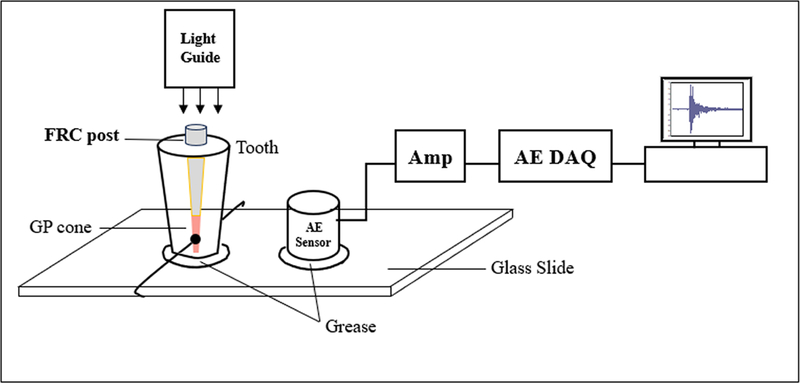
Schematic diagram of AE testing instrument. Polymerization shrinkage stress during light-curing of resin cement can cause debonding at the bonding interface between FRC post and dentin, which generates acoustic emission.
Gate-glidden drill No.2룰 사용하여 치근의 치관부 및 중앙부의 gutta-percha를 제거하였다. 각 치아의 근관은 RelyX Fiber Post drill (3M Deutschland GmbH, Neuss, Germany) size 3까지 확대하여 치아의 치관부 절단면으로부터 근관 내로 8 mm 깊이의 post space를 형성하였고, 치근단 4 mm의 gutta-percha는 치근단 봉쇄를 위해 남겨놓았다. 포스트 형성 공간을 2.5% NaOCl 용액(Duksan Pure Chemicals Co. Ltd., Ansan, Korea)으로 세척하였고, 최종적으로 증류수로 세척한 후, paper point로 건조하였다. RelyX Fiber Post (3M Deutschland GmbH, Neuss, Germany) size 3을 근관 내 post space에 미리 시적해보고 포스트 상방을 diamond disc로 절단하여 포스트가 치관부 절단면으로부터 1 mm 가량 돌출되도록 길이를 조절하였다. 근관 내 삽입 전, 포스트 표면을 알코올로 세척하고 공기로 5초간 건조시켰다.
3. 포스트 접착 시 음향방출(acoustic emission, AE)의 시간적 측정
고무줄을 이용하여 치아를 글라스 슬라이드에 고정하고 치근단측 바닥면과 글라스 슬라이드 경계면에 초음파 신호가 잘 전달되게 하기 위해 grease를 도포하였다(Figure 1).
치아를 다음과 같이 포스트의 접착 방법에 따라 무작위로 8개씩 3개의 group으로 분류하였다. 접착 방법에 따른 group 분류 및 세부사항은 Table 2와 같다.

Group classification based on cementation methods(n=8)
Group 1: 자가접착 레진시멘트 RelyX Universal Resin Cement만 적용 후 포스트 삽입.
Group 2: Scotchbond Universal Plus Adhesive 20초 도포(Self-Etch mode) 후 5초 동안 건조시킨 다음 RelyX Universal Resin Cement 적용 후 포스트 삽입.
Group 3: Etchant로 산부식 15초 후 수세 20초, Scotchbond Universal Plus Adhesive 20초 도포(Etch & Rinse mode)한 후 5초 건조, RelyX Universal Resin Cement 적용 후 포스트를 삽입하였다.
치아가 부착된 글라스 슬라이드를 실험대 위해 놓고 고정한 후 치아와 1 cm 떨어진 위치에 grease를 바르고 음향방출 센서(M204A, Rectuson, Sungnam, Korea)를 부착하였다(Figure 1).
근관내에 RelyX Universal Resin Cement를 주입한 후 RelyX Fiber Post size 3을 포스트 형성 공간에 삽입하고 음향방출 기록을 시작하였다. 광중합기 Elipar freelight 2(3M ESPE, St,Paul, MN, USA)를 이용하여 포스트 상단 직상방에서 수직방향으로 60초간 광조사를 하였다. 광조사 완료 후 치아가 탈수되는 것을 방지하기 위하여 젖은 거즈로 치아를 덮어 습도를 유지하였다.
음향방출은 광조사 개시 이후 2000초 동안 기록하였다. 센서로부터 얻어진 신호는 증폭기를 통해 2500배 증폭된 후 National instrument사의 DAQ 보드(USB-6361, National instrument, Austin, TX, USA)를 통해 LabView 2010을 이용하여 컴퓨터에 저장되었다. Sampling rate는 2 MHz이며 한 음향방출 event당 신호지속시간은 2 ms로 지정하였다. Threshold level은 70 mV로 하였다. Wave form (파형), amplitude (진폭), event number (사상수), event time (사상 발생 시간)과 같은 음향방출 parameter를 이용하여 음향방출 데이터를 분석하였다.
4. Push-out 결합 강도 시험
음향방출 측정을 완료한 포스트 접착 치아 시편을 putty 인상재(Exafine putty; GC, Tokyo Japan)로 만든 주형에 아크릴릭 레진(Orthojet acrylic; Lang Dental, IL, USA)으로 매몰하여 절단 시편 제작을 위한 준비를 하였다. 치근은 주수 하에 Diamond saw (Isomet; Buehler Co., Chicago, IL, USA)를 이용하여 저속 절제하였다. 1 mm 시편 두께가 되도록 하였고, 한 치아당 3개의 시편을 제작하였다. 치관부 절단면으로부터 1.5 mm 위치에서 절제를 시작하여 그 위치 이상의 상부는 폐기하였고, 다시 1 mm씩 절제를 시작하여 상부 1 mm 절제 시편을 치근 치관부 시편, 중앙 1 mm 절제 시편을 중앙부 시편, 하부 1 mm 절제 시편을 치근단 부위 시편으로 정의하였다. Push-out 결합 강도 시험 시 지름이 큰 포스트 상단 방향으로 탈락될 수 있도록 치근의 상부와 하부를 구별하여 표시해 두었다.
Push-out 결합 강도 시험을 위하여 직경 1.0 mm의 push-out plugger를 제작하고 만능시험기(IB Systems, Seoul, Korea)에 장착하여 접착 실패까지 최대 하중으로 결합 강도를 측정하였다. 시편을 준비된 금속 주형 위에 위치하고 시험 속도 0.5 mm/min으로 치근단에서 치관부로 부하를 가하여 포스트가 탈락되도록 하였다. 탈락 및 포스트 파절 시의 최대 하중은 N 단위로 측정하였다. 탈락된 포스트의 직경과 두께를 마이크로미터(Mitutoyo, Kawasaki, Japan)로 측정하였다. 접착 강도(MPa)는 파절 시 최대 하중/포스트 접착 면적으로 계산하였고 이때 접착 면적은 다음과 같다.
A = 2πrh (A: 접착면적, r: 포스트의 반지름, h: 시편의 두께)
5. 접착 분리 양상의 분류
Push-out 결합 강도 시험이 완료된 후, 분리된 FRC post의 표면과 절단 시편의 분리된 면을 180배의 디지털 카메라(HySCOPE DS-MV1C, Furonteer, Seongnam, Korea)로 관찰하여 접착 분리 양상을 다음과 같이 분류하여 기록하였다.
- ㆍType of debonding
- (a) adhesive failure between dentin and luting material
- (b) adhesive failure between post and luting material
- (c) cohesive failure of luting materials
- (d) mixed type, a combination of 2 of the aforementioned types
6. 통계 분석
포스트 접착 방법 간의 평균 음향방출 사상수의 차이를 분석하기 위하여 Kruskal- Wallis test를 시행하였다. 포스트 접착 방법과 치근의 부위에 따른 push-out 결합 강도의 차이를 알아보기 위하여 Two-way ANOVA를 시행하였고, 사후분석으로는 Tukey's test를 시행하였다. 통계분석은 SPSS software version 29.0.1.0 (IBM, Armonk, NY, USA)을 이용하였으며, 검정을 위한 유의수준은 5%로 설정하였다.
결 과
1. 음향방출(acoustic emission, AE) 분석
포스트와 치아의 계면에서 검출된 음향방출 신호의 파형은 Figure 2와 같다. 신호지속시간은 대략 0.3 ms이었으며, 순간적인 짧은 시간 동안 0.62 V (2500배 증폭된 신호)의 최대 진폭을 갖는 음향방출 신호가 포착되었음을 알 수 있다.
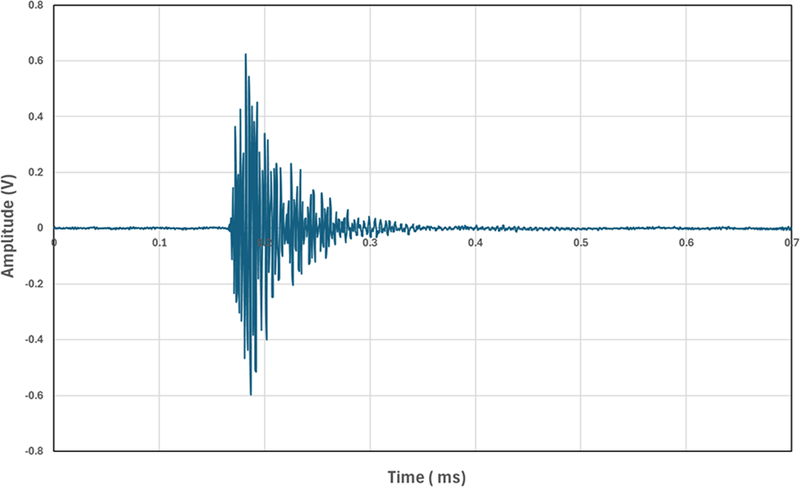
A representative AE signal.
각 group의 대부분의 음향방출 신호는 1 V 이하의 약한 신호를 보였으나, Group 1과 Group 2에서는 각각 4.89 V, 6.71 V와 같이 4 V 보다 높은 강한 신호가 추가적으로 검출되었다(Figure 3).
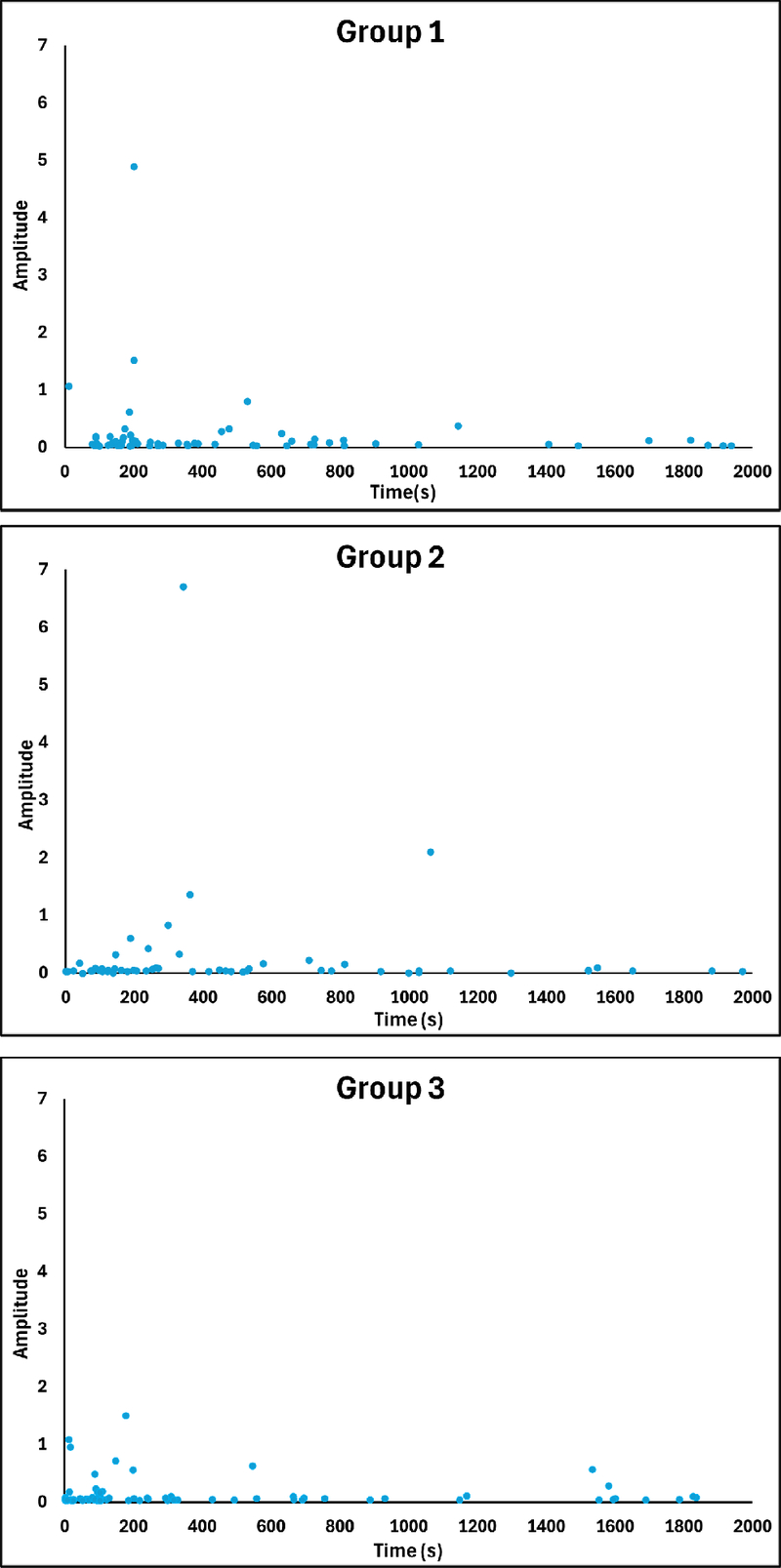
Total AE events and amplitude distribution for 2000 s.
평균 음향방출 사상수는 Group 1이 9.13 (10.95), Group 2는 7.25 (4.74), Group 3는 10.13 (11.73) 로서 포스트 접착 방법에 따른 평균 음향방출 사상수는 유의한 차이가 관찰되지 않았다(p>0.05; Table 3).
Mean number of AE events (SD) for each group(n=8)
시간의 흐름에 따른 그룹 내 모든 시편의 총 누적 사상수를 Figure 4에 나타냈다. 광중합 개시 후 4-500초 이내의 초기에 음향방출 사상수가 집중되었고 시간이 흐름에 따라 증가율이 감소하는 양상을 보였다.
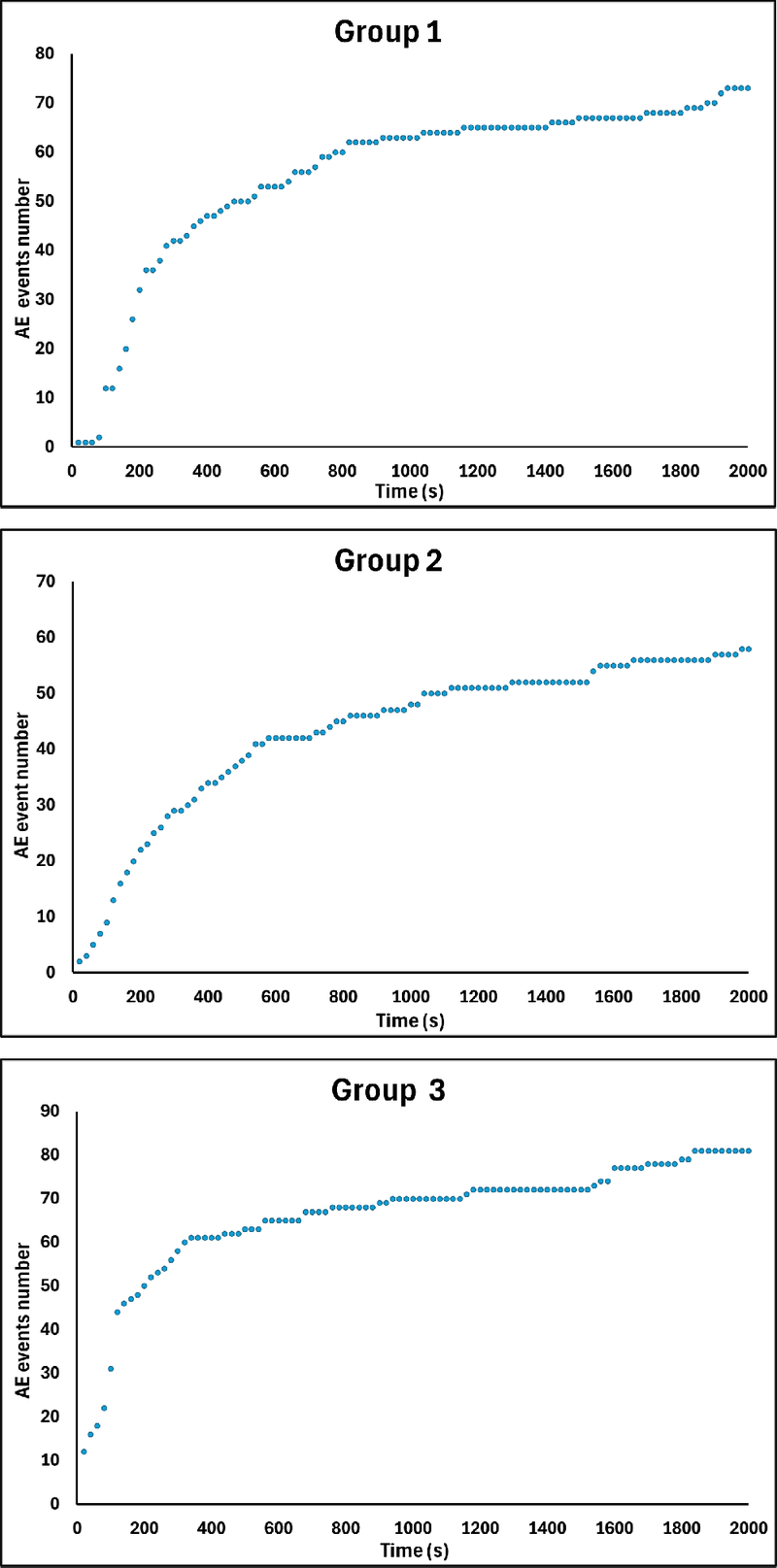
Total cumulative AE events as a function of time.
2. Push-out 결합 강도와 접착 분리 양상
포스트 접착 방법과 치근의 부위에 따른 push-out 결합 강도는 Table 4와 같다. 포스트 접착 방법의 차이에 따른 결합 강도는 통계적으로 유의할 만한 차이를 보이지 않았다(p>0.05). Group 1과 Group 2에서는 치근단 부위의 결합 강도는 치근 치관부의 결합 강도보다 유의할 만한 수준으로 높았다(p<0.05). Group 3 내에서 치근의 부위에 따른 결합 강도는 유의할 만한 차이가 없었다(p>0.05).
Push-out strength (MPa) for each group with different positions(n=8)
Push-out 결합 강도 시험 후 접착 분리 양상(Figure 5)을 분류하여 Table 5에 제시하였다. 모든 group에서 포스트와 레진시멘트 간의 adhesive failure와 mixed type의 분리가 관찰되었다.
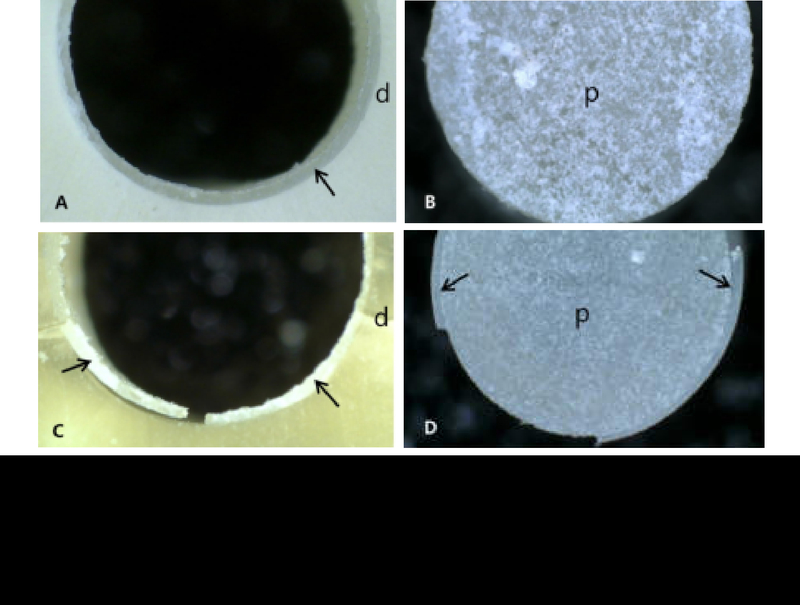
Images of debonding modes after push-out test at ×180 magnification. (A) and (B) adhesive failure between post and luting material, (C) and (D) mixed type failure at the middle level (black arrows: resin cement, d; dentin, p: post).
Number (%) of debonding mode after push-out test for each group with different positions
고 찰
음향방출법은 치과영역에서 섬유강화레진에 함유된 fiber의 수와 방향의 차이에 따른 파괴거동의 연구(14, 15), 도재의 initial fracture와 final fracture의 규명(16), 복합레진이 중합되는 동안 치아와 수복재 간의 계면 분리를 감지하는 방법(17, 18)으로 적용된 바 있다. 또한, 와동의 종류, 복합레진의 종류, 중합 방법 등에 따라 중합수축에 의한 복합레진-치아의 계면분리를 음향방출법으로 실시간 검출하여 분석한 연구(12, 13, 19)들이 있으나, 근관 내에 FRC post를 접착할 때 레진시멘트의 중합수축에 따른 계면 분리를 시간의 흐름에 따라 모니터링한 연구는 없다. 치아의 치관부가 아닌 근관 내부에서 발생하는 균열음을 포착하는 것은 매우 민감도가 높아야 함에도 불구하고, 4 V 보다 높은 강한 신호뿐만이 아니라 1 V 이하의 약한 신호도 포착할 수 있었다(Figure 2, 3). 본 연구를 통해 음향방출법을 이용하여 치아의 치관부 와동에서 뿐만 아니라 근관 내면에서 발생하는 접착 파괴도 실시간으로 검출할 수 있음을 알 수 있었다.
치아와 FRC post의 계면에서 음향방출신호가 검출되는 원리는 다음과 같이 유추해 볼 수 있다. 접착 재료의 도포 후 근관 내에서 레진시멘트의 중합이 시작됨에 따라 레진 시멘트의 중합수축과 더불어 중합체 사슬의 생성과 교차결합은 탄성계수를 증가시킨다 (20). 불용성의 네크워크가 형성되는 gel point 단계에서 탄성계수가 급속히 증가하여 레진시멘트의 탄성한계가 중합수축을 보상하기 위한 가소 변형을 허용하지 않게 된다. 이 지점을 넘어서면 부가적인 수축은 레진 시멘트 내부에 상당한 응력을 유발하게 된다. 따라서 수축하려는 힘이 레진시멘트와 치아 사이 그리고 레진시멘트와 FRC post 사이의 결합 강도보다 클 경우에 계면 분리가 발생하게 되고 이 순간의 충격파가 음향방출 신호로 발생하게 되어 초음파센서에 의해 포착될 수 있다(12). 계면의 균열음을 실시간으로 검출한 음향방출 측정의 결과, 각 group에서 발생한 평균 음향방출 사상수는 유의한 차이를 보이지 않았다(Table 3). 접착 방법에 따라 접착 파괴의 빈도 차이가 유의하게 나타나지 않았음을 의미한다. 시간의 흐름에 따른 group 내 모든 시편의 총 누적 사상수 그래프에 의하면, 광중합 개시 후 4-500초 이내의 초기에 음향방출 사상수가 집중되었고 시간이 흐름에 따라 증가율이 감소하는 양상을 보였다(Figure 4). 레진시멘트의 중합수축이 발생함에 따라 중합수축응력에 의한 계면 분리가 초기 4-500초 이내에 일어났고 그 이후에는 분리될 부분들은 대부분 분리되어 응력이 해소되면서 음향방출 신호가 드물게 발생한 것으로 해석할 수 있다.
Universal 접착제는 Self-Etch 방식과 Etch & Rinse 방식으로 사용할 수 있으며 접착 전략에 따른 결합력의 차이에 대해서는 아직 논란이 존재한다(21-24). 본 연구에서는 Scotchbond Universal Plus Adhesive의 Self-Etch 방식과 Etch & Rinse 방식 사이에 결합력의 유의미한 차이가 나타나지 않았다(Table 4). 이는 산부식이 접착 과정에서 필수적인 단계가 아님을 의미한다. Scotchbond Universal Plus Adhesive는 RelyX Universal Resin Cement와 함께 사용하도록 설계된 universal 접착제로서 2011년에 출시되었던 Scotchbond Universal Adhesive의 업그레이드 버전이다. 많은 universal 접착제의 대표 성분 중의 하나인 기능성 모노머 10-MDP를 포함하고 있으며, 10-MDP는 법랑질과 상아질의 수산화인회석과 결합을 하여, 결과적으로 높은 안정성과 가수분해 저항성을 보이는 MDP-Ca salt를 생성한다(25). 또 다른 구성 성분 중 하나인 3M Vitrebond Copolymer의 carboxylic acid group은 수산화인회석 및 콜라겐과 이온 결합 및 수소 결합을 한다. 또한 상당량의 물을 흡수하고 방출할 수 있는 수분 내성이 있어, 다양한 수분 조건에서도 상아질에 대한 우수한 접착력를 보인다고 하였다(26, 27). FRC post 접착 시 근관을 세척한 후에는 시야 확보가 어렵고 수분 조절이 어려워지므로, 이러한 수분 내성은 중요한 장점으로 작용할 수 있다. Wagner 등(28)에 의하면, universal 접착제는 자가부식 산성 모노머에 의한 이온화 반응을 통해 Etch & Rinse 방식과 유사한 접착 강도를 보장할 수 있어, 접착 전략에 따라 접착력이 크게 좌우되지는 않을 수 있다고 하였고, 체계적인 문헌고찰에 따르면 universal 접착제는 상아질에서 Etch & Rinse 방식으로 사용할 경우 접착 강도가 향상되는 효과가 뚜렷하게 나타나지 않았다고 하였는데(29), 이는 본 연구 결과와도 일치한다.
자가접착 레진시멘트의 가장 큰 단점은 높은 점도로 인해 젖음성이 낮고, 그로 인해 치아 경조직 내로의 침투가 제한된다는 점이다(6). 또한, 일부 연구들은 자가접착 레진시멘트를 단독으로 사용할 경우, 하이브리드 층이나 레진 태그가 형성되지 않았다고 보고한 바 있다(30, 31). 이에 따르면, 자가접착 레진시멘트를 단독으로 사용할 경우 접착력의 약화를 우려할 수도 있으나, 제품 고유의 특성에 따라 다른 결과를 보일 수도 있음을 고려해야 한다. 산부식 여부나 접착제 사용 유무에 따른 RelyX Universal Resin Cement의 상아질에 대한 결합 강도를 평가한 연구는 제한적으로만 보고되었다. RelyX Universal Resin Cement의 적용 전에 Scotchbond Universal Plus Adhesive를 사용할 경우, 접착제를 사용하지 않을 경우보다 상아질의 전단 결합 강도가 더 높았다고 보고된 바 있으며(32, 33), RelyX Universal Resin Cement와 Scotchbond Universal Plus Adhesive의 사용 조합에서 상아질에 산부식 선행 여부는 상아질 전단 결합 강도에 영향을 주지 않았다고 보고되었다(34). 본 연구에서는 산부식과 Scotchbond Universal Plus Adhesive 도포 과정 없이 RelyX Universal Resin Cement를 단독 적용한 경우 추가적인 다단계 과정과 동일하거나 그 이상으로 우수한 결합력을 보여주었다(Table 4). 제조사의 설명에 의하면, RelyX Universal Resin Cement는 amphiphilic adhesion monomers와 amphiphilic redox initiator system (AIS)을 포함하고 있는데 AIS는 기능성 모노머와 함께 친수성 상아질의 도말층으로 확산되어 상아질과 강한 접착을 형성하며 고도로 교차 결합된 3차원 고분자 네트워크의 형성을 촉진하여 레진-상아질 계면의 장기적 안정성을 확보한다고 한다(35). Amphiphilic이란, 한 분자 안에 친수성 부분과 소수성 부분을 모두 가지고 있는 것을 의미하며 이러한 특성으로 인해 RelyX Universal Resin Cement가 치아 내부로 잘 젖어 들어가 치아의 pretreatment 없이도 견고한 결합이 가능한 것으로 보인다.
FRC post는 복합 레진 매트릭스에 실란 처리된 유리섬유가 함침된 재료로, FRC post의 레진 기질은 중합 완료된 레진이기 때문에 반응성이 낮고 중합 반응을 위한 자유 반응기가 적은 특징이 있어 레진시멘트와의 결합력이 떨어지게 된다(36). 접착 레진이 FRC post 내부로 잘 침투할 수 있다면 FRC post와 레진 시멘트 간의 접착 강도가 향상된다(37). 접착 강도를 향상시키기 위해 FRC post에 전처리를 하는 다양한 방법들이 보고되었으며, 실란 처리, 불산 에칭, 샌드블라스팅, tribochemical silica coating 등의 방법이 있다(36, 38-40). 제조사의 설명에 의하면, RelyX Fiber Post의 접착 시 RelyX Universal Resin Cement를 사용할 경우에는 포스트 표면에 전처리를 하지 않아도 무방하기 때문에 임상적인 접착 절차를 더욱 간소화할 수 있다고 하였다(35). 하지만 push-out 결합 강도 시험 후 접착 분리 양상(Figure 5)을 관찰하였을 때 FRC post-레진시멘트 계면에서의 접착 분리가 상대적으로 많았다(Table 5). 따라서 접착 강도의 향상을 위해 RelyX Fiber Post 표면을 전처리하는 방법에 대한 비교 연구가 추가적으로 필요할 것으로 사료된다.
본 연구에서 Group 1과 Group 2의 push-out 결합 강도는 치근 부위의 영향을 받았다. FRC post의 결합 강도가 치근의 다른 부위보다 apical 1/3 부위에서 더 높았다고 보고한 연구가 있는 반면(41-43) 치근의 cervical 1/3 부위에서는 결합력이 우수하지만, apical 1/3 부위에서는 결합력이 약하다고 보고한 연구도 있다(44, 45). 본 연구의 결과 Group 1과 Group 2의 push-out 결합 강도는 근단부가 치근 치관부보다 유의하게 높은 것으로 나타났다(Table 4).
FRC post는 기성품이기 때문에 포스트 공간 형성 시 사용한 drill과 같은 사이즈의 포스트를 선택하였더라도 모든 부위에서 항상 근관에 밀착되어 적합되지 않는다. 특히 단근치 치근의 치관부에서는 FRC post와 근관 직경 사이의 불일치로 인하여 포스트 주위에 더 두꺼운 레진시멘트 층이 형성될 수 있다. 두꺼운 레진시멘트 층에는 기포, 균열, 틈새와 같은 구조적 불연속성이 더 많이 존재하며, 이러한 요소들에 의해 응력 집중 영역이 형성되어 균열이 시작될 수 있다(9, 46). 반면에 근관의 치근단 부위는 포스트와 근관 내면 사이에 긴밀한 적합이 이루어지는 부분이므로 FRC post의 탈락 저항성이 더 높았다고 볼 수 있다. 또한, RelyX Universal Resin Cement는 이중중합 레진시멘트이기 때문에 광중합형 레진 시멘트와 달리 치근단부에서 발생할 수 있는 광조사 부족으로 인한 접착 강도 저하와 같은 문제들이 상대적으로 적을 수 있다.
이로써, 본 연구의 첫 번째 귀무가설인 "접착 방법에 따른 음향방출특성의 차이는 없을 것이다."와 두 번째 귀무가설인 "접착 방법에 따른 push-out 결합 강도의 차이는 없을 것이다."는 채택되었고 "치근의 부위에 따른 push-out 결합 강도의 차이는 없을 것이다"는 부분적으로 기각되었다.
본 연구의 group 별 접착 과정 및 음향방출 측정은 술자의 시편 제작 기술 민감도에 좌우되며 정교하고 일관된 시편 조작이 필수적이다. 치근 상아질과 접착 재료 간의 상호 영향을 고려하여 발치된 사람의 치아에서 진행하였는데 발치된 치아의 해부학적인 형태 차이로 인해 FRC post와 근관 내면 사이의 간극은 치아마다 그리고 치아 내에서도 다양할 수밖에 없다. 이로 인해 시편의 개수가 한정된 상황에서 실험의 오차가 발생했을 가능성이 있다.
또한, universal 접착제 및 자가접착 레진시멘트의 접착 매커니즘은 제품의 종류마다 서로 다를 수 있으므로 본 연구에 사용된 제품에 한정하여 결과를 해석해야 한다. 후속 연구에서는 접착 방법에 따른 유의한 차이를 보이지 않았던 본 연구의 결과를 참고하여 group 당 표본 수를 늘리는 것을 고려해야 할 것이다.
본 연구는 음향방출법을 통해 근관 내 접착 계면의 접착 파괴 기전을 시간적으로 해석할 수 있음을 확인한 첫 모델로서 향후 음향방출법을 활용하여 중합방법, 레진시멘트의 종류, FRC post의 표면 처리방법 등 다양한 변수 하에 근관 내 상아질과 FRC post 간의 접착 파괴 거동을 비교 분석할 수 있을 것이다. 또한, 포스트 접착 후 시간이 경과함에 따라 저작력에 의한 결합 약화, 상아질-레진시멘트 간 접착층의 가수 분해 등에 대한 연구도 필요할 것으로 사료된다.
결 론
In vitro 연구의 한계 내에서 RelyX Fiber Post의 근관 내 접착에 관한 음향방출 측정의 결과, 레진시멘트의 접착 방법에 따른 평균 음향방출 사상수는 유의한 차이를 보이지 않았다(p>0.05). 또한, Push-out 결합 강도 시험에서 레진시멘트의 접착 방법에 따른 결합력의 차이가 유의하게 나타나지 않았다(p>0.05). 모든 group에서 포스트와 접착제 간의 adhesive failure와 mixed type의 분리가 관찰되었다. RelyX Fiber Post를 치아에 접착할 때 자가접착 레진시멘트인 RelyX Universal Resin Cement를 단독 사용하는 것과 산부식 또는 Scotchbond Universal Plus Adhesive로 치아를 전처리한 후 RelyX Universal Resin Cement를 사용하는 것은 임상적으로 선택적 사용이 가능하다고 할 수 있다.
Acknowledgments
이 논문은 서울대학교치과병원 원내연구과제 연구비 지원에 의해 이루어진 것임(과제번호 08-2024-0029).
본 연구에 사용된 인체자원은 한국인체자원은행 네트워크의 일원인 서울대학교치과병원 인체유래물은행에서 제공받았음(project No. 2024ER050700).
References
-
Lamichhane A, Xu C, Zhang FQ. Dental fiber-post resin base material: a review. J Adv Prosthodont 2014;6:60-5.
[https://doi.org/10.4047/jap.2014.6.1.60]

-
Pereira JR, Lins do Valle A, Ghizoni JS, Lorenzoni FC, Ramos MB, Dos Reis So′MV. Push-out bond strengths of different dental cements used to cement glass fiber posts. J Prosthet Dent 2013;110:134-40.
[https://doi.org/10.1016/s0022-3913(13)60353-4]
-
da Silva MB, Tavarez RR, de Assis FS, Tonetto MR, Neto TP, Bhandi SH, et al. The effect of self-adhesive and self-etching resin cements on the bond strength of nonmetallic posts in different root thirds. J Contemp Dent Pract. 2015;16(2):147-53.
[https://doi.org/10.5005/jp-journals-10024-1652]
-
Pereira JR, Pamato S, Santini MF, Porto VC, Ricci WA, Só MVR. Push-out bond strength of fiberglass posts cemented with adhesive and self-adhesive resin cements according to the root canal surface. Saudi Dent J. 2021;33(1):22-26.
[https://doi.org/10.1016/j.sdentj.2019.11.009]
-
Erdemir U, Sar-Sancakli H, Yildiz E, Ozel S, Batur B. An in vitro comparison of different adhesive strategies on the micro push-out bond strength of a glass fiber post. Med Oral Patol Oral Cir Bucal 2011;16:e626-34.
[https://doi.org/10.4317/medoral.16.e626]
-
Kıvanç, BH., Arısu, HD., Üçtaşlı, MB., Okay, TC. The effect of different adhesive system applications on push-out bond strengths of glass fiber posts. J Adv Prosthodont 2013;5:305-11.
[https://doi.org/10.4047/jap.2013.5.3.305]
-
Kim MW, Ahn JH, Kim LK, Shim HW. Effect of different adhesive systems and post surface treatments on the push-out bond strengths of fiber-reinforced post. J Korean Acad Prosthodont 2016;54(3):218-25.
[https://doi.org/10.4047/jkap.2016.54.3.218]
-
Goracci C, Tavares AU, Fabianelli A, Monticelli F, Raffaelli O, Cardoso PC, et al. The adhesion between fiber posts and root canal walls: comparison between microtensile and push-out bond strength measurements. Eur J Oral Sci 2004;112:353-61.
[https://doi.org/10.1111/j.1600-0722.2004.00146.x]
-
Gomes GM, Rezende EC, Gomes OM, Gomes JC, Loguercio AD, Reis A. Influence of the resin cement thickness on bond strength and gap formation of fiber posts bonded to root dentin. J Adhes Dent. 2014;16(1):71-8.
[https://doi.org/10.1590/s0103-64402011000600004]
-
Daleprane B, Nemesio de Barros Pereira C, Oréfice RL, Bueno AC, Vaz RR, Moreira AN, et al. The effect of light-curing access and different resin cements on apical bond strength of fiber posts. Oper Dent. 2014;39(2):E93-100.
[https://doi.org/10.2341/12-477-l]
- Hamstad MA. A review: Acoustic emission, a tool for composite-materials studies. Exp Mech 1986;26:7-13.
-
Cho NY, Ferracane JL, Lee IB. Acoustic emission analysis of tooth-composite interfacial debonding. J Dent Res. 2013;92(1):76-81.
[https://doi.org/10.1177/0022034512465757]
-
Kim RJY, Choi NS, Ferracane J, Lee IB. Acoustic emission analysis of the effect of simulated pulpal pressure and cavity type on the tooth–composite interfacial de-bonding. Dent Mater 2014;30:876-83.
[https://doi.org/10.1016/j.dental.2014.05.027]
-
Alander P, Lassila LV, Tezvergil A, Vallittu PK. Acoustic emission analysis of fiber-reinforced composite in flexural testing. Dent Mater 2004;20:305–312.
[https://doi.org/10.1016/s0109-5641(03)00108-8]
-
Ereifej NS, Oweis YG, Altarawneh SK. Fracture of fiber-reinforced composites analyzed via acoustic emission. Dent Mater J. 2015;34(4):417-24.
[https://doi.org/10.4012/dmj.2014-325]
-
Ereifej N, Silikas N, Watts DC. Initial versus final fracture of metal-free crowns, analyzed via acoustic emission. Dent Mater. 2008;24(9):1289-95.
[https://doi.org/10.1016/j.dental.2008.04.010]
-
Li H, Li J, Yun X, Liu X, Fok AS. Non-destructive examination of interfacial debonding using acoustic emission. Dent Mater. 2011;27(10):964-71.
[https://doi.org/10.1016/j.dental.2011.06.002]
-
Liu X, Li H, Li J, Lu P, Fok AS. An acoustic emission study on interfacial debonding in composite restorations. Dent Mater. 2011;27(9):934-41.
[https://doi.org/10.1016/j.dental.2011.05.008]
- 조낙연, 임범순, 이인복. 음향방출법을 이용한 복합레진-치아 접착 파괴의 시간적 해석. 2012;39(2):165-176.
-
Dauvillier BS, Feilzer AJ, de Gee AJ, Davidson CL. Viscoelastic parameters of dental restorative materials during setting. J Dent Res 2000;79:818-823.
[https://doi.org/10.1177/00220345000790030601]
-
Campos MFTP, Moura DMD, Borges BCD, Assuncao IV, Caldas MRGR, Platt JA, et al. Influence of acid etching and universal adhesives on the bond strength to dentin. Braz Dent J. 2020;31(3):272-280.
[https://doi.org/10.1590/0103-6440202002884]
-
Bitter K, Paris S, Pfuertner C, Neumann K, Kielbassa AM. Morphological and bond strength evaluation of different resin cements to root dentin. Eur J Oral Sci. 2009;7(3):326-33.
[https://doi.org/10.1111/j.1600-0722.2009.00623.x]
-
Suda S, Tsujimoto A, Barkmeier WW, Nojiri K, Nagura Y, Takamizawa T et al. Comparison of enamel bond fatigue durability between universal adhesives and two-step self-etch adhesives: effect of phosphoric acid pre-etching. Dent Mater J 2018;37:244-255.
[https://doi.org/10.4012/dmj.2017-059]
-
Tsujimoto A, Barkmeier WW, Takamizawa T, Watanabe H, Johnson WW, Latta MA et al. Comparison between universal adhesives and two-step self-etch adhesives in terms of dentin bond fatigue durability in self-etch mode. Eur J Oral Sci 2017;125:215-222.
[https://doi.org/10.1111/eos.12346]
-
Yaguchi T. Layering mechanism of MDP-Ca salt produced in demineralization of enamel and dentin apatite. Dent Mater. 2017;33(1):23-32.
[https://doi.org/10.1016/j.dental.2016.09.037]
-
Trevor Burke FJ, Lawson A, Green DJB, Mackenzie L. What’s new in dentine bonding?: universal adhesives. Dent Update. 2017;44(4):328-340.
[https://doi.org/10.12968/denu.2017.44.4.328]
- Sezinando A, Serrano ML, Pérez VM, Muñoz RA, Ceballos L, Perdigão J. Chemical Adhesion of Polyalkenoate-based Adhesives to Hydroxyapatite. J Adhes Dent. 2016;18(3):257-65.
-
Wagner A, Wendler M, Petschelt A, Belli R, Lohbauer U. Bonding performance of universal adhesives in different etching modes. J Dent 2014;42(7):800-807.
[https://doi.org/10.1016/j.jdent.2014.04.012]
-
Rosa WL, Piva E, Silva AF. Bond strength of universal adhesives: A systematic review and meta-analysis. J Dent. 2015;43(7):765-76.
[https://doi.org/10.1016/j.jdent.2015.04.003]
-
Calixto LR., Bandeca MC, Clavijo V, Andrade MF, Vaz LG, Campos EA. Effect of resin cement system and root region on the push-out bond strength of a translucent fiber post. Oper Dent 2012;37(1):80-86.
[https://doi.org/10.2341/11-035-l]
- Tay FR, Carvalho R, Sano H, Pashley DH. Effect of smear layers on the bonding of a self-etching primer to dentin. J Adhes Dent 2000;2(2):99-116.
-
Andrews EK, Gedge JL, Vandewalle KS. Bond strength of a novel universal resin cement to dentin with or without an adhesive bonding agent: An In Vitro Study. J Contemp Dent Pract. 2023;24(10):725-728.
[https://doi.org/10.5005/jp-journals-10024-3568]
-
Atalay C, Koc Vural U, Miletic I, Gurgan S. Shear bond strengths of two newly marketed self-adhesive resin cements to different substrates: A light and scanning electron microscopy evaluation. Microsc Res Tech. 2022;85(5):1694–1702.
[https://doi.org/10.1002/jemt.24031]
-
Watanabe S, Takamizawa T, Hayashi K, Aoki R, Barkmeier WW, Latta MA, et al. Comparing various resin luting cement systems in different etching modes through bond durability and morphological features. Oper Dent 2024;49(2):231-244.
[https://doi.org/10.2341/23-096-l]
- 3M Deutschland GmbH. 3MTM RelyXTM Universal Resin Cement-Technical product profile, International. 2020.07.
-
Bitter K, Noetzel J, Neumann K, Kielbassa AM. Effect of silanization on bond strengths of fiber posts to various resin cements. Quintessence Int 2007;38:121-8.
[https://doi.org/10.1016/j.joen.2007.04.010]
-
Mannocci F, Sherriff M, Watson TF, Vallittu PK. Penetration of bonding resins into fibre-reinforced composite posts: a confocal microscopic study. Int Endod J 2005;38:46-51.
[https://doi.org/10.1111/j.1365-2591.2004.00900.x]
-
Calixto LR, Bandéca MC, Clavijo V, Andrade MF, Vaz LG, Campos EA. Effect of resin cement system and root region on the push-out bond strength of a translucent fiber post. Oper Dent 2012;37(1):80-6.
[https://doi.org/10.2341/11-035-l]
-
Oliveira AS, Ramalho ES, Ogliari FA, Moraes RR. Bonding self-adhesive resin cements to glass fibre posts: to silanate or not silanate? Int Endod J. 2011;44(8):759-63.
[https://doi.org/10.1111/j.1365-2591.2011.01883.x]
-
Wrbas KT, Altenburger MJ, Schirrmeister JF, Bitter K, Kielbassa AM. Effect of adhesive resin cements and post surface silanization on the bond strengths of adhesively inserted fiber posts. J Endod. 2007;33(7):840-3.
[https://doi.org/10.1016/j.joen.2007.04.010]
-
Gaston BA, West LA, Liewehr FR, Fernandes C, Pashley DH. Evaluation of resional bond strength of resin cement to endodontic surfaces. J Endod 2001;27:321-324.
[https://doi.org/10.1097/00004770-200105000-00001]
-
Pang NS, Jung BY, Roh BD, Shin Y. Comparison of self-etching ceramic primer and conventional silanization to bond strength in cementation of fiber reinforced composite post. Materials (Basel). 2019;12(10):1585.
[https://doi.org/10.3390/ma12101585]
-
Chang HS, Noh YS, Lee Y, Min KS, Bae JM. Push-out bond strengths of fiber-reinforced composite posts with various resin cements according to the root level. J Adv Prosthodont. 2013;5(3):278-86.
[https://doi.org/10.4047/jap.2013.5.3.278]
-
Alves Dos Santos GN, Silva-Sousa YTC, Alonso ALL, Souza-Gabriel AE, Silva-Sousa AC, Lopes-Olhê FC, et al. Evaluation of the push-out bond strength of an adjustable fiberglass post system to an endodontically treated oval root canal. Dent Mater J. 2023;42(4):532-541.
[https://doi.org/10.4012/dmj.2022-248]
-
D'Arcangelo C, Cinelli M, De Angelis F, D'Amario M. The effect of resin cement film thickness on the pullout strength of a fiber-reinforced post system. J Prosthet Dent. 2007;98(3):193-8.
[https://doi.org/10.1016/s0022-3913(07)60055-9]
- Grandini S, Goracci C, Monticelli F, Borracchini A, Ferrari M. SEM evaluation of the cement layer thickness after luting two different posts. J Adhes Dent 2005;7:235-240.