
Bilayer porcine-derived collagen membrane Promotes Bone Formation through Enhanced Osteoblastic Activity and Immunomodulatory Effects

Abstract
The present study aimed to evaluate the osteogenic potential and immunological safety of bilayer porcine-derived collagen membrane (BPCM), a collagen-based barrier membrane widely used in guided bone regeneration (GBR). In vivo experiments were conducted using a rabbit calvarial defect model, and In vivo assays were performed using MC3T3-E1 osteoblastic cells and THP-1 macrophages. Histological analyses revealed robust new bone formation along the BPCM, characterized by active osteoblast proliferation and bone matrix deposition, while maintaining bone marrow integrity. In vivo studies confirmed the enhanced osteogenic differentiation of MC3T3-E1 cells, as evidenced by increased alkaline phosphatase (ALP) activity, mineral deposition, and upregulation of osteogenic markers (ALP, bone sialoprotein [BSP], and osteocalcin). Notably, both In vivo and In vivo immune assessments revealed minimal inflammatory response. Tissues surrounding BPCM showed negligible immune cell infiltration, and THP-1 cells exposed to BPCM showed no significant elevation in pro-inflammatory cytokines compared with that of controls. Collectively, these results indicate that BPCM promotes bone regeneration, while maintaining excellent biocompatibility, thus highlighting its clinical utility in regenerative dentistry and maxillofacial surgery.
초록
본 연구는 골유도재생술(Guided Bone Regeneration, GBR)에서 널리 사용되는 콜라겐 기반 차폐막인 돼지 유래 콜라겐 이중층 막의 골형성 잠재력과 면역학적 안전성을 평가하는 것을 목적으로 하였다. In vivo 실험은 토끼 두개골 결손 모델을 이용하여 수행하였으며, in vitro 실험은 MC3T3-E1 조골세포와 THP-1 대식세포를 사용하여 진행하였다. 조직학적 분석 결과, 돼지 유래 콜라겐 이중층 막을 따라 활발한 조골세포 증식과 골기질 침착이 관찰되어 강력한 신생골 형성이 확인되었으며, 골수의 구조적 완전성은 유지되었다. 또한, in vitro 분석에서는 MC3T3-E1 세포의 골분화가 현저히 증가하였으며, 이는 알칼리성 인산분해효소(ALP) 활성, 무기질 침착, 및 골분화 관련 유전자(ALP, bone sialoprotein [BSP], osteocalcin의 발현 증가로 입증되었다. 특히, in vivo 및 in vitro 면역반응 평가에서 모두 염증 반응이 최소 수준으로 나타났다. 돼지 유래 콜라겐 이중층 막 주변 조직에서는 면역세포의 침윤이 거의 관찰되지 않았으며, THP-1 세포를 돼지 유래 콜라겐 이중층 막에 노출시킨 경우에도 대조군과 비교하여 염증성 사이토카인 발현의 유의한 증가가 없었다. 이상의 결과는 돼지 유래 콜라겐 이중층 막이 우수한 생체적합성을 유지하면서 효과적인 골재생을 촉진함을 보여주며, 재생치의학 및 악안면외과 영역에서의 임상적 유용성을 강조한다.
Keywords:
Bilayer porcine-derived collagen membrane (BPCM), guided bone regeneration, osteogenic differentiation, biocompatibility, collagen membrane키워드:
돼지 유래 콜라겐 이중층 막, 골유도재생술, 조골세포분화, 생체적합성, 콜라겐막Introduction
Guided bone regeneration (GBR) has emerged as a cornerstone technique in oral and maxillofacial surgery for restoring bone defects and providing adequate bone volume for implant placement (1, 2). GBR relies on barrier membranes that prevent soft tissue ingrowth, while facilitating the migration and proliferation of osteoprogenitor cells into the defect site (3, 4). An ideal GBR membrane should exhibit biocompatibility, appropriate biodegradation kinetics, sufficient mechanical properties, and the ability to promote osteogenesis without eliciting adverse inflammatory responses (5).
Among commercially available membranes, bilayer porcine-derived collagen membrane (BPCM), a bilayer porcine-derived collagen membrane, has gained widespread clinical acceptance due to its favorable biological properties and ease of handling (6). The membrane features an asymmetric structure with a compact layer facing the soft tissue to prevent cellular invasion and a porous layer facing the bone defect to facilitate cell attachment and vascularization (7). Clinical studies have presented successful outcomes with BPCM in various applications, including ridge preservation, sinus augmentation, and peri-implant bone regeneration (8). This BPCM was selected due to its structural stability and previous preclinical validation in bone regeneration studies.
Despite extensive clinical documentation, the precise cellular and molecular mechanisms underlying the osteogenic effects of BPCM remain unclear. The interaction between biomaterials and the host immune system plays a critical role in determining the regenerative success (9, 10). Prolonged or excessive inflammatory reactions can lead to fibrous encapsulation and treatment failure, whereas appropriate immune responses facilitate tissue integration and healing (11). Macrophages, as key orchestrators of inflammation, can adopt either pro-inflammatory (M1) or tissue repair-promoting (M2) phenotypes, and the balance between these states is crucial for successful bone regeneration (12).
The direct effects of BPCM on osteoprogenitor cells require further investigation. Osteogenic differentiation involves the sequential expression of specific marker genes, including alkaline phosphatase (ALP), bone sialoprotein (BSP), and osteocalcin (13). Understanding how BPCM influences these molecular pathways and preserves bone marrow architecture could provide insights for optimizing GBR protocols. Therefore, this study evaluated the biological effects of BPCM using in vitro and in vivo models, including a rabbit calvarial defect and assays with MC3T3-E1 osteoblasts and THP-1 macrophages.
Materials and Methods
1. Animals and Surgical Procedure
Male New Zealand white rabbits (n = 6, 2.5-3.0 kg, 12 weeks old) were used. All animal protocols were approved by the Institutional Animal Care and Use Committee (KHMC-IACUC-2012-026). Animals were anesthetized using an intramuscular injection of ketamine (35 mg/kg) and xylazine (5 mg/kg). A midline sagittal incision was made on the calvaria, and full-thickness flaps were created. Standardized circular bone defects (8 mm diameter) were created using a trephine bur under sterile saline irrigation. In the experimental group, defects were covered with BPCM (Geistlich Pharma, Switzerland), whereas control defects were left untreated. After surgery, the animals received analgesics and antibiotics and were sacrificed 4 and 8 weeks postoperatively.
2. Histological Processing and Evaluation
Harvested calvarial specimens were fixed in 10% neutral-buffered formalin, decalcified in 10% EDTA, embedded in paraffin, and sectioned at 5 µm thickness. Sections were stained with hematoxylin and eosin (H&E) and examined using a light microscope. The assessed parameters included new bone formation (NB), bone marrow (BM) preservation, and inflammatory cell infiltration.
3. MC3T3-E1 Cell Culture and Osteogenic Differentiation Assays
MC3T3-E1 osteoblastic cells (ATCC, Manassas, VA, USA) were maintained in α-minimum essential medium (α-MEM; Gibco, Grand Island, NY, USA) supplemented with 10% fetal bovine serum (FBS; Gibco) and 1% penicillin/streptomycin (Gibco) at 37℃ in a humidified atmosphere with 5% CO2. Cells were sub-cultured every 2–3 days when reaching 80–90% confluence using 0.25% trypsin-EDTA (Gibco). For osteogenic differentiation experiments, MC3T3-E1 cells were seeded at a density of 2×10⁴ cells/cm2 in 24-well plates or 96-well plates depending on the assay. After 24 hours of attachment, BPCMs were cut into sterile fragments (approximately 5×5 mm) and directly placed into the culture wells in contact with the cell layer. The culture medium was then replaced with osteogenic induction medium consisting of α-MEM supplemented with 10% FBS, 50 µg/mL L-ascorbic acid (Sigma-Aldrich, St. Louis, MO, USA), 10 mM β-glycerophosphate (Sigma-Aldrich), and 100 nM dexamethasone (Sigma-Aldrich). The medium was changed every 2–3 days throughout the experimental period.
4. ALP Activity
To assess early osteogenic differentiation, MC3T3-E1 osteoblastic cells were cultured in osteogenic induction medium consisting of α-MEM supplemented with 10% FBS, 50 µg/mL ascorbic acid, 10 mM β-glycerophosphate, and 100 nM dexamethasone. Cells were cultured in the presence of BPCM fragments placed directly on the cell layer and incubated for 7 days, with medium changes every 2–3 days. After induction, the cells were fixed with 4% paraformaldehyde and stained using a commercial ALP staining kit (Sigma-Aldrich, USA). ALP-positive areas were visualized using a light microscope.
5. Mineralization Assay
For late-stage osteogenic differentiation, mineralized nodule formation was examined by Alizarin Red S (ARS) staining. MC3T3-E1 cells were cultured in osteogenic induction medium with or without direct contact of BPCM fragments for 14 days. At the endpoint, the cells were fixed with 70% ethanol and stained with 40 mM ARS solution (pH 4.2) for 30 minutes. Excess dye was removed and mineralized deposits were observed microscopically.
6. Real-Time quantitative reverse transcription–polymerase chain reaction (qRT–PCR) for Osteogenic Markers
To examine the effect of BPCM on osteogenic differentiation, gene expression analysis was performed using real-time qPCR. MC3T3-E1 cells were cultured under osteogenic induction conditions in the presence or absence of direct contact with BPCM fragments. Total RNA was extracted using the TRIzol reagent (Invitrogen, USA), and cDNA was synthesized using a reverse transcription kit (Takara, Japan). qPCR was conducted with SYBR Green Master Mix (Applied Biosystems, USA) on a StepOnePlus Real-Time PCR System. Primer sets targeted the key osteogenic markers, namely ALP, BSP, and (OC, with GAPDH serving as an internal control. Relative expression levels were calculated using the 2-ΔΔCt method. The primer sequences are listed in Table 1.

Primer sequences used for qPCR analysis
7. THP-1 Macrophage Immune Response Assay
THP-1 human monocytes were differentiated into macrophages using phorbol 12-myristate 13-acetate (PMA, 100 ng/mL) for 24 hours and were cultured in RPMI 1640 medium with 10% FBS. Differentiated THP-1 macrophages were cultured in direct contact with BPCM fragments (same sterile preparation as above) for 24 hours. As a positive control, cells were stimulated with 100 ng/mL lipopolysaccharide (LPS).
8. Statistical Analysis
All experiments were performed in triplicates. Quantitative data are expressed as mean ± standard deviation (SD). Statistical analysis was performed using a one-way analysis of variance (ANOVA) followed by Tukey’s post-hoc test. Statistical significance was set at p<0.05.
Results
1. BPCM enhances osteogenic differentiation of MC3T3–E1 cells in vitro
Osteogenic differentiation was validated using histochemical staining and gene expression analyses. Alkaline phosphatase (ALP) staining showed markedly stronger purple-blue coloration in MC3T3-E1 cells cultured with BPCM fragments compared to the control group, indicating enhanced early osteogenic differentiation (Figure 1A). ARS staining revealed abundant mineralized nodules in the BPCM group, confirming advanced mineral deposition and late-stage osteogenic activity (Figure 1B). Furthermore, real-time RT-PCR analysis revealed significant upregulation of osteogenic markers, including ALP, BSP, and (OC in BPCM–treated cultures compared with controls (Figure 1C). Collectively, these results provide strong evidence that BPCMs exert a robust osteo-inductive effect in vitro.
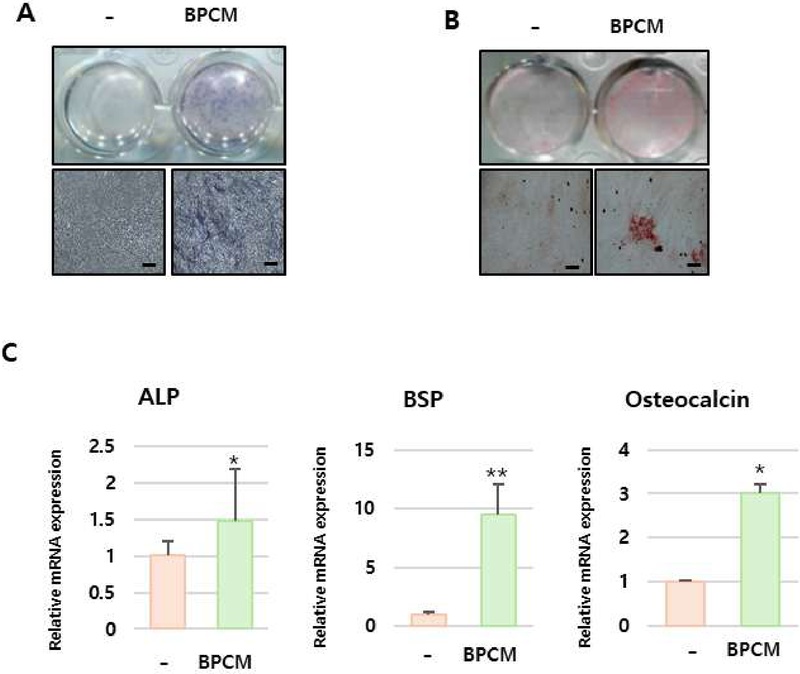
Osteogenic differentiation of MC3T3-E1 cells cultured with bilayer porcine-derived collagen membrane (BPCM) fragments. (A) ALP staining showed intense purple-blue coloration in the BPCM group compared with the control, indicating enhanced early osteogenic differentiation. (B) ARS staining showed abundant mineralized nodules in the BPCM group, confirming increased mineral deposition and late-stage osteogenic activity. (C) Real-time RT-PCR analysis revealed significant upregulation of osteogenic markers, including ALP, BSP, and OC, in the BPCM group compared with the control. Data are presented as mean ± SD; p<0.05, **p<0.01 vs control. Scale bar = 100 μm.
2. BPCM promotes in vivo bone formation in a rabbit model
Histological evaluation of calvarial defects treated with BPCM revealed successful GBR at 8 weeks post-surgery (Figure 2). The membrane effectively maintained the space for bone formation, with new bone (NB) evident throughout the defect area. The newly formed bone displayed an organized trabecular architecture with osteoblastic activity along the bone surface. Importantly, the BPCM (indicated by red arrow in the magnified view) remained intact and well-integrated with surrounding tissues, showing no signs of adverse inflammatory reaction. The interface between the membrane and the newly formed bone showed intimate contact without fibrous tissue interposition (white arrow). Bone marrow (BM) spaces were appropriately formed within the regenerated bone tissue, indicating mature bone development. The membrane exhibited excellent biocompatibility, as evidenced by the absence of inflammatory cell infiltration around the membrane material (the green arrow indicates the membrane-tissue interface). These findings confirm that BPCM functions effectively as a barrier membrane for GBR, promoting organized bone formation, while maintaining structural integrity throughout the healing period.
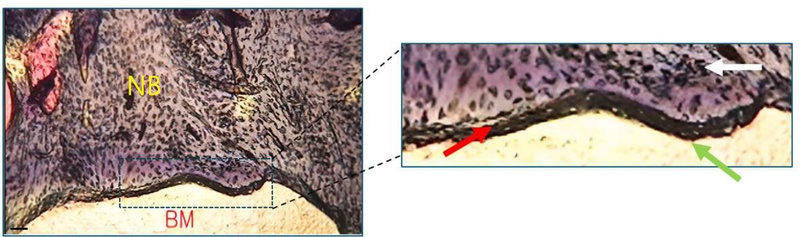
Representative histological sections (H&E staining) of rabbit calvarial bone defects treated with bilayer porcine-derived collagen membrane (BPCM) at 8 weeks post-surgery. Left panel shows low magnification overview of the defect area; right panel shows high magnification view of the membrane-bone interface (outlined area in left panel). NB, new bone formation; BM, bone marrow space. Red arrow indicates BPCM; white arrow shows membrane-bone interface; green arrow indicates membrane-tissue interface. Scale bar = 100 μm. Original magnification: left panel ×40, right panel ×200 (magnifications to be adjusted based on actual images).
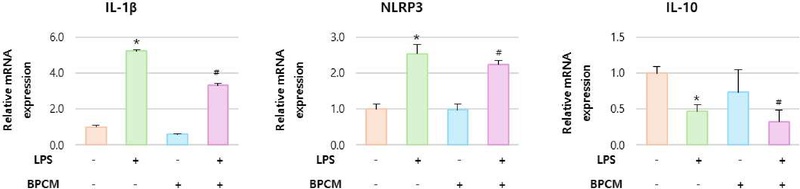
Differentiated THP-1 macrophages were cultured for 24 hours in the presence or absence of bilayer porcine-derived collagen membrane (BPCM) fragments and/or LPS (100 ng/mL). The relative mRNA expression levels of IL-1β, NLRP3, and IL-10 were quantified by qRT-PCR and normalized to housekeeping genes. Data are expressed as mean ± SEM after re-evaluation of the dataset to ensure consistency of variance and labeling (n = 3–4 per group). Statistical significance was analyzed using one-way ANOVA followed by appropriate post-hoc testing. *p<0.05 vs. untreated control; #p<0.05 vs. LPS alone. LPS: lipopolysaccharide.
3. BPCM reveals minimal pro-inflammatory activation and anti-inflammatory properties in THP-1 cells
To assess immunological safety, differentiated THP-1 macrophages were directly cultured in contact with BPCM fragments. Compared with untreated controls, BPCM treatment alone showed minimal changes in inflammatory marker expression. IL-1β expression remained at baseline levels similar to untreated controls, whereas LPS-treated positive controls showed significant upregulation (approximately 5-fold increase, *p<0.05). NLRP3 inflammasome expression was moderately elevated in BPCM treated cells but remained significantly lower than LPS-induced levels. Notably, IL-10 expression was significantly reduced in BPCM treated cells compared to controls (*p<0.05), indicating a distinct immunomodulatory profile.
When BPCM was combined with LPS treatment, IL-1β expression was significantly attenuated compared to LPS alone treatment (#p<0.05), whereas NLRP3 expression showed a similar trend toward reduction. IL-10 levels were also decreased in the combination treatment group (p<0.05). These results indicate that BPCM maintains low baseline inflammatory activation and possesses anti-inflammatory properties that can modulate LPS-induced inflammatory responses in vitro.
4. BPCM reveals excellent biocompatibility with minimal inflammatory response in vivo
Histological evaluation of tissues surrounding the implanted BPCM revealed excellent biocompatibility with minimal inflammatory cell infiltration (Figure 4). The membrane-tissue interface showed well-organized host tissue integration with mature fibrous connective tissue formation. The magnified view shows an organized collagen fiber arrangement (yellow arrow) running parallel to the membrane surface, indicating healthy tissue remodeling without excessive fibrosis. Scattered fibroblasts are present throughout the connective tissue (white arrow), showing normal cellular activity and tissue maintenance. Notably, the tissue surrounding the BPCM showed normal vascular architecture with well-formed blood vessels (green arrow), indicating adequate tissue perfusion and healthy healing response.
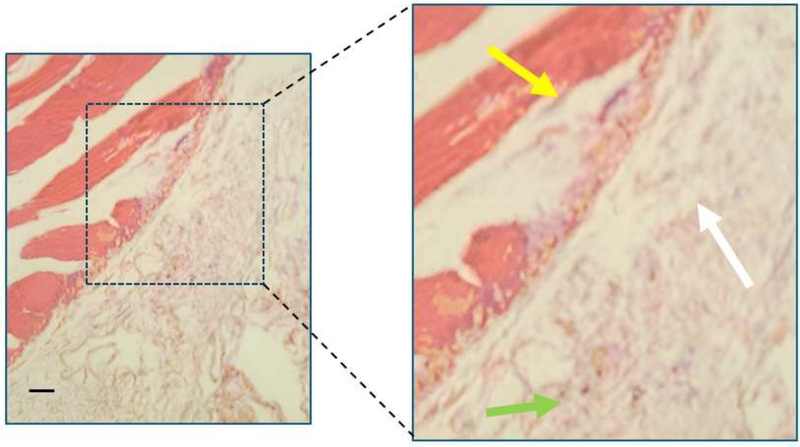
Representative histological sections (H&E staining) showing the tissue response around implanted bilayer porcine-derived collagen membrane (BPCM) at 8 weeks post-implantation. Left panel shows overview of the membrane-tissue interface area; right panel shows high magnification view of the outlined area in left panel, revealing tissue organization around the membrane. Yellow arrow indicates organized collagen fibers; white arrow shows fibroblasts within connective tissue; green arrow indicates blood vessel formation. Scale bar = 100 µm. Original magnification: left panel ×100, right panel ×400 (magnifications to be adjusted based on actual images).
The absence of dense inflammatory cell aggregates, such as neutrophils, macrophages, or lymphocytes, confirmed the minimal immune activation induced by the BPCM. The tissue morphology appeared normal, with preserved cellular architecture and no signs of necrosis or tissue damage. Consistently, semi-quantitative histological scoring demonstrated comparably low inflammatory responses in both the control and BPCM groups, with no statistically significant difference between them, as summarized in Table 2. The interface zone showed a smooth transition from the membrane material to the surrounding host tissue without the formation of a thick fibrous capsule, which is typically observed in foreign-body reactions. These histological findings provide strong evidence for the excellent biocompatibility of BPCM and its ability to integrate harmoniously with host tissues without eliciting significant inflammatory responses.
Semi-quantitative inflammatory scoring in control and bilayer porcine-derived collagen membrane groups
Discussion
This comprehensive study provides compelling evidence that BPCM effectively supports bone regeneration, while maintaining exceptional biocompatibility through dual mechanisms of osteogenic enhancement and immunomodulation. These findings contribute significantly to our understanding of the biological basis underlying the clinical success of collagen-based membranes in GBR procedures. The robust new bone formation observed in the rabbit calvarial defect model reveals the strong osteoconductive potential of BPCM. The presence of active osteoblast proliferation and organized bone matrix deposition along the membrane interface indicates that BPCM provides an optimal microenvironment for bone regeneration. The preservation of the bone marrow architecture beneath the newly formed bone is particularly noteworthy, as it indicates that the membrane supports physiologically relevant bone healing that maintains the essential stem cell niche required for long-term bone homeostasis and remodeling.
In vitro osteogenic differentiation studies using MC3T3-E1 osteoblastic cells revealed the molecular mechanisms underlying these beneficial effects. The significant upregulation of key osteogenic markers, namely ALP (early differentiation marker), BSP (matrix organization), and OC (late differentiation and mineralization marker), indicates that BPCM influences the entire osteogenic cascade. Enhanced ALP activity indicates accelerated early osteoblast commitment, whereas increased mineralization revealed using ARS staining confirms advanced osteogenic maturation. These findings align with those of previous studies showing that collagen-based biomaterials can provide biochemical cues that promote osteoblast differentiation, possibly through integrin-mediated cell adhesion and the subse-quent activation of osteogenic signaling pathways (14, 15).
The collagen structure of BPCM likely contributes to its osteogenic properties through multiple mechanisms. First, native collagen provides a familiar extracellular matrix environment that supports cell attachment and migration. Second, the bilayer architecture with its asymmetric porosity creates distinct microenvironments; the compact layer prevents soft tissue invasion, whereas the porous layer facilitates osteoprogenitor cell infiltration and vascularization. Third, controlled degradation of porcine collagen may release bioactive fragments that further stimulate osteogenic activity.
The minimal immune response observed both in vivo and in vitro represents a critical advantage of BPCM over synthetic alternatives. Histological analysis of the rabbit tissue surrounding the implanted membrane revealed well-organized fibrous tissue with parallel collagen fibers and minimal inflammatory cell infiltration. This organized tissue response indicates proper biological integration rather than a foreign-body reaction, which is essential for long-term clinical success.
The THP-1 macrophage studies provide mechanistic insights into the immunocompatibility of BPCM. The absence of significant IL-1β and NLRP3 upregulation indicates that the membrane does not trigger the inflammasome pathway, which is associated with chronic inflammation and tissue damage (16). The NLRP3 inflammasome is particularly relevant in the context of biomaterial-induced inflammation because its activation can lead to sustained inflammatory responses that compromise tissue regeneration (17). While IL-10 expression showed a modest decrease, this result should be interpreted cautiously, as IL-10 regulation can be influenced by various contextual factors and may not directly reflect impaired anti-inflammatory activity (18). Overall, these findings suggest that BPCM does not elicit strong pro-inflammatory signaling in macrophages.
This immunomodulatory profile indicates that BPCM may actively contribute to the creation of a proregenerative immune environment. Rather than being immunologically inert, the membrane appears to promote the transition from the inflammatory to the reparative phase of healing. This is consistent with the emerging concepts in regenerative medicine that emphasize the importance of immunomodulation in successful tissue engineering approaches (19).
The dual functionality of BPCM, which combines osteogenic stimulation with immunological compatibility, provides a significant clinical advantage. Although many synthetic membranes provide excellent barrier functions, they lack the biological activity necessary to actively promote bone formation (20, 21). Conversely, some biological materials with strong osteoinductive properties may elicit excessive inflammatory responses that compromise the clinical outcomes. BPCM seems to provide an optimal balance between these requirements.
The preservation of bone marrow integrity observed in this study has important clinical implications for long-term implant success. Healthy bone marrow provides an ongoing supply of stem cells for bone maintenance and remodeling, which are crucial for sustaining osseointegration over time (22, 23). This finding supports the use of BPCM in implant site preparation and augmentation procedures where long-term bone stability is paramount.
Although this study provides valuable insights, certain limitations should be acknowledged. Although the rabbit calvarial model is widely accepted in bone regeneration studies, it may not fully replicate the complex healing environments of human oral tissues. The 8-week observation period, which is sufficient to reveal bone formation, may not capture the long-term remodeling processes. In addition, in vitro studies, which are mechanistically informative, cannot fully reproduce the complex cellular interactions present in vivo.
Future research should focus on investigating the specific molecular pathways through which BPCM promotes osteogenesis, particularly the role of integrin signaling and growth factor interactions. Long-term studies examining bone quality and remodeling patterns would provide valuable information regarding the durability of regenerated bone. Comparative studies with other membrane types could help define the optimal indications for BPCM use.
Conclusion
This study reveals that BPCM possesses an optimal combination of osteogenic activity and immunological compatibility that underlies its clinical success in GBR. The membrane functions as a physical barrier preventing soft tissue invasion as well as actively contributes to creating a pro-regenerative microenvironment through enhanced osteoblast differentiation and immunomodulation. The preservation of bone marrow architecture and the organized tissue integration observed indicate that BPCM supports physiologically relevant healing processes. These findings provide scientific validation for the continued clinical application of BPCM in regenerative dentistry and maxillofacial surgery, while highlighting the importance of considering both osteogenic and immunological factors in the development of next-generation regenerative biomaterials.
Acknowledgments
This research was supported by Development Fund Program of Wonkwang University College of Dentistry funded by Dentium Co., Ltd. in 2024.
References
-
Gandhi Y. Biomaterials for Guided Bone Regeneration: Science and Rationale. J Maxillofac Oral Surg. 2025;24(4):877-85. Epub 2025/08/04.
[https://doi.org/10.1007/s12663-025-02668-0]

-
Dhondt RAL, Quirynen M, Lahoud P, Cortellini S, Temmerman A. Horizontal Guided Bone Regeneration: L-PRF Bone Block Versus a Mixture of Autogenous Bone with Deproteinized Bovine Bone Mineral-A Split-Mouth RCT Study with a 25-Month Follow-up. Int J Oral Maxillofac Implants. 2025;40(5):579-90. Epub 2025/01/31.
[https://doi.org/10.11607/jomi.11095]
- Chen L, Han J, Guo C. Research status and prospects of biodegradable magnesium-based metal guided bone regeneration membranes. Hua Xi Kou Qiang Yi Xue Za Zhi. 2024;42(4):415-25. Epub 2024/07/26.
-
Alqahtani AM, Moorehead R, Asencio IO. Guided Tissue and Bone Regeneration Membranes: A Review of Biomaterials and Techniques for Periodontal Treatments. Polymers (Basel). 2023;15(16). Epub 2023/08/26.
[https://doi.org/10.3390/polym15163355]
-
Giragosyan K, Chenchev I, Ivanova V, Zlatev S. Immunological Response to Nonresorbable Barrier Membranes Used for Guided Bone Regeneration and Formation of Pseudo Periosteum: a Narrative Review. Folia Med (Plovdiv). 2022;64(1):13-20. Epub 2022/07/20.
[https://doi.org/10.3897/folmed.64.e60553]
-
Apaza Alccayhuaman KA, Heimel P, Tangl S, Lettner S, Kampleitner C, Panahipour L, et al. Active and Passive Mineralization of Bio-Gide((R)) Membranes in Rat Calvaria Defects. J Funct Biomater. 2024;15(3). Epub 2024/03/27.
[https://doi.org/10.3390/jfb15030054]
-
Oliveira EA, Dalla-Costa KL, Franca FM, Kantovitz KR, Peruzzo DC. Influence of melatonin associated with the Bio-Gide(R) membrane on osteoblast activity: an in vitro Study. Acta Odontol Latinoam. 2022;35(2):90-7. Epub 2022/10/20. Influencia da melatonina associada a membrana bio gide(R) na atividade de osteoblastos: um estudo in vitro.
[https://doi.org/10.54589/aol.35/2/90]
- Camelo M, Nevins ML, Schenk RK, Simion M, Rasperini G, Lynch SE, et al. Clinical, radiographic, and histologic evaluation of human periodontal defects treated with Bio-Oss and Bio-Gide. Int J Periodontics Restorative Dent. 1998;18(4):321-31. Epub 2003/04/16.
-
Las Heras K, Garcia-Orue I, Rancan F, Igartua M, Santos-Vizcaino E, Hernandez RM. Modulating the immune system towards a functional chronic wound healing: A biomaterials and Nanomedicine perspective. Adv Drug Deliv Rev. 2024;210:115342. Epub 2024/05/27.
[https://doi.org/10.1016/j.addr.2024.115342]
-
Backlund C, Jalili-Firoozinezhad S, Kim B, Irvine DJ. Biomaterials-Mediated Engineering of the Immune System. Annu Rev Immunol. 2023;41:153-79. Epub 2023/01/26.
[https://doi.org/10.1146/annurev-immunol-101721-040259]
-
Yaron JR, Pallod S, Grigaitis-Esman N, Singh V, Rhodes S, Patel DM, et al. Histamine receptor agonism differentially induces immune and reparative healing responses in biomaterial-facilitated tissue repair. Biomaterials. 2025;315:122967. Epub 2024/11/26.
[https://doi.org/10.1016/j.biomaterials.2024.122967]
- Wang L, Yang K, Xie X, Wang S, Gan H, Wang X, et al. Macrophages as Multifaceted Orchestrators of Tissue Repair: Bridging Inflammation, Regeneration, and Therapeutic Innovation. J Inflamm Res. 2025;18:8945-59. Epub 2025/07/14.
-
Dong Q, Fei X, Zhang H, Zhu X, Ruan J. Effect of Dimethyloxalylglycine on Stem Cells Osteogenic Differentiation and Bone Tissue Regeneration-A Systematic Review. Int J Mol Sci. 2024;25(7). Epub 2024/04/13.
[https://doi.org/10.3390/ijms25073879]
-
Feng Y, Li HP. Optimizing collagen-based biomaterials for periodontal regeneration: clinical opportunities and challenges. Front Bioeng Biotechnol. 2024;12:1469733. Epub 2024/12/20.
[https://doi.org/10.3389/fbioe.2024.1469733]
-
Wang Y, Wang Z, Dong Y. Collagen-Based Biomaterials for Tissue Engineering. ACS Biomater Sci Eng. 2023;9(3):1132-50. Epub 2023/02/18.
[https://doi.org/10.1021/acsbiomaterials.2c00730]
-
Satheesan A, Kumar J, Leela KV, Murugesan R, Chaithanya V, Angelin M. Review on the role of nucleotide-binding oligomerization domain-like receptor protein 3 (NLRP3) inflammasome pathway in diabetes: mechanistic insights and therapeutic implications. Inflammopharmacology. 2024;32(5):2753-79. Epub 2024/08/20.
[https://doi.org/10.1007/s10787-024-01556-2]
-
Blevins HM, Xu Y, Biby S, Zhang S. The NLRP3 Inflammasome Pathway: A Review of Mechanisms and Inhibitors for the Treatment of Inflammatory Diseases. Front Aging Neurosci. 2022;14:879021. Epub 2022/06/28.
[https://doi.org/10.3389/fnagi.2022.879021]
-
Qi L, Yu H, Zhang Y, Zhao D, Lv P, Zhong Y, et al. IL-10 secreted by M2 macrophage promoted tumorigenesis through interaction with JAK2 in glioma. Oncotarget. 2016;7(44):71673-85. Epub 2016/10/22.
[https://doi.org/10.18632/oncotarget.12317]
-
Zhao J, Zhang X, Wang Y, Zeng Y, Sun H, Cui X. The Role of m6A Modification in Regulating MSC Differentiation and Immunomodulation: Implications for Regenerative Medicine and Therapeutic Applications. Front Biosci (Landmark Ed). 2025;30(9):36475. Epub 2025/10/11.
[https://doi.org/10.31083/FBL36475]
-
Jasni N, Saidin S, Arifin N, Azman DK, Shin LN, Othman N. A Review: Natural and Synthetic Compounds Targeting Entamoeba histolytica and Its Biological Membrane. Membranes (Basel). 2022;12(4). Epub 2022/04/22.
[https://doi.org/10.3390/membranes12040396]
-
Jeffrey M. Review: membrane-associated misfolded protein propagation in natural transmissible spongiform encephalopathies (TSEs), synthetic prion diseases and Alzheimer's disease. Neuropathol Appl Neurobiol. 2013;39(3):196-216. Epub 2012/11/23.
[https://doi.org/10.1111/nan.12004]
- Ho YH, Del Toro R, Rivera-Torres J, Rak J, Korn C, Garcia-Garcia A, et al. Remodeling of Bone Marrow Hematopoietic Stem Cell Niches Promotes Myeloid Cell Expans