
Effect of speed sintering on the color, translucency, and hardness of single layers of multilayered zirconia

Abstract
This study evaluated the effects of speed sintering (90 min) compared to conventional sintering (7 h) on the physical properties of multilayer zirconia. Specimens were composed of four layers—Enamel, Transition 1, Transition 2, and Dentin and were analyzed using a spectrophotometer, a Micro-Vickers hardness tester, and field emission scanning electron microscopy (FE-SEM) to assess color, hardness, and microstructure. Significant differences in the L*, a*, b* coordinates were observed across all layers (p<.001). While sintering time did not significantly influence the lightness (L*), it resulted in statistically significant variations in the a* and b* values, as well as translucency. Regarding hardness, no significant difference was found between the two sintering methods (p>.05); however, significant differences were observed between the single layers (p<.01). Microstructural analysis via FE-SEM visual inspection suggested that speed sintering produced relatively finer grain sizes compared to conventional sintering. Speed sintering refines the grain size of multilayer zirconia without significantly affecting its hardness. However, as it tends to reduce translucency compared to conventional sintering, clinicians should carefully consider aesthetic requirements when selecting the sintering protocol.
초록
본 연구는 다층 지르코니아의 급속 소결(90분)이 일반 소결(7시간)과 비교하여 물성에 미치는 영향을 분석하였다. 시편은 법랑질(Enamel), 이행층(Transition 1, 2), 상아질(Dentin)의 4개 층으로 구성하였으며, 분광광도계, 마이크로비커스 경도계 및 전계방출주사전자현미경(FE-SEM)을 활용해 색상, 경도, 미세구조를 평가하였다. 모든 층에서 색좌표계(CIE L*, a*, b* )의 유의미한 차이가 확인되었다(p<.001). 소결 시간에 따라 명도(L*)는 큰 차이가 없었으나, 적색도(a* )와 황색도(b* ), 그리고 반투명도에서는 통계적으로 유의미한 변화가 나타났다. 소결 방식(일반, 고속)에 따른 경도 차이는 미비했으나(p>.05), 다층 지르코니아의 각 층간 경도 값은 서로 유의미하게 달랐다(p<.01). 소결 시간과 층의 위치에 따라 미세구조적 변화가 관찰되었다. 급속 소결 시 일반 소결보다 결정립의 크기가 더 작게 형성되는 경향을 보였다. 급속 소결은 다층 지르코니아의 경도에 큰 영향을 주지 않으면서도 결정립을 미세화하는 효과가 있다. 다만, 일반 소결 대비 반투명도를 낮추는 특성이 있으므로 임상 적용 시 심미적 요소를 고려한 선택이 필요하다.
Keywords:
Multilayered zirconia, Speed sintering, Translucency, Hardness키워드:
다층지르코니아, 급속소결, 반투명도, 경도Introduction
Multilayered zirconia has been introduced as a solution for color enhancement of monolithic zirconia (1, 2). Multilayered zirconia blocks have different shades and translucencies depending on the layer, with the incisal part of the tooth being translucent and becoming more saturated and opaque towards the cervical part, resembling the natural tooth structure (2, 3). Multilayered zirconia has different pigment types and contents depending on the layer (2). The translucency of each layer of multilayered zirconia increases from the dentin to the enamel layer (4-6). Conversely, Kolakarnprasert et al (2) reported no difference in translucency between the enamel and dentin layers of Katana STML zirconia blocks.
The sintering method of zirconia can be categorized into two types based on the sintering time: conventional and speed sintering. Depending on the manufacturer, conventional sintering of zirconia requires between 7 hours and 10 hours in the range of 1350℃ to 1550℃ (7-10). Stawarczyk et al (11) showed that conventional sintering of zirconia has the highest flexural strength at temperatures between 1400℃ and 1550℃ and lower flexural strength at sintering temperatures below 1350℃ and above 1600℃.
The speed sintering of dental zirconia generally consists of a fast heating step, a short dwell time at the final sintering temperature, and a fast cooling step. Speed sintering is a technique in which a powder is rapidly heated to a high temperature and sintered for a short time to obtain a microstructure with high density and small grain size. Sintering within 10 minutes to 1 hour is possible (8-10, 12) and zirconia restoration is possible in a single step (12).
Sintering parameters, such as temperature and time, affect the optical properties of zirconia. Attachoo et al (13) reported that sintering temperature (1350℃, 1450℃, and 1550℃) and dwell time (60, 120, and 180 minutes) can affect the optical properties, crystal size, and structure of zirconia, and that translucency increases with increasing sintering temperature and time. Ebeid et al (14) reported that an increase in sintering temperature (1460℃, 1530℃ and 1600℃) and dwell time (1, 2, and 4 hours) reduces the pores between the grains and increases the final density, which reduces light scattering and increases light transmittance, thereby improving translucency. Jiang et al (15) reported that increasing sintering temperature (1350℃, 1400℃, 1450℃, and 1500℃) increased density and increased translucency. Stawarczyk et al (11) reported that translucency increased with increasing sintering temperature above 1300℃.
Lawson et al (8) reported that speed sintering did not reduce the translucency of Katana STML blocks, a multilayered zirconia block recommended for speed sintering, whereas other zirconia blocks did. Kaizer et al (12) reported that ultra-speed sintering (10 minutes) of inCoris TZI, a translucent zirconia block, increased the translucency compared to speed (60 minutes) and long (4 hours) sintering. Kim et al (16) reported that rapid sintering using microwaves increased the translucency of zirconia compared with conventional sintering. Li et al (17) reported that when zirconia is sintered using a speed sintering furnace, the speed sintering method of 10 minutes (total sintering time, 25 minutes) or 20 minutes dwelling (total sintering time, 40 minutes) at 1580℃ shows similar translucency to conventional sintering (total sintering time, 15 hours). However, Salah et al (18) reported that speed sintering (1450℃, 2 hours 30 minutes) and ultra-speed sintering (1580℃, 10 minutes) decreased the translucency of cubic and tetragonal zirconia compared to long sintering (1450℃, 9 hours 30 minutes). Jansen et al (19) reported that speed sintering (1570℃, 10 minutes and 1590℃, 10 minutes) decreased the translucency of zirconia. Thus, the results of previous studies on the effect of speed sintering on the translucency of zirconia vary depending on the furnace used, type of zirconia block, and sintering time and temperature. Salah et al (18) reported that the color change of cubic zirconia was observed depending on the sintering time when comparing ultra-speed (1580℃, 10 minutes) and longtime sintering (1450℃, 9 hours 30 minutes).
During speed sintering, sintering parameters such as temperature and time can affect the mechanical properties of multilayered zirconia. Hjperppe et al (20) reported that varying the sintering time from 2.6–5 hours did not affect the biaxial flexural strength of zirconia. Ebeid et al (14) reported that sintering temperatures (1460℃, 1530℃, and 1600℃) and dwell times (1, 2, and 4 hours) of zirconia had no effect on surface roughness, flexural strength, and surface hardness. Ersoy et al (21) reported that speed sintering (1580℃, 10 minutes) using a speed sintering furnace resulted in higher flexural strength than conventional sintering (1510℃, 8 hours). Liu et al (10) reported that the speed sintering does not affect the hardness of zirconia. Lubauer et al (22) reported that sintering using a speed sintering schedule in a conventional zirconia sintering furnace did not significantly impair the mechanical properties of various types of zirconia. Jansen et al (19) reported that the flexural strength of zirconia does not decrease during speed sintering (1570℃, 10 minutes and 1590℃, 10 minutes). Lawson et al (8) reported no reduction in flexural strength for Katana STML blocks, a multilayered zirconia block recommended for speed sintering, whereas other zirconia blocks showed a reduction in flexural strength.
Reducing sintering time in the fabrication of multilayered zirconia blocks can improve patient satisfaction by reducing zirconia fabrication time. Although there are studies on the speed sintering of various zirconia materials, there is a lack of research on the effect of speed sintering of multilayered zirconia on its optical and mechanical properties. Therefore, this study aimed to evaluate the effect of a single layer and the sintering time on the optical properties and hardness of multilayered zirconia.
The first null hypothesis of this study was that single layers and sintering time do not affect the color of multilayered zirconia. The second null hypothesis was that single layers and sintering times do not affect the translucency of multilayered zirconia. The third null hypothesis was that single layers and sintering times do not affect the hardness of multilayered zirconia.
Materials and Methods
1. Specimen preparation
In this study, 5 mol% yttria (5Y) stabilized multilayered zirconia blocks (KATANA STML, Kuraray Noritake Dental, Niigata, Japan) were used. Multilayered zirconia was cut using a diamond disk and adjusted to a uniform thickness using #1000 abrasive paper. The specimen size was 8×8×1.2-mm after sintering, in the form of a plate, divided into four layers (enamel, transition layer 1, transition layer 2, and dentin layers). The multilayered zirconia block used in this study was composed of 35% enamel, 15% transition 1, 15% transition 2, and 35% dentin (Figure 1). The multilayer zirconia specimens were sintered in a conventional sintering furnace (KFCT, Daegu, Korea) with a 7-hour sintering schedule and a 90-minute speed sintering schedule as instructed by the manufacturer. Eighty specimens (10 from each group) were fabricated for surface hardness and color measurements (Table 1).
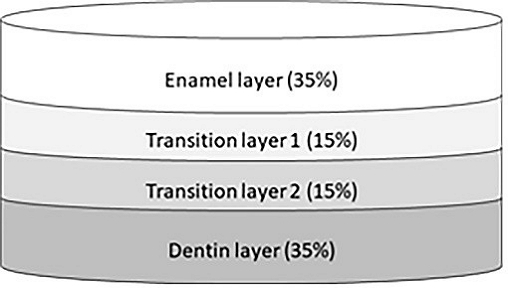
Layer of zirconia.

Classification of zirconia specimens depending on sintering time (n=10)
The 90-minute speed sintering schedule heated at 50℃/min from room temperature to 1400℃, heated at 4℃/min from 1400℃ to 1500℃, heated at 10℃/min from 1500℃ to 1560℃, maintained at 1560℃ for 16 minutes and cooled at 50℃/min to room temperature. The 7-hour normal schedule was heated from room temperature to 1550℃ at 10℃/min, maintained at 1550℃ for 2 hours, and cooled to room temperature at 10℃/min (Figure 2).
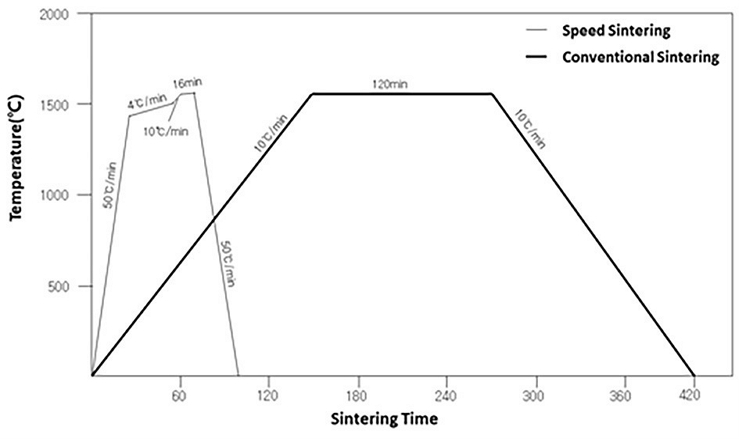
Sintering schedule.
2. Color measurement
The color of the sintered zirconia specimens was measured using a spectrophotometer (CM-3600A, KONICA Minolta, Tokyo, Japan). Color was measured using the International Commission on Illumination (CIE) L*, a*, b* values. The light source was D65 (6503 K), the standard light of the Commission Internationale de L'eclairage, and the CIE L*, a*, b* values of the specimens were measured on the white (L*: 97.41, a*: 0.1, b*: 3.9) and the black plates (L*: 2.91, a*: 2.15, b*: -2.61) in the specular component excluded (SCE) method. The CIE L*, a*, b* values are three-dimensional coordinates, with the L value representing brightness on the y-axis, the a* value on the x-axis representing red for (+) and green for (-), and the b* value on the z-axis representing yellow for (+) and blue for (-) (23). Black and white plates were prepared and measured twice for each specimen and 20 times for each group of specimens, focused at the center of the specimen and averaged. After measuring the CIE L*, a*, b* values, the color difference (ΔE*) value was calculated using the formula ΔE* = [(ΔL* )2 + (Δa* )2 + (Δb* )2]½ (ΔL* = L*2 - L*1, Δa* = a*2 - a*1, Δb* = b*2 – b*1). Translucency (TP) was calculated using the formula below.TP = [(L*B - L*W)2 + (a*B - a*W)2 + (b*B – b*W)2]½. Subscript B in the translucency formula indicates the color coordinates on the black plate background, and subscript W indicates the color coordinates on the white plate background. The larger the TP value, the higher the actual translucency of the material; a TP value of 0 corresponds to a completely opaque material (24).
3. Hardness test
A microVickers hardness tester (HM-122, Mitutoyo, Kawasaki, Japan) was used to measure the surface hardness of the sintered zirconia specimens. A load of 9.81 N was applied for 10 seconds. Two measurements were taken for each specimen, and 20 measurements were taken for each group of specimens at the center of gravity and averaged.
4. Field radiation scanning electron microscope (FE-SEM) observation
The fabricated specimens were pretreated with a platinum coating. The coated specimens were examined using an ultra-high-analytical FE-SEM (GEMINI 500, ZEISS, Oberkochen, Germany) at 20,000 × magnification to observe the grain size and microstructural changes.
5. Statistical analysis
SPSS Ver.26.0 (SPSS Inc., Chicago, IL, USA) was used to analyze the experimental results. A 2-way ANOVA was performed to analyze the color, translucency, and hardness of the multilayered zirconia groups. Tukey’s post hoc test was performed. The statistical significance level for each group was set at .05.
Results
1. Color analysis
Table 2 presents the results of the two-way ANOVA regarding the influence of sintering time on the color coordinates of multilayered zirconia. The L*, a*, and b* values significantly differed among the single layers (p<.001). While sintering time did not significantly affect L*values (p>.05), it had a significant effect on both a* and b* values (p<.001).
Mean L*, a*, and b* and standard deviation of multilayered zirconia specimens as analyzed by 2-way ANOVA
The L* values decreased from the enamel to the dentin layers (p<.05). The a* and b* values increased from the enamel to the dentin layers (p<.05). The a* values increased during speed sintering, shifting toward a reddish hue, while the b* values also increased, leading to a more yellowish appearance.
The effect of sintering time on the color difference (ΔE* ) between single layers of multilayered zirconia was compared (Figure 3). For all single layers, the color difference (ΔE* ) between the 7-hour and 90-minute sintering groups was less than 3, and the color difference (ΔE* ) decreased from the enamel to the dentin layers.
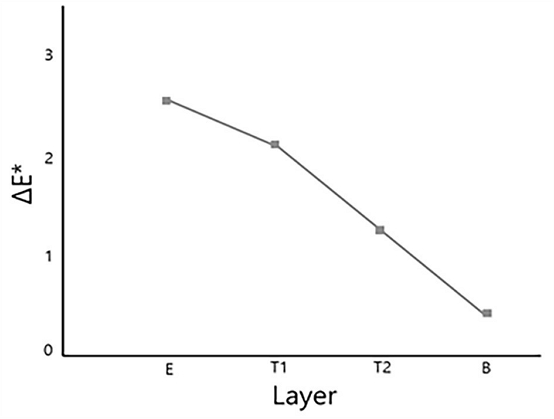
Color differences(ΔE* ) value among layer groups sintered using different sintering time. E, Enamel. T1, Transition 1. T2, Transition 2. B, Body.
2. Translucency analysis
The translucency of each group of zirconia specimens was analyzed according to the sintering time and single layers (Figure 4). The translucency values of multilayered zirconia according to sintering time and single layers were significantly different (p<.001). The translucency values between single layers decreased from the enamel to dentin (p<.05). Speed sintering resulted in lower translucency values than conventional sintering.
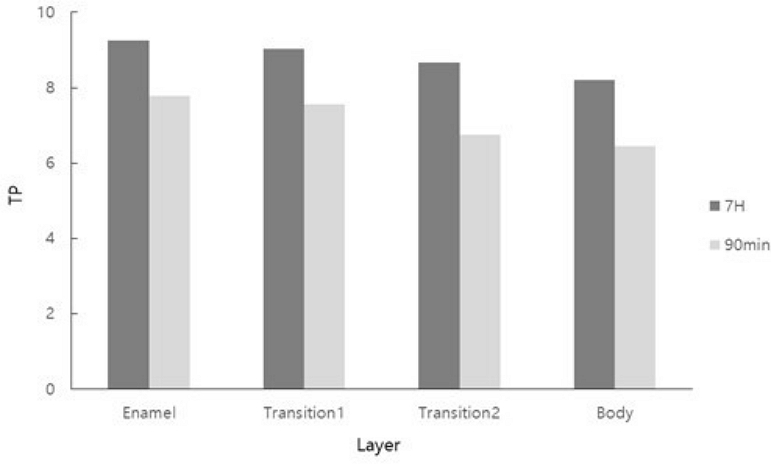
Translucency parameter (TP) value among layer groups sintered using different sintering time.
3. Hardness changes
The hardness measurement results for the zirconia specimens are presented in Tables 3 and 4. The hardness values of the multilayered zirconia specimens according to the sintering time were not significantly different (p>.05). The hardness values of multilayered zirconia were significantly different from those of single layers (p<.01). The hardness values between single layers decreased from the enamel to dentin (p<.05).
Two-way ANOVA identifying interactions between layer and sintering time with hardness of zirconia specimens
Mean Hardness and stand deviation of zirconia specimens as analyzed by 2-way ANOVASuperscript letters for each column and row indicate mean values that are significantly different between groups (p<.05)
4. Microstructure observation
Figure 5 shows a 20,000 × magnification high-resolution FE-SEM image of multilayered zirconia specimens with different sintering times. The microstructure of the multilayered zirconia exhibited variations depending on the sintering conditions and the single layers. Qualitative observation via FE-SEM indicated that speed sintering tended to produce finer grain sizes, with a decreasing trend observed from the enamel toward the dentin layers.
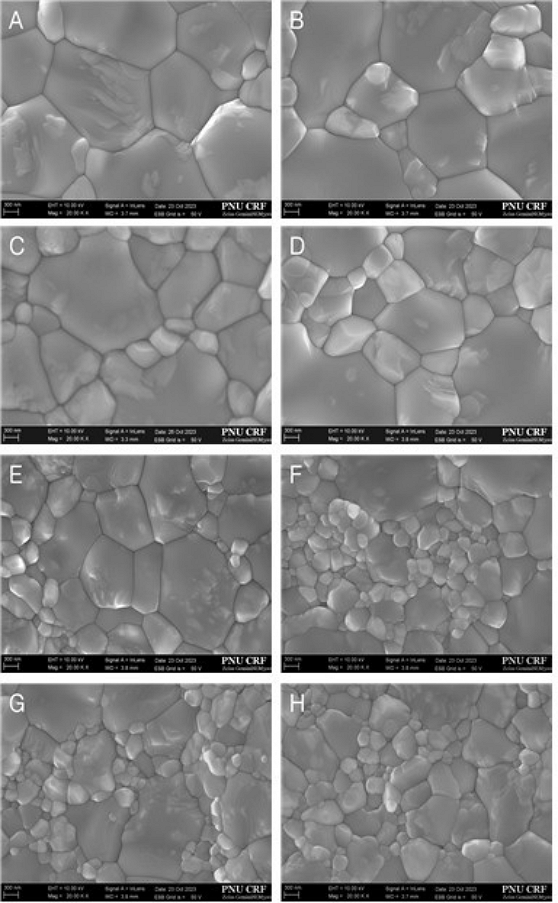
FE-SEM images showing surface of zirconia specimens.A, 7h-Enamel. B, 7h-Transition 1. C, 7h-Transition 2. D, 7h-Body. E, 90min-Enamel. F, 90min-Transition 1. G, 90min-Transition 2. H, 90min-Body. Original magnification, ×20,000.
Discussion
The results of this study showed that the L* values of the multilayered zirconia with different sintering times did not show statistically significant differences; however, the L* values of the single layers showed significant differences. Both the a* and b* values were significantly different for the single layers and sintering times. Therefore, the first null hypothesis that single layers and sintering time do not affect the color of multilayered zirconia was partially rejected.
Vichi et al (25) reported that successful esthetic restoration requires the integration of factors such as the individual's perception of color, the light source used for color evaluation, structural characteristics of the tooth and restorative material used, and color perception. Salah et al (18) reported that speed and ultra-speed sintering increased the color change and decreased the translucency of cubic and tetragonal zirconia compared with conventional sintering. Similar to the results of Salah et al (18), the results of this study also showed a significant difference in the a* and b* values depending on the sintering time, that is, speed sintering increased the a* and b* values, which tended to be red and yellow, respectively. In this study, all color coordinates (L*, a*, b* ) of the single layers exhibited significant differences, characterized by a decrease in brightness (L* ) and an increase in a* and b* values from the enamel toward the dentin layers, resulting in a more reddish and yellowish appearance. This is believed to be due to the increase in metal oxide content from the enamel to dentin in the multilayered zirconia blocks used in this study (4).
Vichi et al (25) reported that color difference (ΔE* ) values less than 1 are imperceptible to the human eye, values greater than 1 and less than 3.3 are perceptible to a trained operator but clinically acceptable, and values greater than 3.3 are considered perceptible to an untrained observer such as a patient and are not clinically acceptable. Kuehni et al (26) reported that the human eye can distinguish shades when the ΔE* value is up to 1, and Johnston et al (27) reported that ΔE* values of 3.7 or less are acceptable for clinical use in dental restorations. Ishikawa-Nagai et al (28) compared the color difference (ΔE* ) between natural teeth and all-ceramic restorations and reported that color differences (ΔE* ) smaller than 1.6 were not perceptible to the human eye. In this study, based on the color difference (ΔE* ) criteria of Vichi et al (25), the color difference (ΔE* ) values between the 7-hour and 90-minute groups were less than 3.3 for all four layers, which is perceptible to an experienced operator but clinically acceptable.
However, it should be noted that modern dental color science increasingly favors the CIEDE2000 (ΔE00) formula, which more accurately reflects human visual perception compared to the traditional CIE L*, a*, b* method. Recent studies suggest a more stringent threshold of approximately 1.8 to 2.2 units for ΔE00 as the limit of clinical acceptability (29, 30). While the results of this study fall within the ΔE* 3.3 limit, this interpretation may be considered relatively permissive by these modern standards. Therefore, future research should incorporate both formulas to ensure a more nuanced and clinically relevant evaluation. In the present study, the single-layer color difference (ΔE* ) decreased with sintering time from the enamel layer to the dentin layer. This is because there was less change in the a* and b* values with speed sintering from the enamel to the dentin layers.
The results of this study showed significant differences in the translucency of multilayered zirconia depending on the single layer and sintering time. The translucency values between single layers decreased from the enamel to the dentin layer. This correlates with an increase in the a* and b* values from enamel to dentin. In the Katana STML zirconia blocks used in this study, the pigmentation content increased from the enamel layer to the dentin layer, which decreased the translucency of the zirconia (6). The results of this study showed that speed sintering of multilayered zirconia resulted in lower translucency values than conventional sintering. Therefore, the second null hypothesis that single layers and sintering time do not affect the translucency of multilayered zirconia was rejected.
Consistent with the present results, previous studies have also reported that the translucency of multilayered zirconia varies between each layer, with the enamel layer exhibiting higher translucency than the transition layer or dentin layer (4, 6). Ebeid et al (14) reported that grain size (0.55-0.92 µm) increased and translucency (CR:0.68–0.75) increased with increasing sintering temperature (1460℃, 1530℃, and 1600℃) and dwell time (1, 2, and 4) hours of zirconia. Kim et al (16) reported that when the sintering time of zirconia was varied from 20 minutes to 40 hours, the grain size decreased from 1512 nm to 347 nm with shorter sintering time, and this decrease in grain size increased translucency. While Kim et al (16) observed this increase in translucency as grains reached the sub-micron level (347 nm), the grains in the present study remained within a range larger than or comparable to the wavelength of light, where grain refinement conversely promotes scattering.
Although the translucency of zirconia is related to the grain size, Pekkan et al (31) reported that there is no direct linear relationship between the grain size and translucency of zirconia. When the grain size is similar to the wavelength of light, light transmission decreases owing to the increased scattering of light at the grain boundaries with increasing grain size (16). When the particle size is much larger than the wavelength of the incident light, the amount of light scattering is inversely proportional to the particle size and independent of the wavelength of the incident light (16).
The translucency of zirconia is closely associated with microstructural changes occurring during the sintering process, particularly grain size and densification. Qualitative FE-SEM observations in this study revealed that the 7-hour conventional sintering group exhibited a distinct increase in grain size compared to the 90-minute speed sintering group. This grain growth acts as a key factor in enhancing the optical properties of zirconia. Generally, as grain size increases, the total surface area of grain boundaries per unit volume decreases. Since grain boundaries serve as sites where light scattering occurs due to changes in the refractive index, a lower density of these boundaries minimizes light scattering and improves translucency (11). The superior translucency observed in the 7-hour group can be attributed to the coarsening of grains during the extended dwell time, which reduced the total interfacial area responsible for light scattering. These findings align with the report by Salah et al (18), which stated that increased sintering time enhances translucency by increasing density and refining the microstructure. Furthermore, the correlation between grain growth and optical performance in this study is supported by Zhang et al (32), who reported that high-yttria zirconia with grains larger than 1.5 μm demonstrates excellent translucency. In conclusion, the reduction in translucency observed under the speed sintering conditions of this study is likely due to insufficient grain growth within the shortened sintering cycle, leaving the grains in a finer state and thereby amplifying light scattering at the relatively increased grain boundaries.
In the present study, the hardness of the multilayered zirconia decreased significantly from the enamel toward the dentin layer, while sintering time showed no significant influence on hardness. Consequently, the third null hypothesis was partially rejected. This lack of significant change in hardness with varying sintering time is consistent with the findings of Kong et al (33), who reported that sintering temperature and time did not significantly alter the hardness of zirconia. Furthermore, while Ersoy et al (21) suggested that high-temperature speed sintering could even enhance flexural strength, other studies such as Hjperppe et al (20) found that varying sintering times did not affect biaxial strength, supporting the observation that mechanical properties can remain stable despite shorter cycles.
The limitations of this study include the observation of only color and hardness and the use of a single shade (A3) from one manufacturer. Clinically, it is important to note that while speed sintering may not compromise the hardness of multilayered zirconia, it could potentially reduce its translucency. Therefore, future research should encompass a wider range of multilayered zirconia blocks from various manufacturers to evaluate the comprehensive effects of speed sintering on both optical and mechanical properties.
Conclusion
Within the limitations of this study, speed sintering had a grain-refining effect and no significant impact on the hardness or lightness of multilayered zirconia; however, it significantly reduced translucency and induced color shifts. Given that speed sintering results in lower translucency compared to conventional sintering, clinicians should carefully consider these aesthetic implications when selecting the sintering protocol in practice.
References
-
Tabatabaian F. Color aspect of monolithic zirconia restorations: a review of the literature. J Prosthodont. 2019;28(3):276-87.
[https://doi.org/10.1111/jopr.12906]

-
Kolakarnprasert N, Kaizer MR, Kim DK, Zhang Y. New multi-layered zirconias: Composition, microstructure and translucency. Dent Mater. 2019;35(7):797-806.
[https://doi.org/10.1016/j.dental.2019.02.017]
-
Bruhnke M, Awwad Y, Müller WD, Beuer F, Schmidt F. Mechanical Properties of New Generations of Monolithic, Multi-Layered Zirconia. Materials. 2023;16(1):276.
[https://doi.org/10.3390/ma16010276]
-
Ueda K, Güth JF, Erdelt K, Stimmelmayr M, Kappert H, Beuer F. Light transmittance by a multi-coloured zirconia material. Dent Mater J. 2015;34(3):310-4.
[https://doi.org/10.4012/dmj.2014-238]
-
Erdelt K, Pinheiro Dias Engler ML, Beuer F, Güth JF, Liebermann A, Schweiger J. Computable translucency as a function of thickness in a multi-layered zirconia. J Prosthet Dent. 2019;121(4):683-9.
[https://doi.org/10.1016/j.prosdent.2018.08.013]
-
Cho MH, Seol HJ. Optical Properties, Microstructure, and Phase Fraction of Multi-Layered Monolithic Zirconia with and without Yttria-Gradient. Materials. 2023;16(1):41.
[https://doi.org/10.3390/ma16010041]
-
Marinis A, Aquilino SA, Lund PS, Gratton DG, Stanford CM, Diaz-Arnold AM, Qian F. Fracture toughness of yttria-stabilized zirconia sintered in conventional and microwave ovens. J Prosthet Dent. 2013;109(3):165-71.
[https://doi.org/10.1016/S0022-3913(13)60037-2]
-
Lawson NC, Maharishi A. Strength and translucency of zirconia after high-speed sintering. J Esthet Restor Dent. 2020;32(2):219-25.
[https://doi.org/10.1111/jerd.12524]
-
Antón X, Liebermann A, Hampe R, Joda T, Stawarczyk B. Impact of high-speed sintering and choice of preshaded monochrome or multilayered blanks on fatigue behavior of 4 mol% yttria-stabilized tetragonal zirconia polycrystal. J Prosthet Dent. 2023;130(4):639-45.
[https://doi.org/10.1016/j.prosdent.2021.11.006]
-
Liu H, Inokoshi M, Xu K, Tonprasong W, Minakuchi S, et al. Does speed-sintering affect the optical and mechanical properties of yttria-stabilized zirconia? A systematic review and meta-analysis of in-vitro studies. Jpn Dent Sci Rev. 2023;59:312-28.
[https://doi.org/10.1016/j.jdsr.2023.08.007]
-
Stawarczyk B, Ozcan M, Hallmann L, Ender A, Mehl A, Hämmerle CH. The effect of zirconia sintering temperature on flexural strength, grain size, and contrast ratio. Clin Oral Investig. 2013;17(1):269-74.
[https://doi.org/10.1007/s00784-012-0692-6]
-
Kaizer MR, Gierthmuehlen PC, Dos Santos MB, Cava SS, Zhang Y. Speed sintering translucent zirconia for chairside one-visit dental restorations: Optical, mechanical, and wear characteristics. Ceram Int. 2017;43(14):10999-1005.
[https://doi.org/10.1016/j.ceramint.2017.05.141]
-
Attachoo S, Juntavee N. Role of sintered temperature and sintering time on spectral translucence of nano-crystal monolithic zirconia. J Clin Exp Dent. 2019;11(2):e146-53.
[https://doi.org/10.4317/jced.55497]
-
Ebeid K, Wille S, Hamdy A, Salah T, El-Etreby A, Kern M. Effect of changes in sintering parameters on monolithic translucent zirconia. Dent Mater. 2014;30(12):e419-24.
[https://doi.org/10.1016/j.dental.2014.09.003]
-
Jiang L, Liao Y, Wan Q, Li W. Effects of sintering temperature and particle size on the translucency of zirconium dioxide dental ceramic. J Mater Sci Mater Med. 2011;22(11):2429-35.
[https://doi.org/10.1007/s10856-011-4438-9]
-
Kim MJ, Ahn JS, Kim JH, Kim HY, Kim WC. Effects of the sintering conditions of dental zirconia ceramics on the grain size and translucency. J Adv Prosthodont. 2013;5(2):161-6.
[https://doi.org/10.4047/jap.2013.5.2.161]
-
Li L, Zhao C, Du Z, Qiu Y, Si W. Rapid-sintered dental zirconia for chair-side one-visit application. J Appl Ceram Technol. 2019;16(5):1830-5.
[https://doi.org/10.1111/ijac.13228]
-
Salah K, Sherif AH, Mandour MH, Nossair SA. Optical effect of rapid sintering protocols on different types of zirconia. J Prosthet Dent. 2023;130(2):253.e1-7.
[https://doi.org/10.1016/j.prosdent.2023.05.001]
-
Jansen JU, Lümkemann N, Letz I, Pfefferle R, Sener B, Stawarczyk B. Impact of high-speed sintering on translucency, phase content, grain sizes, and flexural strength of 3Y-TZP and 4Y-TZP zirconia materials. J Prosthet Dent. 2019;122(4):396-403.
[https://doi.org/10.1016/j.prosdent.2019.02.005]
-
Hjerppe J, Vallittu PK, Fröberg K, Lassila LV. Effect of sintering time on biaxial strength of zirconium dioxide. Dent Mater. 2009;25(2):166-71.
[https://doi.org/10.1016/j.dental.2008.05.011]
-
Ersoy NM, Aydoğdu HM, Değirmenci BÜ, Çökük N, Sevimay M. The effects of sintering temperature and duration on the flexural strength and grain size of zirconia. Acta Biomater Odontol Scand. 2015;1(2-4):43-50.
[https://doi.org/10.3109/23337931.2015.1068126]
-
Lubauer J, Schuenemann FH, Belli R, Lohbauer U. Speed-sintering and the mechanical properties of 3-5 mol% Y2O3-stabilized zirconias. Odontology. 2023;111(4):883-90.
[https://doi.org/10.1007/s10266-023-00796-y]
-
Sulaiman TA, Abdulmajeed AA, Donovan TE, Ritter AV, et al. Optical properties and light irradiance of monolithic zirconia at variable thicknesses. Dent Mater. 2015;31(10):1180-7.
[https://doi.org/10.1016/j.dental.2015.06.016]
- Johnston WM, Ma T, Kienle BH. Translucency parameter of colorants for maxillofacial prostheses. Int J Prosthodont. 1995;8(1):79-86.
-
Vichi A, Louca C, Corciolani G, Ferrari M. Color related to ceramic and zirconia restorations: A review. Dent Mater. 2011;27(1):97-108.
[https://doi.org/10.1016/j.dental.2010.10.018]
-
Kuehni RG, Marcus RT. An experiment in visual scaling of small color differences. Color Res Appl. 1979;4(2):83-91.
[https://doi.org/10.1111/j.1520-6378.1979.tb00094.x]
-
Johnston WM, Kao EC. Assessment of appearance match by visual observation and clinical colorimetry. J Dent Res. 1989;68(5):819-22.
[https://doi.org/10.1177/00220345890680051301]
-
Ishikawa-Nagai S, Yoshida A, Sakai M, Kristiansen J, Da Silva JD. Clinical evaluation of perceptibility of color differences between natural teeth and all-ceramic crowns. J Dent. 2009;37 Suppl 1:e57-63.
[https://doi.org/10.1016/j.jdent.2009.04.004]
-
Paravina RD, Ghinea R, Herrera LJ, Bona AD, Igiel C, et al. Color difference thresholds in dentistry. J Esthet Restor Dent. 2015;27 Suppl 1:S1-9.
[https://doi.org/10.1111/jerd.12149]
-
Ghinea R, Pérez MM, Herrera LJ, Rivas MJ, Yebra A, et al. CIEDE2000 acceptability thresholds for lightness, chroma and hue differences in dental ceramics. J Dent. 2011;39 Suppl 3:e37-44.
[https://doi.org/10.1016/j.jdent.2011.09.007]
-
Pekkan G, Pekkan K, Bayindir BÇ, Özcan M, Karasu B. Factors affecting the translucency of monolithic zirconia ceramics: A review from materials science perspective. Dent Mater J. 2020;39(1):1-8.
[https://doi.org/10.4012/dmj.2019-098]
-
Zhang Y, Lawn BR. Novel zirconia materials in dentistry. J Dent Res. 2018;97(2):140-7.
[https://doi.org/10.1177/0022034517737483]
-
Kong MC, Park MG. Effect of sintering condition and aging on hardness and optical properties of monolithic zirconia. Korean J Dent Mater. 2020;47(4):221-34.
[https://doi.org/10.14815/kjdm.2020.47.4.221]