
Curing depth and temperature change during polymerization of light-cured pulp capping materials

Abstract
Light-cured pulp capping materials are increasingly used in deep carious lesions due to their favorable handling and mechanical properties. However, their polymerization depth and heat generation vary by composition and shade, which may influence clinical outcomes. This study evaluated the curing depth and temperature changes of five light-activated pulp capping materials: Theracal LC, two shades of Ultra-Blend Plus, Vitrebond, and Base-It. Curing depth was measured using a 4×6 mm (Internal diameter, Depth) stainless-steel mold, and temperature changes were recorded with a non-contact infrared sensor during light curing (1793 mW/cm2, 20 s). One-way ANOVA and Tukey’s post hoc test (α =0.05) revealed significant α differences among materials. Base-It showed the greatest curing depth (1.98±0.08 mm), while Theracal LC had the lowest (0.52±0.03 mm). Ultra-Blend Plus – Dentin shade had the highest temperature rise (18.0±0.3℃), and the Opaque White shade the lowest (14.0±0.4℃). These findings suggest that material- and shade-specific characteristics affect curing behavior and thermal safety. Incremental layering is recommended for low-depth materials, and heat management is important for high-exothermic ones. These results may guide clinicians in selecting and handling pulp capping materials safely and effectively.
초록
광중합형 치수복조재는 우수한 조작성과 기계적 강도로 인해 깊은 우식 병소에서 점차 널리 사용되고 있다. 그러나 이들 재료는 조성 및 색상에 따라 중합 깊이와 발열 특성이 달라지며, 이는 임상 결과에 영향을 미칠 수 있다. 본 연구에서는 Theracal LC, Ultra-Blend Plus 두 가지 쉐이드, Vitrebond, Base-It 등 총 다섯 가지 광중합형 치수복조재의 중합 깊이와 중합 중 온도 변화를 평가하였다. 중합 깊이는 4×6 mm (내경, 깊이) 크기의 스테인리스 몰드를 이용하여 측정하였으며, 광중합(1793 mW/cm2 , 20초) 동안 비접촉 적외선 센서를 통해 온도 변화를 기록하였다. 일원분산분석(ANOVA) 및 Tukey 사후검정(α=0.05) 결과, 재료 간 유의한 차이가 관찰되었다. Base-It은 가장 깊은 중합 깊이(1.98 mm)를 보였으며, Theracal LC는 가장 얕은 중합 깊이(0.52 mm)를 나타냈다. Ultra-Blend Plus의 Dentin 쉐이드는 가장 높은 온도 상승(18℃), Opaque White 쉐이드는 가장 낮은 온도 상승(14℃)을 보였다. 이러한 결과는 재료 및 쉐이드에 따라 중합 및 열 안전성에 차이가 있음을 시사한다. 중합 깊이가 얕은 재료는 적층 방식으로 적용하는 것이 권장되며, 발열이 큰 재료는 열 손상에 유의해야 한다. 본 연구 결과는 임상에서 치수복조재를 보다 안전하고 효과적으로 선택·조작하는 데 도움이 될 수 있다.
Keywords:
Pulp capping material, Polymerization, Maximum temperature rise, Curing depth키워드:
치수복조재, 중합, 최대온도상승, 중합깊이Introduction
Pulp capping is a crucial procedure aimed at preserving pulp vitality, promoting healing, and protecting the pulp tissue from harmful stimuli. In cases of severe tooth damage or deep carious lesions, application of pulp capping material is essential for pulp protection. Traditionally, calcium hydroxide has been widely used as a pulp capping material due to its excellent biocompatibility and antibacterial properties, as well as its ability to stimulate hard tissue formation within the pulp. However, calcium hydroxide is highly soluble and can be gradually lost over time. It also has drawbacks such as a relatively long setting time and limited handling properties (1). These limitations may compromise the long-term pulp protection effect, highlighting the need for alternative materials.
Recently, light-cured pulp capping materials containing resin monomers have gained popularity due to their advantages over conventional calcium hydroxide-based materials including a faster setting time, superior mechanical strength, and lower solubility. These materials also provide strong adhesion, reducing microleakage between the restorative material and tooth structure, and they exhibit lower potential for tooth discoloration and are highly favored in clinical practice (2). Nevertheless, insufficient polymerization of these materials can allow residual monomers to diffuse through the dentinal tubules and damage the pulp tissue. Furthermore, inadequate polymerization may compromise the material's mechanical properties and bonding strength, leading to microleakage (3). In addition, the heat generated during light curing can increase the pulp temperature and potentially cause thermal damage (4). Previous studies have reported that an increase in pulp temperature of 5.5–11.1℃ or more may result in irreversible pulp damage (5). Therefore, it is crucial to consider the temperature changes that occur during the polymerization of light-cured pulp capping materials to ensure pulp protection. Since this factor may directly affect pulp vitality during clinical procedures, it is necessary to evaluate the curing depth, polymerization process, and thermal characteristics of these materials (6).
Both the exothermic reaction of polymerization and the radiant heat emitted from the light-curing unit are major contributors to the increase in pulp temperature during the polymerization of light-cured materials (7, 8). Hence, it is important to assess factors influencing curing depth and temperature increase. Previous studies have reported that the type of light-curing unit, light intensity, irradiation time, material thickness, and composition affect both the temperature change and curing depth (7, 9, 10). Particularly, verifying whether sufficient polymerization occurs under the manufacturer's recommended conditions is directly related to the material's clinical stability (10). However, there is a lack of comparative data on the curing characteristics and thermal behavior of light-cured pulp capping materials commonly used in clinical practice. To reflect the diversity of materials used in clinics, this study selected four representative types-calcium silicate-based, calcium hydroxide-based, resin-modified glass ionomer, and methacrylate resin-based-each known for specific advantages in bioactivity, biocompatibility, adhesion, or mechanical performance.
The purpose of this study was to experimentally evaluate the curing depth and temperature changes generated during light curing of five pulp capping materials and to compare their polymerization kinetics. The findings of this study aim to provide reliable data for clinical application, ultimately enhancing both the safety and effectiveness of treatment.
The null hypotheses of this study were as follows: (1) there would be no difference in curing depth among the materials, and (2) there would be no differences in exothermic heat generation and temperature increase during polymerization among the materials.
Materials and Methods
1. Materials
The names and components of the pulp capping materials used in this study are listed in Table 1. The tested materials included a calcium silicate-based material, Theracal LC (Bisco, Schamburg, IL, USA); a calcium hydroxide-based material, Ultra-Blend Plus (Ultradent Products, South Jordan, UT, USA); a resin-modified glass ionomer, Vitrebond (3M ESPE Dental Products, St. Paul, MN, USA); and a methacrylate resin-based material, Base-it (SPIDENT Co., Incheon, Korea).

Brand names and their constituents of the pulp capping materials used in the study
2. Measurement of curing depth
For measuring curing depth, a cylindrical stainless-steel mold (internal diameter: 4 mm, height: 6 mm) was placed on a glass slide covered with a transparent film. Each material was applied to the mold according to the manufacturer's instructions. Another transparent film and a glass slide were placed on top, and the excess material was gently pressed out [Figure 1-(a)]. Light curing was performed for 20 seconds using an LED curing unit (IB Systems, Seoul, Korea) with an intensity of 1,793 mW/cm2. After curing, the specimen was removed from the mold, and the uncured material on the side opposite the light source was scraped off using a plastic spatula. The height of the remaining cured specimen was measured using a micrometer and divided by two to determine the curing depth, according to ISO standard 4049 (n=3) (11).
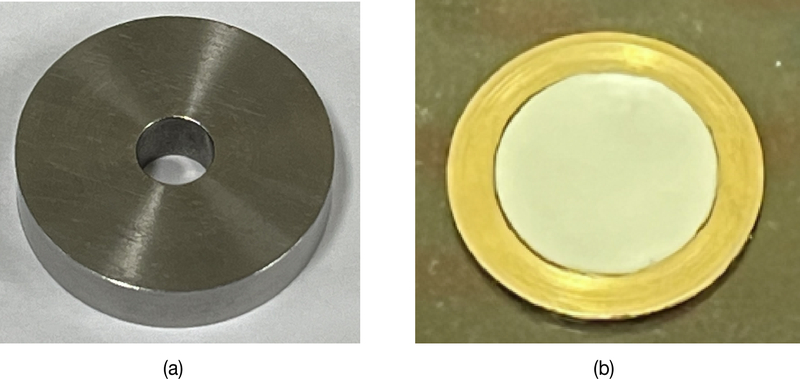
(a) Cylindrical stainless-steel mold (internal diameter: 4 mm, height: 6 mm) to prepare specimens for measuring the depth of cure. (b) Disc-shaped brass mold (internal diameter: 11 mm, thickness: 0.5 mm) to prepare specimens for measuring temperature change.
3. Measurement of temperature change during polymerization
For measurement of temperature changes during polymerization, disc-shaped specimens were prepared using a brass mold with an internal diameter of 11 mm and a thickness of 0.5 mm [Figure 1-(b)]. A non-contact infrared temperature sensor (DTS-L300-V2, Diwellshop, Gunpo, Korea, detecting wavelength range: 5.5–14 µm, operating temperature range: -20 to 70°C) was used for temperature measurements. Baseline temperature was recorded for the initial 10 seconds, followed by light irradiation for 20 seconds using the LED curing unit (Figure 2). At 300 seconds from the start of the first light curing, a second light curing cycle was performed for 20 seconds. The temperature change was continuously recorded for a total of 610 seconds (n=3).
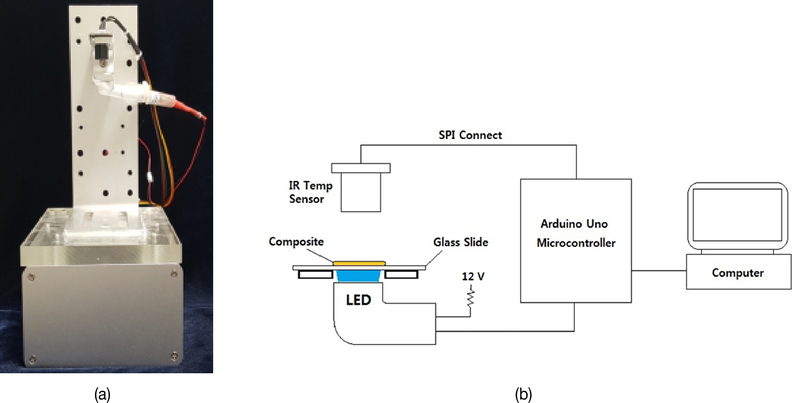
(a) IR temperature measurement instrument and (b) schematic diagram of its structure.
The temperature curve of the second curing was subtracted from the first curing temperature curve to obtain the net temperature increase curve. The following parameters were analyzed: maximum temperature rise during the first curing (∆T at 1st peak), maximum temperature rise during the second curing (∆T at 2nd peak), net peak temperature rise (Net peak temperature), and time to reach the net peak temperature (Time at Net peak temperature) (Figure 3). All experiments in Sections 2.2 and 2.3 were conducted at room temperature, 25±0.5℃
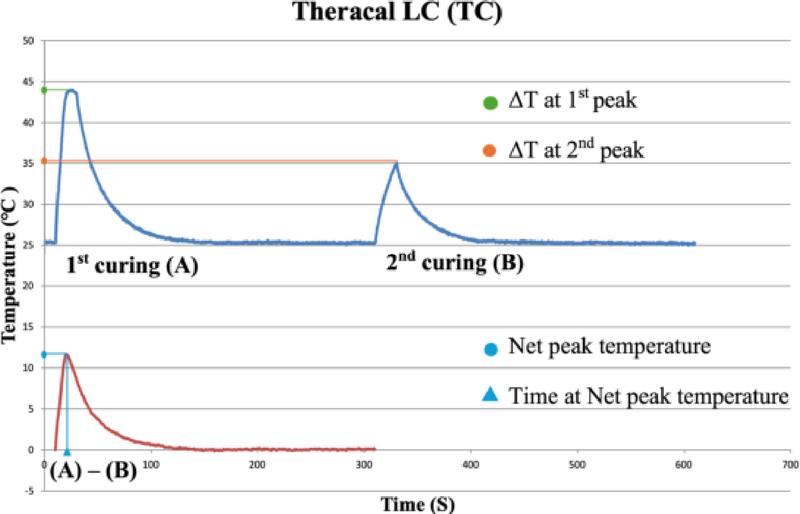
Representative curves of the temperature changes during photo-polymerization.
4. Statistical analysis
The differences in curing depth, maximum temperature rise, and time to reach the maximum temperature among the materials were statistically analyzed using one-way analysis of variance (ANOVA). Tukey's post hoc test was applied for multiple comparisons (α=0.05). Statistical analysis was performed using SPSS software version 28.0 (IBM, Armonk, NY, USA).
Results
1. Measurement of curing depth
The curing depths of the pulp capping materials are presented in Table 2. BI showed the greatest curing depth (1.98±0.08 mm), followed by UB-OW (1.28±0.03 mm), VB (1.10±0.00 mm), UB-DS (0.82±0.03 mm), and TC (0.52±0.03 mm) (p<0.05).
Depth of cure (mm) of the pulp capping materials(n=3)
2. Measurement of temperature change during polymerization
The temperature changes during light curing are summarized in Table 3. The maximum temperature increase during the first light curing (ΔT at 1st peak) was highest in UB-DS (18.0±0.3℃) and lowest in UB-OW (14.0±0.4℃). During the second light curing (ΔT at 2nd peak), UB-DS also showed the highest temperature rise (10.8±0.5℃), while UB-OW exhibited the lowest (5.9±0.3℃).
Temperature changes and peak time of pulp capping materials during photo-polymerization
Regarding the net peak temperature rise, BI recorded the highest value (12.6±1.1℃), with the shortest time to reach the peak (2.8±0.1 s). In contrast, VB showed the lowest net peak temperature (8.6±0.7℃) and the longest time to reach the peak (13.5±1.0 s).
Discussion
The curing depth and temperature changes during polymerization of light-cured pulp capping materials showed significant differences depending on the material composition and shade, leading to rejection of both null hypotheses in this study.
Curing depth is closely related to the physical properties of the material and is a critical factor in ensuring mechanical strength and biocompatibility in clinical applications. The differences in curing depth are attributed to the type and proportion of resin monomers, photo-initiators, filler content, and translucency of each material (7, 9, 12). These factors should be considered when selecting appropriate materials in clinical settings.
BI demonstrated the highest curing depth (1.98 mm), whereas TC showed the lowest depth (0.52 mm). The superior curing depth of BI can be explained by its methacrylate-based composition and translucent nature, allowing deeper light penetration. In contrast, TC, based on calcium silicate, exhibited low translucency due to its high content of inorganic fillers, which likely caused light scattering and limited depth of cure (1, 13). This trend aligns with previous studies reporting that opaque materials tend to have lower curing depths due to reduced light transmittance (10). A similar pattern was observed between UB-OW and UB-DS, which share the same composition but differ in shade. The Opaque White shade (UB-OW) exhibited a deeper curing depth (1.28±0.03 mm), than the darker Dentin shade (UB-DS, 0.82±0.03 mm), likely due to increased light transmittance through the brighter material. These results further support the notion that material color and translucency significantly influence the depth of cure, even within the same product line.
Insufficient polymerization of light-cured pulp capping materials may result in residual monomers and degradation products, which can diffuse through dentinal tubules and cause cytotoxicity to pulp tissues (3, 14). Residual components such as HEMA, TEGDMA, bis-GMA, and camphorquinone may induce inflammatory responses, oxidative stress, and pulp damage (1). Therefore, when using materials with low curing depths, clinicians should be cautious of potential incomplete curing in deeper regions, which may compromise mechanical properties and biocompatibility.
The maximum temperature rise during the first light curing (ΔT at 1st peak) ranged from 14℃ to 18℃ above the baseline temperature of 25℃. This exceeds the critical threshold for potential pulp damage, as previous studies have shown that a 5.5℃ rise causes necrosis in 15% of cases and an 11℃ rise may irreversibly damage more than 60% of pulp tissue (4). However, it is important to interpret these results with caution. This in vitro setup does not reflect the in vivo environment, where pulp blood flow and surrounding dentin help dissipate heat (5, 15). Therefore, the actual intra-pulpal temperature rise in clinical scenarios is likely lower than the experimental measurements (16, 17). Nonetheless, net peak temperature serves as a useful index for comparing the intrinsic exothermic behavior of materials. Although it cannot directly predict pulpal injury thresholds in clinical situations, materials showing consistently higher net values may warrant closer attention. Future studies correlating this parameter with histological pulpal outcomes will be essential to define its clinical significance.
Interestingly, although UB-DS and UB-OW have the same chemical composition, UB-DS showed the largest ΔT at the first peak (18.0±0.3℃), while UB-OW showed the smallest (14.0±0.4℃). In contrast, their net peak temperatures were not significantly different (UB-DS: 10.3±0.5℃, UB-OW: 11.2±0.4℃), suggesting that the difference in initial temperature rise was primarily due to variations in radiant heat absorption influenced by material color and translucency. Previous studies also reported that opaque materials tend to induce greater temperature rises during light curing due to higher absorption of radiant energy, while translucent materials show relatively smaller temperature increases (9, 18). Therefore, the higher initial temperature rise observed in UB-DS was likely caused by increased absorption of radiant heat, whereas the actual exothermic heat generated from polymerization remained comparable between the two materials.
The temperature rise during the light-curing process is primarily attributed to two factors: the exothermic reaction of the material itself and the radiant heat emitted from the light-curing device (19). In this study, the second light curing was performed on already polymerized specimens where no additional exothermic reaction occurred. Therefore, the temperature rise measured during the second irradiation reflects only the radiant heat from the curing unit. By subtracting this radiant heat curve from the first curing temperature curve, the net peak temperature rise solely generated by the polymerization reaction of the material was calculated. This method has also been utilized in previous studies to distinguish between heat generation from the curing light and that from material polymerization (9, 18).
The effect of radiant heat from the curing unit is influenced by the material's color and light absorption characteristics. Each material has inherent color properties and microstructural differences, leading to variations in light reflectance, absorption, and transmittance. Materials with darker shades tend to absorb more light and transmit less, resulting in a greater temperature rise due to radiant heat absorption (18).
Among the materials tested, BI exhibited the highest net peak temperature (12.6±1.1℃) and the shortest time to reach the peak (2.8±0.1 s), whereas VB showed the lowest net peak temperature (8.6±0.7℃) and the longest peak time (13.5±1.0 s). BI, methacrylate-based with a high resin content, generated substantial heat during polymerization. Previous studies have also reported that materials with higher methacrylate resin content produce greater temperature rises during curing (10). Additionally, faster polymerization leads to more rapid heat accumulation, resulting in a shorter peak time.
In contrast, VB, a glass ionomer-based material, exhibited low thermal conductivity and relatively lower exothermic heat generation. Due to the simultaneous occurrence of the acid-base reaction along with light polymerization, VB showed a slower polymerization rate and a more gradual heat release. This contributed to a longer peak time and a milder temperature rise. Furthermore, the water content in glass ionomer materials enhances their heat capacity, mitigating temperature changes. Consistent with previous studies, glass ionomer-based materials exhibited lower temperature increases (ΔT) during curing compared to resin composites (20).
The thermal diffusivity of materials is an important factor influencing intra-dentin temperature distribution and pulp protection during heat transfer (21, 22). Although this study measured the surface temperature of each material, it may not directly reflect the actual temperature change within the pulp. Materials with high thermal diffusivity can rapidly transfer heat toward the pulp during light curing, potentially increasing the risk of thermal injury. In contrast, materials with low thermal diffusivity tend to accumulate heat, limiting the amount of heat transmitted to the pulp (19). Glass ionomer and calcium silicate-based materials have low thermal diffusivity, which may provide an advantage in protecting the pulp (19).
Based on the results of this study, several important clinical considerations are proposed when using light-cured pulp capping materials. First, it is crucial to optimize the light-curing conditions by considering both the radiant heat from the curing unit and the exothermic heat generated by the material itself. Although high-power curing units can achieve rapid polymerization, they may also generate excessive heat, increasing the risk of pulp damage (10, 22). Therefore, an appropriate light intensity and sufficient curing time are recommended to prevent a sudden temperature rise while achieving adequate polymerization (7, 9). This approach helps minimize heat generation while ensuring complete curing.
Second, the color of the material can influence curing depth. Darker materials generally exhibit lower light transmittance, leading to reduced curing depth (6). In such cases, incremental layering techniques should be applied, where thin layers are repeatedly cured to ensure complete polymerization throughout the material (9, 18).
This study was conducted under in vitro conditions that do not fully replicate the clinical environment. In actual pulp chambers, thermal diffusion is modulated by factors such as pulpal blood flow, dentin thickness, and surrounding tissues, which can buffer heat and reduce peak temperature rise.
Furthermore, the results were obtained using flat specimens and standardized curing parameters, which may differ from variations in cavity geometry or clinical handling. Thus, while the findings provide a useful comparative reference, clinical adaptation should consider individual patient and procedural factors.
Conclusion
In this study, the curing depth and temperature changes during the polymerization of five light-cured pulp capping materials were evaluated. The materials exhibited distinct curing depths and thermal behavior patterns, which may contribute to preventing incomplete polymerization and thermal damage to the pulp. These findings will help to establish practical guidelines to improve clinical safety and treatment efficiency.
References
-
Nilsen BW, Jensen E, Örtengren U, Michelsen VB. Analysis of organic components in resin‐modified pulp capping materials: critical considerations. Eur J Oral Sci. 2017;125(3):183-94.
[https://doi.org/10.1111/eos.12347]

-
Lakhani J, Agrawal V, Mahant R, Kapoor S, Vaghamshi D, Shah A. Pulpal temperature rise: Evaluation after light activation of newer pulp-capping materials and resin composite. Contemp Clin Dent. 2018;9(4):644-8.
[https://doi.org/10.4103/ccd.ccd_504_18]
-
Arias-Moliz MT, Farrugia C, Lung CY, Wismayer PS, Camilleri J. Antimicrobial and biological activity of leachate from light curable pulp capping materials. J Dent. 2017;64:45-51.
[https://doi.org/10.1016/j.jdent.2017.06.006]
-
Stewardson DA, Shortall ACC, Harrington E, Lumley PJ. Thermal changes and cure depths associated with a high intensity light activation unit. J Dent. 2004;32(8):643-51.
[https://doi.org/10.1016/j.jdent.2004.06.007]
-
Baldissara P, Catapano S, Scotti R. Clinical and histological evaluation of thermal injury thresholds in human teeth: a preliminary study. J Oral Rehabil. 1997;24(11):791-801.
[https://doi.org/10.1046/j.1365-2842.1997.00566.x]
-
Goodis HE, White JM, Gamm B, Watanabe L. Pulp chamber temperature changes with visible-light-cured composites in vitro. Dent Mater. 1990;6(2):99-102.
[https://doi.org/10.1016/s0109-5641(05)80038-7]
-
Al-Qudah AA, Mitchell CA, Biagioni PA, Hussey DL. Effect of composite shade, increment thickness and curing light on temperature rise during photocuring. J Dent. 2007;35(3):238-45.
[https://doi.org/10.1016/j.jdent.2006.07.012]
-
Hannig M, Bott B. In-vitro pulp chamber temperature rise during composite resin polymerization with various light-curing sources. Dent Mater. 1999;15(4):275-81.
[https://doi.org/10.1016/s0109-5641(99)00047-0]
-
Kim MJ, Kim RJY, Ferracane J, Lee IB. Thermographic analysis of the effect of composite type, layering method, and curing light on the temperature rise of photo-cured composites in tooth cavities. Dent Mater. 2017;33(10):e373-83.
[https://doi.org/10.1016/j.dental.2017.07.007]
-
Lee IB, Um CM. Thermal analysis on the cure speed of dual cured resin cements under porcelain inlays. J Oral Rehabil. 2001;28(2):186-97.
[https://doi.org/10.1046/j.1365-2842.2001.00639.x]
- International Organization for Standardization. ISO 4049: Dentistry Polymer-based restorative — materials. Geneva: ISO; 2009.
-
McCabe JF. Cure performance of light-activated composites by differential thermal analysis (DTA). Dent Mater. 1985;1(6):231-4.
[https://doi.org/10.1016/s0109-5641(85)80048-8]
-
Camilleri J, Laurent P, About I. Hydration of biodentine, theracal lc, and a prototype tricalcium silicate–based dentin replacement material after pulp capping in entire tooth cultures. J Endod. 2014;40(11):1846-54.
[https://doi.org/10.1016/j.joen.2014.06.018]
-
Mickenautsch S, Yengopal V, Banerjee A. Pulp response to resin-modified glass ionomer and calcium hydroxide cements in deep cavities: A quantitative systematic review. Dent Mater. 2010;26(8):761-70.
[https://doi.org/10.1016/j.dental.2010.03.021]
-
Al-Qudah AA, Mitchell CA, Biagioni PA, Hussey DL. Thermographic investigation of contemporary resin-containing dental materials. J Dent. 2005;33(7):593-602.
[https://doi.org/10.1016/j.jdent.2005.01.010]
-
Soares CJ, Ferreira MS, Bicalho AA, de Paula Rodrigues M, Braga SSL, Versluis A. Effect of light activation of pulp-capping materials and resin composite on dentin deformation and the pulp temperature change. Oper Dent. 2018;43(1):71-80.
[https://doi.org/10.2341/16-325-l]
-
Petrovic V, Stasic J, Komlenic V, Savic-Stankovic T, Latkovic M, Miletic V. Temperature changes in the pulp chamber induced by polymerization of resin-based dental restoratives following simulated direct pulp capping. Hem Ind. 2019;73(4):239-48.
[https://doi.org/10.2298/hemind190504020p]
-
Lee CH, Lee IB. Effect of translucency and absorbance of composite on temperature change during photopolymerization. Dent Mater J. 2023;42(6):894-900
[https://doi.org/10.4012/dmj.2023-143]
-
Shortall AC, Harrington E. Temperature rise during polymerization of light‐activated resin composites. J Oral Rehabil. 1998;25(12):908-13.
[https://doi.org/10.1046/j.1365-2842.1998.00336.x]
- McCabe JF, Wilson H. The use of differential scanning calorimetry for the evaluation of dental materials. J Oral Rehabil. 1980;7(3):235-43.
-
Watts DC, McAndrew R, Lloyd CH. Thermal diffusivity of composite restorative materials. J Dent Res. 1987;66(10):1576-8.
[https://doi.org/10.1177/00220345870660101201]
-
Jakubinek MB, O’Neill C, Felix C, Price RB, White MA. Temperature excursions at the pulp–dentin junction during the curing of light-activated dental restorations. Dent Mater. 2008;24(11):1468-76.
[https://doi.org/10.1016/j.dental.2008.03.012]