
Effect of light transmittance and thermal diffusivity on the temperature changes of layered restorative materials during photopolymerization

Abstract
This study investigated the light transmittance and thermal diffusivity of different shades of the composite (FiltekTM Z250) and a resin-modified glass ionomer (RMGI), and their effects on temperature changes during photopolymerization in single- and bi-layered configurations. Light transmittance was measured using a real-time device or a radiometer, and thermal diffusivity was measured with a temperature controller. Temperature changes of single-layer materials were recorded during photopolymerization using a non-contact infrared sensor to obtain temperature-time curves. For bi-layered materials, temperature changes were measured in the same manner. Layer combinations included Z250/Z250 and RMGI/Z250 A2. Light transmittance differed among composite shades, while thermal diffusivity showed no difference among composite shades but was lower in RMGI. RMGI exhibited higher temperature increases than composites in single-layer. In bi-layered materials, the temperature rise varied according to the material and shade combination.
초록
본 연구는 복합레진(FiltekTM Z250)의 다양한 색상과 레진강화형 글라스아이오노머(RMGI)의 광 투과도 및 열 확산도를 측정하고, 이들이 단일층 및 적층 시 광중합 중 온도 변화에 미치는 영향을 평가하였다. 광 투과도는 실시간 측정 장치 또는 광도계를 사용하여 측정하였고, 열 확산도는 온도 조절 장치를 이용해 측정하였다. 단일층 재료의 온도 변화는 비접촉식 적외선 센서를 사용하여 광중합 동안 측정하였으며, 이를 통해 온도-시간 곡선을 얻었다. 적층 재료의 경우에도 동일한 방식으로 온도 변화를 측정하였다. 적층 조합은 Z250/Z250과 RMGI/Z250 A2가 포함되었다. 결과적으로, 복합레진의 색상에 따라 광 투과도는 차이를 보였으나, 열 확산도는 색상 간 차이가 없었으며, RMGI에서 더 낮게 나타났다. RMGI는 단일층 구성에서 복합레진보다 더 큰 온도 상승을 보였다. 적층 시 온도 상승은 재료 및 색상 조합에 따라 달랐다.
Keywords:
Composite resin, Light transmittance, Thermal diffusivity, Temperature change, Photopolymerization키워드:
복합레진, 광 투과도, 열 확산도, 온도 변화, 광중합Introduction
Resin composite is widely used in clinical dentistry due to its esthetics and tooth-preserving properties. With the development of materials mimicking the color and translucency of natural teeth, layering techniques using different shades and translucencies have been adopted to achieve natural esthetics.
During the photopolymerization of a composite, heat is generated both from the curing light’s radiant energy and the composite’s exothermic polymerization reaction (1). Since heat-induced temperature rise can pose a risk of pulpal damage, it is crucial to consider the temperature increase during composite restoration (2, 3). A previous study reported that heat measured at the composite base primarily results from radiant energy transmission, while exothermic reactions contribute to the early phase of temperature increase (4). The generated heat is conducted through the composite and transferred to underlying dentin and pulp. Thus, temperature changes are affected by the composite’s light transmittance, exothermic heat release, and thermal diffusivity.
The light transmittance of a composite is influenced by several factors, including the composition of monomers and fillers, differences in refractive indices, as well as type and content of photoinitiator (5, 6). Increased filler content and shorter light wavelengths reduce transmittance due to increased light scattering (7). The shade of resin composites affects light transmission, with darker shades showing lower transmittance than lighter ones (8). Darker shades generate more heat during photopolymerization due to reduced transmittance and increased light absorption (9). Lighter shades reach peak temperatures more rapidly, as deeper light penetration accelerates polymerization, while darker shades exhibit slower curing and prolonged heat retention due to limited light penetration (10). These findings suggest that the type and concentration of coloring agent impact light transmittance, influencing both polymerization and thermal behavior. A spectrophotometer is commonly used to measure light transmittance across multiple wavelengths. However, it cannot capture real-time changes during photopolymerization (9). To address this, recent studies have adopted a real-time monitoring device to evaluate dynamic changes in transmittance over time (11, 12).
Heat transfer during photopolymerization occurs via radiation absorbed at the surface, conduction through the material, and convection within the pulp. Thermal diffusivity - defined as thermal conductivity divided by the product of density and specific heat capacity - describes how effectively heat spreads through a material. It is influenced by the composition of the composite, particularly filler type and content. The nanofilled composite Filtek Supreme XT has been found to have lower thermal diffusivity than the microhybrid composite Filtek Z250, which is attributed to its smaller filler particle size (13).
The layering technique used in composite restorations offers several clinical advantages, including improved cavity adaptation, reduced polymerization shrinkage stress, and enhanced esthetics. The first layer of composite transmits heat into the tooth during polymerization but subsequently acts as a thermal insulator, limiting heat transfer from subsequent layers. While this effect is clinically significant, little is known about how each layer’s optical and thermal properties affect heat transmission. In particular, resin-modified glass ionomer (RMGI) is commonly layered with composites in clinical practice; thus, it was included in this study to reflect clinical restorative conditions.
This study aimed to evaluate the light transmittance and thermal diffusivity of resin composites with different shades and RMGI using self-developed measurement devices. Furthermore, it investigated how these properties influence temperature changes during photopolymerization in both single-layer and bi-layered configurations.
Materials and Methods
1. Materials
In this study, the microhybrid composite Filtek™ Z250 (A1: Z2A1, A2: Z2A2, A3: Z2A3, 3M ESPE, St. Paul, MN, USA) and the resin-modified glass ionomer cement (RMGI: GI) GC Fuji II LC (A2 shade, GC Dental Corporation, Tokyo, Japan) were used (Table 1, Figure 1b).

Materials used in the study
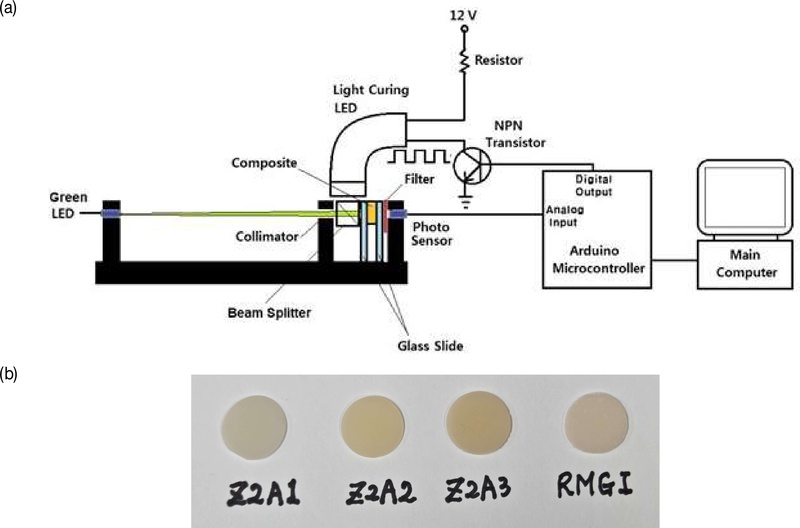
(a) The instrument for measuring light transmittance of the restorative materials using green light. (b) A real image showing the shades of the materials used.
2. Measurement of light transmittance using green light
Real-time light transmittance was measured using the setup in Figure 1a. Green light (568 nm, 50 mW) from an LED passed through a collimator and beam splitter, then irradiated the specimen placed between two glass slides. Transmitted light passed through a 550 nm long-pass filter (Edmund Optics, Barrington, NJ, USA) and was converted to voltage by a Vis-IR photodetector (GDET257; KAOS, Seoul, Korea). The signal was digitized via Arduino microcontroller (Arduino, Torino, Italy) and stored on a computer. The curing light used pulse-width modulation (PWM) with 50 ms exposure and 50 ms pause at 10 Hz. To reduce interference from blue light during curing, voltage was recorded immediately after each 50 ms pause. A long-pass filter was also installed before the sensor, and curing light passed through a beam splitter for uniform irradiation.
Initial output voltage (IO) was recorded using an empty glass slide. For specimen preparation, 0.15 g of material was placed between two 1-mm spacers and compressed to form a 1-mm-thick, 9-10-mm-diameter disk. The specimen was then aligned with the light path and fixed in position. Baseline data were collected for 10 seconds, followed by 40 seconds of irradiation with a PWM-LED curing unit (IB Systems, Seoul, Korea; 460 nm, 1,739 mW/cm2, 50% duty ratio, 10 Hz). The transmitted light intensity (It) was recorded for 310 seconds. Transmittance (%) was calculated from the voltage data (n=5) (11, 12).
3. Measurement of light transmittance using an LED curing unit and a radiometer
The baseline value (IO) was obtained by irradiating a portable radiometer (Bluephase Meter II, Ivoclar Vivadent, Liechtenstein) with a blue LED curing unit (3M™ Elipar™ S10, 3M ESPE, USA; 1,200 mW/cm2) without any material. The polymerized specimen was then placed on the radiometer and irradiated again to record the corresponding value (It). % Transmittance was calculated from these values (n=5).
4. Measurement of thermal diffusivity of restorative materials using a temperature control device
Thermal diffusivity was measured using a temperature control device (IB Systems, Seoul, Korea) with a thermocouple and Peltier plate (Figure 2). To create insertion holes for the sensor in each layer, a 0.7-mm syringe needle was fixed to a glass slide, and 0.57 g of material was placed on top. Two 1-mm-thick glass slides were used as spacers, and a top slide was pressed to form a 2-mm-thick specimen. Using the same process, two additional layers were stacked to form a 6-mm three-layer specimen. Sensor holes were arranged at 120° angles to avoid overlap between layers. Thermal grease (HY710 Silver, Coolertec, Seoul, Korea) was applied to the Peltier plate and sensor holes before inserting sensors: Sensor 1 in the bottom layer, Sensor 2 in the middle, and Sensor 3 in the top (Figure 2). The grease was used to enhance thermal contact between the sensors and the specimen, and was applied minimally to avoid influencing temperature readings. Each sensor was inserted fully to the end of the needle-formed channel. The plate was set to 25℃. After 10 seconds of baseline recording, the temperature increased to 35℃ for 100 seconds, then returned to 25℃ for 100 seconds, yielding 210 seconds of thermogram data. Thermal diffusivity was calculated based on the results (n=5).
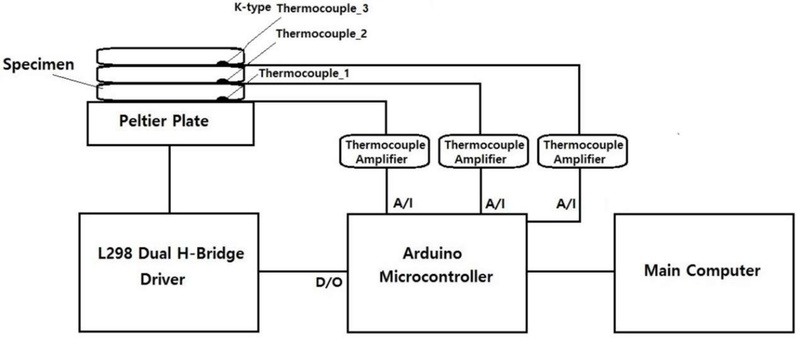
Schematic diagram of the temperature controller. The Peltier plate and thermocouple can control the temperature at the bottom of the first layer of the specimen by adopting a negative feedback mechanism with the Arduino microcontroller. By utilizing a multi-layered arrangement of temperature sensors, temperature variations at different positions can be measured, enabling a detailed analysis of heat transfer within the specimen.
To analyze temperature changes across the specimen layers, a continuous heat conduction model (Figure 3a) was discretized into a finite difference form (Figure 3b). If Q denotes the heat energy between X1 and X2, the following equation applies (14).
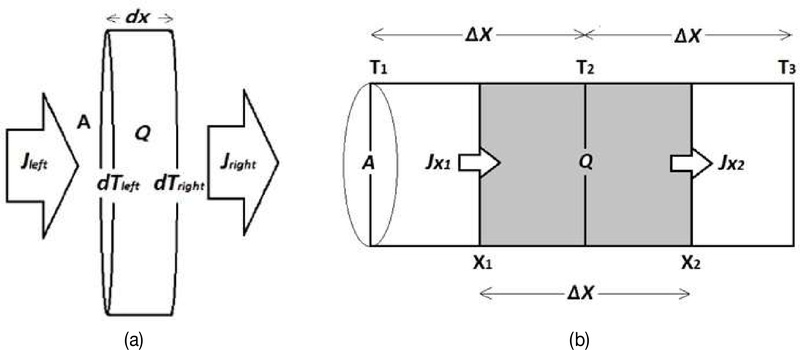
Schematic representation of heat transfer in layered materials, with heat fluxes (J), thermal energy (Q), areas, and temperature gradients. (a) Continuous model, (b) Discrete model (T1 and T3: the temperature at the left and right side of X1 and X2, which are apart Δx from the midpoint between X1 and X2, respectively, T2: the temperature at midpoint between X1 and X2).
(Q : thermal energy, C : specific heat, m : mass of the rod between X1 and X2, T2 : temperature at midpoint of X1 and X2, ρ : density, A : cross-section area of the rod, Δx : thickness)
| (1) |
If the heat flow at X1 is denoted as JX1 and the heat flow at X2 is denoted as JX2,
(k: thermal conductivity, T1 and T3 : the temperature at the left and right side of X1 and X2, which are apart Δx from the midpoint between X1 and X2, respectively, T2 : the temperature at midpoint between X1 and X2, )
| (2) |
dQ/dt, the heat change between X1 and X2 over time, equals Jnet, the net heat flow across X1 and X2 boundaries, satisfying (1) = (2).
Therefore, the thermal diffusivity α can be determined as follows.
Given the experimental conditions where Δx is 2 mm, substitution into the equation yields:
5. Measurement of temperature changes of single-layer materials during photopolymerization
Temperature changes during photopolymerization were measured using a non-contact infrared (IR) device (Figure 4) with an IR sensor (DTS-L300-V2, Diwellshop, Seoul, Korea). 0.37 g of material was placed on a glass slide, with 1-mm spacers on both ends to achieve a 1-mm-thick, 15-mm-diameter disk, which was positioned under the sensor. Baseline data were collected for 10 seconds, followed by 20 seconds of light exposure with the PWM-LED curing light (IB Systems, 100% duty ratio: 1,739 mW/cm2). Temperature was recorded for 300 seconds, followed by another 20-second light exposure and an additional 300 seconds of recording, totaling 610 seconds. From the temperature-time curves, the first peak (ΔT1), indicating the combined effect of polymerization and radiant heat, and the second peak (ΔT2), representing radiant heat alone, were obtained. The net peak temperature (ΔTnet), caused only by polymerization heat, was derived by subtracting the second curve from the first. Peak time was defined as the point where ΔTnet occurred (n=5).
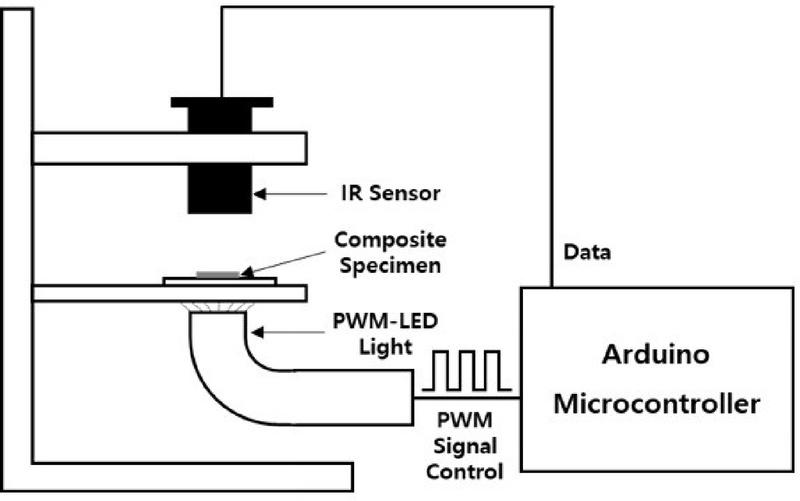
Schematic diagram of the non-contact infrared sensor thermometer.
Combinations of materials and shades for layered specimens used in temperature measurements
6. Measurement of temperature changes of bi-layered materials during photopolymerization
Layered combinations of restorative materials with different shades and translucency are shown in Table 2. For Z250, a darker first layer was followed by the same or a lighter second layer. RMGI was also used as a first layer, followed by either Z2A2 or another RMGI layer. For the first layer, 0.37 g of material was placed between two glass slides with 1-mm spacers and compressed to form a 1-mm-thick specimen, then light-cured for 40 seconds. For the second layer, 0.32 g of material was placed in a 1-mm-thick, 13-mm-diameter mold on a slide, and the first-layer specimen was placed on top. Pressure was applied to produce a 2-mm-thick final specimen. The specimen was placed on the same device as in single-layer experiment, with the second layer facing the curing light (Figrue 5). Temperature change was measured as in the single-layer to obtain the first peak temperature (ΔT1) (n=5). All experiments were conducted at 25±0.5 ℃.
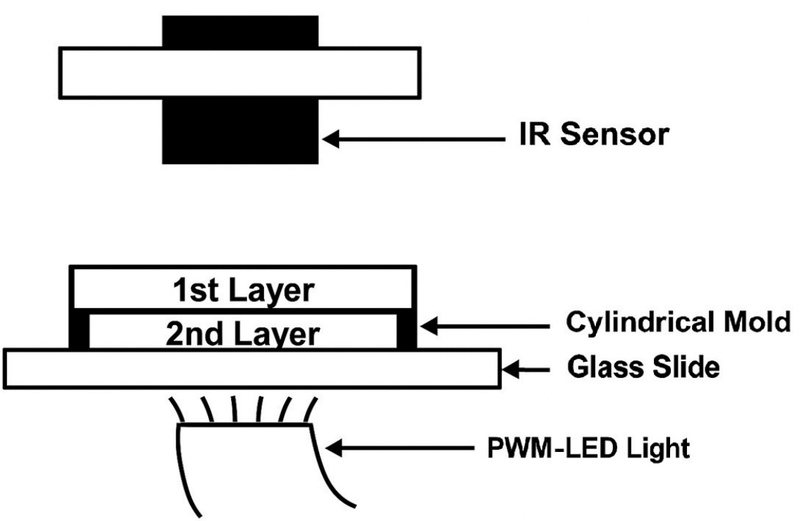
Schematic diagram of the layered specimen for measurement of temperature changes during photopolymerization.
7. Statistical analysis
To compare differences in light transmittance, thermal diffusivity, and temperature changes during photopolymerization in both single-layer and bi-layered configurations, one-way analysis of variance (ANOVA) was performed, followed by Tukey’s HSD post-hoc test. Statistical analyses were conducted using SPSS software version 29.0 (IBM, Armonk, NY, USA) (α = 0.05).
Results
1. Light transmittance measurement
Figure 6 shows a representative light transmittance graph for green light, and Table 3 presents values before and after photopolymerization. Transmittance increased after photopolymerization in all materials. Within the Z250 group, Z2A2 showed significantly higher values than Z2A3 at both time points (p<0.05). RMGI had significantly lower transmittance than Z2A2 before and after curing (p<0.05).
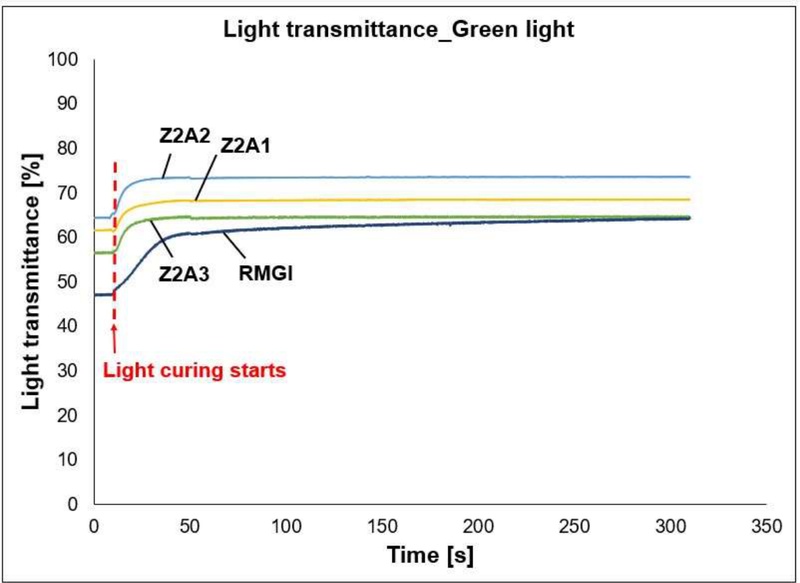
A representative graph of the light transmittance changes of materials under green light during photopolymerization.
Light transmittance of green light through materials
The light transmittance measured with an LED curing light and a radiometer is presented in Table 4. A statistically significant difference was found among Z2A1, Z2A2, and Z2A3 (p<0.05).
Light transmittance measured with an LED curing light and a radiometer
2. Thermal diffusivity of restorative materials measured with the temperature controller
A representative graph of the thermal diffusivity measurements with the temperature controller is shown in Figure 7, while Table 5 lists values for each material. No significant differences were found among the three Z250 shades (p>0.05), but RMGI showed a significantly lower value than Z2A1 and Z2A2 (p<0.05).
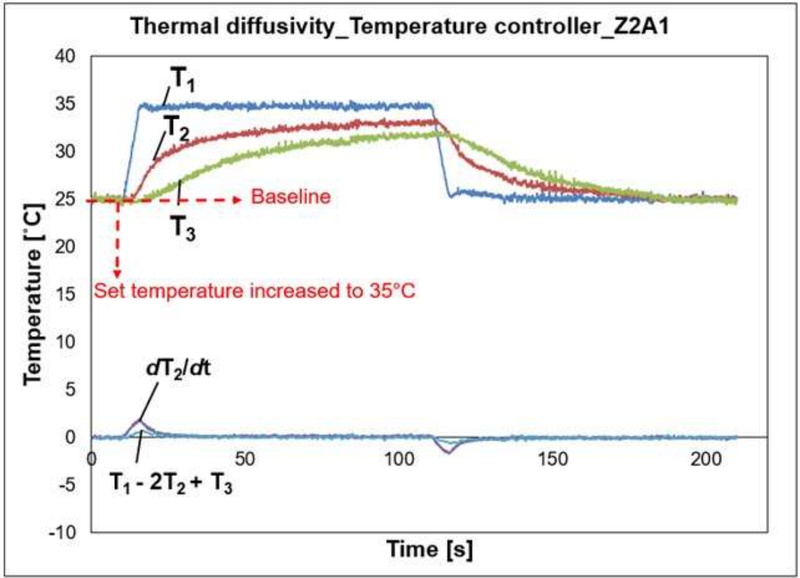
A representative thermogram showing multiple temperature curves and calculated parameters for the thermal diffusivity measurement with the temperature controller. T1 refers to the temperature measured at the bottom layer, T2 at the middle layer, and T3 at the top layer.
Thermal diffusivity (mm2/s) values measured with the temperature controller or by flash method
3. Temperature changes during photopolymerization of single-layer materials
Figure 8 shows a representative temperature curve during photopolymerization of single-layer materials. The measured values for ΔT1, ΔT2, ΔTnet, and peak time are presented in Table 6. Z2A3 showed significantly higher ΔT1 and ΔT2 than Z2A1 (p<0.05). RMGI had significantly higher ΔT1, ΔTnet, and peak time compared to all Z250 shades (p<0.05). No significant differences in ΔTnet and peak time were observed within the Z250 group (p>0.05).
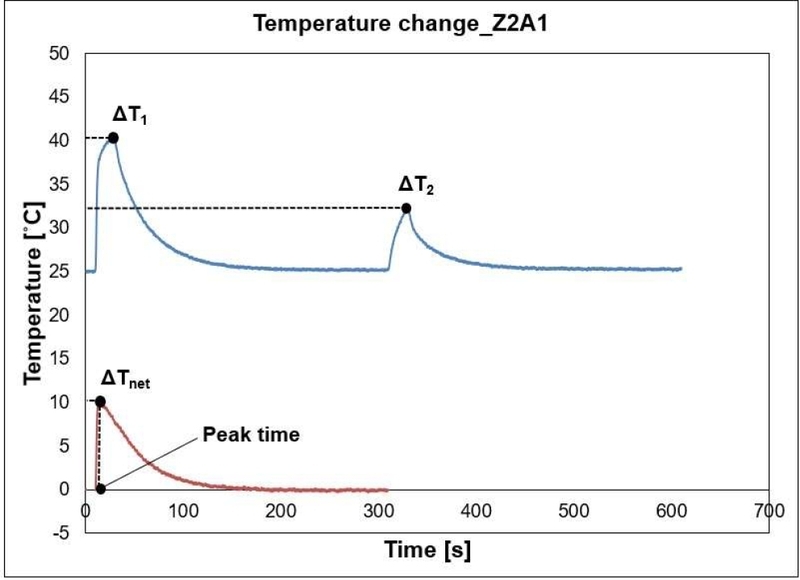
A representative graph of the temperature change of a composite during photopolymerization and additional light exposure. ΔT1 refers to the first maximum temperature rise, which reflects the total temperature increase resulting from both the material's polymerization heat and the radiant heat from the curing light. ΔT2 indicates the maximum temperature rise observed in the second graph, representing the temperature rise due solely to the radiant heat from the curing light. ΔTnet, which represents the maximum temperature rise caused by the material's polymerization heat, was derived by subtracting the second temperature curve from the first. The time at which ΔTnet is reached is defined as peak time.
ΔT1, ΔT2, ΔTnet , and peak time
4. Temperature changes during photopolymerization of bi-layered materials
Figure 9 shows a representative temperature curve during photopolymerization of bi-layered materials, and ΔT1 values are shown in Table 7 and Figure 10. To compare combinations sharing one identical layer, A3/A3 and A3/A2 showed significantly higher values than A3/A1, which in turn was higher than A1/A1 (p<0.05). GI/A2 exhibited significantly lower values than both GI/GI and A2/A2 (p<0.05).
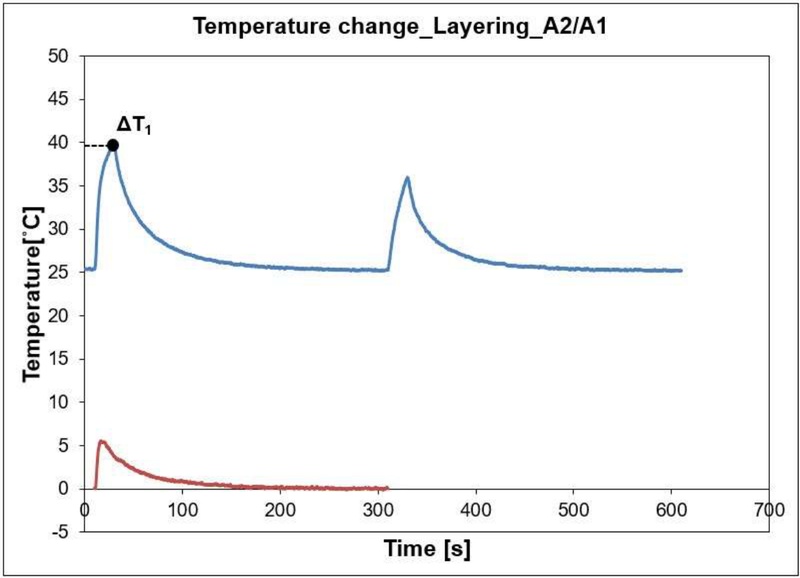
A representative graph of the temperature change of layered composites during photopolymerization and additional light exposure.
ΔT1 of layered Z250 and RMGI
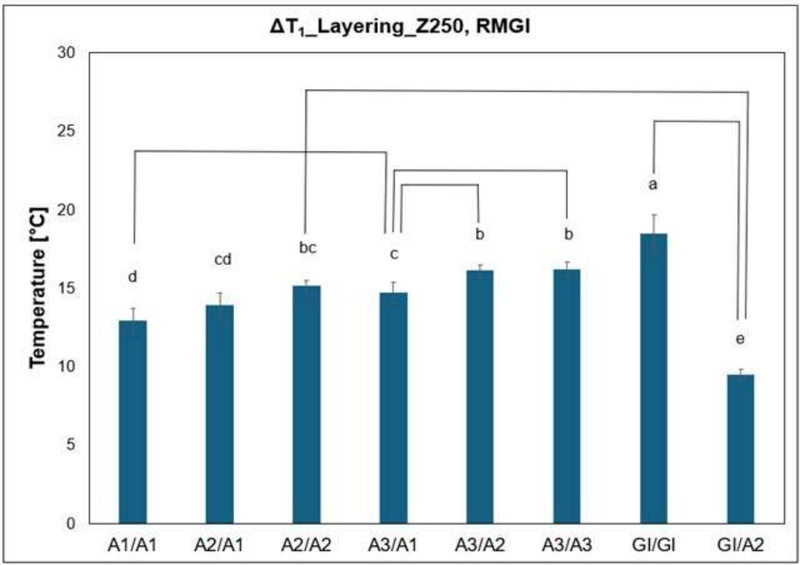
ΔT1 of layered Z250 and RMGI (Different superscript letters indicate significant differences among groups. Lines connecting groups represent statistically significant differences between combinations that share one identical layer and differ in the other).
Discussion
This study examined how composite shade affects light transmittance, thermal diffusivity, and temperature changes during photopolymerization in single- and bi-layered materials. Unlike prior studies analyzing optical or thermal properties separately, this work highlights the combined photothermal effects of layered materials with varying shades and types.
In this study, a green LED, filter, and PWM technique were used to exclude blue light interference during photopolymerization, enabling real-time measurement of light transmittance before, during, and after curing. As shown in Figures 6 and 8, most polymerization occurs within seconds after light exposure; therefore, post-polymerization transmittance is more clinically relevant. Accordingly, transmittance of cured specimens was measured using a blue LED and radiometer, then compared with the green LED data.
Light transmittance increased during photopolymerization in all materials, consistent with previous studies (11, 12). As polymerization progresses, refractive index difference between the resin matrix and fillers decreases, resulting in increased transmittance. Both methods showed that Z2A3 had the lowest transmittance among the three shades. When using a green LED, no significant difference was observed between Z2A1 and Z2A2, whereas in the second method using a blue LED, Z2A1 exhibited the highest transmittance. These differences may be attributed to variations in wavelength and intensity between the light sources, affecting light reflection, scattering, absorption, and transmission within and on the surface of the material. The large difference in transmittance observed in RMGI between green LED and blue LED irradiation can first be attributed to the difference in wavelengths of the two light sources. As the wavelength of light decreases, light transmittance tends to decrease because shorter wavelengths undergo greater scattering (15). In addition, the green LED delivers relatively low intensity (50 mW), whereas the blue LED provides a much higher intensity (1,200 mW), which may further influence light transmittance. In the case of RMGI, light absorption appears to saturate at lower intensities, so incident light exceeding this threshold results in increased transmittance (16).
Thermal diffusivity showed no significant differences among the Z250 shades, while RMGI exhibited the lowest value. Z250 demonstrated thermal diffusivity values ranging from 0.308 to 0.338 mm2/s. To validate these results, a supplementary experiment using the flash method was conducted, yielding similar values (0.313–0.331 mm2/s), which supports the reliability of the measurement device employed in this study (17). The detailed data of flash method is provided in the Table 5. These findings align with previous reports showing that glass ionomer cement generally has lower thermal diffusivity than resin composites (18, 19). In this study, RMGI showed a value of 0.265 mm2/s, close to the previously reported 0.247 mm2/s (20). Its low diffusivity is attributed to its high water content and voids formed during manufacturing and polymerization, both of which hinder heat transfer (21).
To assess temperature changes during photopolymeripzation, a non-contact IR sensor was used for single- and bi-layered specimens. This method offers reliable, contact-free measurements and has shown comparable accuracy to thermocouples in a previous study (22). Among the Z250 shades, both ΔT1 and ΔT2 were highest in Z2A3 and lowest in Z2A1. This trend aligns with the light-transmittance results (Table 4), where Z2A3 exhibited the lowest transmittance, followed by Z2A2, while Z2A1 showed the highest. These findings are consistent with previous reports indicating that darker shades absorb more light and consequently generate greater temperature increases (9). However, ΔTnet showed no significant differences among shades, suggesting that radiant heat has a greater influence on temperature change than polymerization heat. This supports prior research indicating that most of the temperature rise during composite curing originates from the curing light (23).
RMGI exhibited higher ΔT1 and ΔTnet than Z250, indicating stronger polymerization heat. Although typically used near the pulp as a liner or base, it generated more heat than expected. This is attributed to its low-molecular-weight monomers like HEMA, which produce more heat per unit mass than high-molecular- weight monomers. Additionally, its acid-base setting reaction may contribute further heat. Prior studies have also reported higher polymerization heat in some RMGIs than in composites (20).
In bi-layered materials, temperature rise varied with layer combinations. For Z250, A3/A3 and A3/A2 showed significantly higher values than A3/A1, due to the lower transmittance and higher light absorption of the second layer. A3/A1 also showed higher temperatures than A1/A1, as light transmitted through the second A1 layer was more absorbed by the first A3 layer, generating more heat. Lower temperature in GI/A2 compared to GI/GI was attributed to greater polymerization heat from RMGI in the second layer. Meanwhile, GI/A2 showed lower temperatures than A2/A2, because RMGI’s lower thermal diffusivity in the first layer limited heat transfer to the sensor. A supplementary test comparing A3/A1 and A1/A3 revealed that A1/A3, with the darker shade in the second layer, resulted in a higher temperature rise. These results demonstrate how optical and thermal properties of layered materials interact to affect heat generation during photopolymerization.
In this study, measurements were performed on specimens placed on a glass slide, which does not reflect clinical conditions involving dentin. Variables such as dentin thickness and pulpal fluid convection influence intrapulpal temperature dynamics (24). Thus, the measured temperature rise may overestimate in vivo conditions, where heat dissipation is more efficient. According to Kodonas’ study, the presence of pulpal microcirculation limited intrapulpal temperature rise during light irradiation to under 6 ℃, whereas the absence of a simulated pulpal environment resulted in temperature increases exceeding 6 ℃ (25). Previous studies also have shown that temperature rise during composite photopolymerization is strongly affected by the thermal properties of surrounding substrates, with heat sinks yielding much lower increases than insulating materials (4). Therefore, further studies incorporating clinically relevant substrates and thermal environments are warranted before applying these findings in practice.
The measurement devices and methods employed in this study can be widely applied to the analysis of various dental materials. For instance, light transmittance analysis can be extended to evaluate how ceramic shade and thickness influence the polymerization of underlying resin cements. Similarly, the thermal diffusivity method may be used to assess the insulating capacity of pulp capping materials, contributing to the evaluation of their potential to protect the pulp. Collectively, these methods offer a reliable framework for characterizing the optical and thermal behavior of materials, providing a basis for material development and clinical application.
Conclusion
The light transmittance of the studied restorative materials increased after photopolymerization, with significant differences observed depending on the shade. The thermal diffusivity showed no significant differences among the three composite shades but was lower in the glass ionomer compared to the composites. During the photopolymerization of single-layer materials, temperature changes varied depending on the type and shade of the restorative material, with the glass ionomer exhibiting a higher temperature increase than composites. In bi-layered configurations, different combinations of restorative materials and shades resulted in varying temperature changes during photopolymerization.
References
-
Jo SA, Lee CH, Kim MJ, Ferracane JL, Lee IB. Effect of pulse-width-modulated LED light on the temperature change of composite in tooth cavities. Dent Mater 2019;35:554-63.
[https://doi.org/10.1016/j.dental.2019.01.009]

-
Zach L, Cohen G. Pulp response to externally applied heat. Oral Surg Oral Med Oral Pathol 1965; 19:515-30.
[https://doi.org/10.1016/0030-4220(65)90015-0]
-
Amano T, Muramatsu T, Amemiya K, Kubo K, Shimono M. Responses of rat pulp cells to heat stress in vitro. J Dent Res 2006;85:432-5.
[https://doi.org/10.1177/154405910608500507]
- Balestrino A, Verissimo C, Tantbirojn D, Garcia-Godoy F, Soares CJ, Versluis A. Heat generated during light-curing of restorative composites: Effect of curing light, exotherm, and experiment substrate. Am J Dent 2016;29:234-40.
-
Emami N, Sjödahl M, Söderholm KJM. How filler properties, filler fraction, sample thickness and light source affect light attenuation in particulate filled resin composites. Dent Mater 2005;21: 721-30.
[https://doi.org/10.1016/j.dental.2005.01.002]
-
Musanje L, Ferracane JL, Sakaguchi RL. Determination of the optimal photoinitiator concentration in dental composites based on essential material properties. Dent Mater 2009;25:994-1000.
[https://doi.org/10.1016/j.dental.2009.02.010]
-
Arikawa H, Kanie T, Fujii K, Takahashi H, Ban S. Effect of filler properties in composite resins on light transmittance characteristics and color. Dent Mater J 2007;26:38-44.
[https://doi.org/10.4012/dmj.26.38]
-
Arikawa H, Fujii K, Kanie T, Inoue K. Light transmittance characteristics of light-cured composite resins. Dent Mater 1998;14:405-11.
[https://doi.org/10.1016/S0300-5712(99)00014-7]
-
Lee CH, Lee IB. Effect of translucency and absorbance of composite on temperature change during photopolymerization. Dent Mater J 2023;42:894-900.
[https://doi.org/10.4012/dmj.2023-143]
-
Al-Qudah AA, Mitchell CA, Biagioni PA, Hussey DL. Effect of composite shade, increment thickness and curing light on temperature rise during photocuring. J Dent 2007;35:238-45.
[https://doi.org/10.1016/j.jdent.2006.07.012]
-
Oh HJ, Lee CH, Lee IB. Real-time measurement of transmittance changes during photo-polymerization of conventional and bulk-fill composites. Dent Mater J 2022;41:800-807.
[https://doi.org/10.4012/dmj.2022-009]
-
Oh HJ, Choi GW, Lee CH, Lim BS, Lee IB. Real time measurement of the transmittance change of composite during light curing. Korean J Dent Mater 2020;47:119-30.
[https://doi.org/10.14815/kjdm.2020.47.3.119]
- Nica I, Rusu V, Paun MA, Stefanescu C, Vizureanu P, Aluculesei A. Thermal properties of nanofilled and microfilled restorative composites. Mater Plast 2009;46:431-4
- Lee IB. Principles and Practice of Instrumentation for Biomechanical Research in Dentistry. Seoul: IB Systems; 2024. p.97-100, 892-3.
-
Arikawa H, Kanie T, Fujii K, Takahashi H, Ban S. Effect of filler properties in composite resins on light transmittance characteristics and color. Dent Mater J 2007;26:38-44.
[https://doi.org/10.4012/dmj.26.38]
-
Cefaly DFG, Paes de Mello LLC, Wang L, Lauris JRP, D'Alpino PHP. Effect of light curing unit on resin-modified glass-ionomer cements: a microhardness assessment. J Appl Oral Sci 2009;17:150-4.
[https://doi.org/10.1590/S1678-77572009000300004]
-
Parker WJ, Jenkins RJ, Butler CP, Abbott GL. Flash method of determining thermal diffusivity, heat capacity, and thermal conductivity. J Appl Phys 1961;32:1679-84.
[https://doi.org/10.1063/1.1728417]
-
Brantley WA, Kerby RE. Thermal diffusivity of glass ionomer cement systems. J Oral Rehabil 1993;20:61-8.
[https://doi.org/10.1111/j.1365-2842.1993.tb01515.x]
-
Inoue T, Saitoh M, Nishiyama M. Thermal properties of glass ionomer cement. J Nihon Univ Sch Dent 1993;35:252-7.
[https://doi.org/10.2334/josnusd1959.35.252]
-
Kanchanavasita W, Pearson GJ, Anstice HM. Factors contributing to the temperature rise during polymerization of resin-modified glass-ionomer cements. Biomaterials 1996;17:2305-12.
[https://doi.org/10.1016/S0142-9612(96)00065-8]
-
Tay WM, Braden M. Thermal diffusivity of glass-ionomer cements. J Dent Res 1987;66:1040-3.
[https://doi.org/10.1177/00220345870660051001]
-
Lee CH, Lee IB. Real-time analysis of temperature change in composite photopolymerization using non-contact infrared sensor. Korean J Dent Mater 2022;31:131-40.
[https://doi.org/10.14815/kjdm.2022.49.4.131]
-
Lloyd CH, Joshi A, McGlynn E. Temperature rises produced by light sources and composites during curing. Dent Mater 1986;2:170-4.
[https://doi.org/10.1016/S0109-5641(86)80030-6]
-
Guiraldo RD, Consani S, Consani RL, Berger SB, Correr AB, Sinhoreti MA, et al. Comparison of silorane and methacrylate-based composites on the polymerization heat generated with different light-curing units and dentin thicknesses. Braz Dent J 2013;24:258-62.
[https://doi.org/10.1590/0103-6440201301904]
-
Kodonas K, Gogos C, Tziafa C. Effect of simulated pulpal microcirculation on intrachamber temperature changes following application of various curing units on tooth surface. J Dent 2009;37:485-90.
[https://doi.org/10.1016/j.jdent.2009.03.006]