
Application of photosensitizer PpIX and visible light for the elimination of S. mutans

Abstract
Streptococcus mutans (S. mutans) are major oral bacteria that cause dental caries. To maintain healthy and long-lasting teeth, controlling these bacteria is crucial. The present study aimed to evaluate the efficacy of protoporphyrin IX (PpIX), a photosensitizer, in eliminating S. mutans with the aid of brief visible light irradiation. For this study, S. mutans were treated with various combinations of PpIX (at 1-3 ppm) and visible light (at 10-30 mW/cm2). Visible light was irradiated for 3 min after S. mutans were treated with PpIX. PpIX exhibited an absorption peak near 400 nm and weaker peaks beyond 500 nm. Singlet oxygen was produced almost linearly with time by a 405 nm laser in the mixed solution of PpIX and RNO-ID. In contrast, the control and 660 nm laser-treated specimens showed similar levels of singlet oxygen production. S. mutans were completely eliminated by the 405 nm laser within 3 min of irradiation under all tested conditions. However, the elimination outcomes observed with the 660 nm laser were similar to those of the control group.
초록
S. mutans는 충치를 유발하는 원인균이어서 건강한 치아를 오래 쓰기 위해서는 이 균을 잘 관리하는 것이 중요하다. 본 연구는 광감각제인 protoporphyrin IX (PpIX)에 가시광선을 짧은 시간 동안 조사하여 S. mutans가 얼마나 제거되는지를 평가하는 것이다. 이를 위하여 배양한 S. mutans에 다양한 농도의 PpIX를 적용하고 빛을 조사한 다음 colony-forming units (CFU)를 평가하였다. 이 과정에 singlet oxygen이 관여하는지를 확인하기 위하여 RNO-ID 분석을 하였다. 또한 염색 시약으로 세포를 염색한 후 공초점 현미경을 사용하여 세포의 생존여부를 관찰하였다. 실험 결과 PpIX는 400 nm 근처에서 가장 강한 흡수 피크를 보였고, 500 nm 이후에는 약한 피크들이 나타났다. PpIX와 RNO-ID 혼합 용액에서는 405 nm 레이저에 의해 singlet oxygen이 시간에 따라 거의 선형적으로 생성되는 것이 확인되었으나 대조군과 660 nm 레이저로 처리한 시료에서는 singlet oxygen 생성이 비슷하게 나타났다. 균 실험에서405 nm 레이저를 3분간 조사했을 때 모든 실험 조건에서 S. mutans가 완전히 제거되었고 660 nm 레이저를 사용했을 때는 대조군과 비슷하여서 PpIX를 405 nm 레이저와 함께 사용하면 S. mutans가 충분히 제거됨을 알 수 있었다.
Keywords:
Photosensitizer, PpIX, S. mutans키워드:
광감각제Introduction
Teeth are an important organ that break down food through mastication before it goes on a long journey to the digestive organs. To perform this essential function, teeth must remain structurally intact and undamaged. Unlike many other human organs, teeth do not possess regenerative potential. Therefore, if teeth are damaged, they can only be repaired or replaced with artificial materials or substitutes, such as implants. Dental caries is a common example of tooth damage. It causes harm through a lengthy process, evolving from the initiation of incipient lesions to the eventual fracture of the affected tooth. The initiation of caries often begins at a microscopic level. Biofilms are stealthily formed on tooth surfaces by bacteria and can readily progress to an observable stage. In many cases, pain does not manifest until later in the disease’s progression, often resulting in a late diagnosis.
Among the oral bacteria identified thus far, Streptococcus mutans (S. mutans) is a major cariogenic pathogen (1, 2). As a Gram-positive, facultative anaerobic coccus, it resides on the tooth surface by forming biofilms and conducts metabolic activity by consuming sugar (carbohydrates). In the course of sugar consumption, acids are produced, and these acids initiate caries locally and microscopically by dissolving minerals from the teeth (3-5). Incipient caries can progress if the activity of acids exceeds the buffering capacity of saliva. Thus, ideally, dental caries can be largely prevented or delayed if S. mutans and its biofilms are eliminated, and remineralization is enhanced by consistent and continuous fluoride supply.
Tooth brushing and flossing are simple and easy daily routines to clean teeth and remove biofilms. Fluoride mouth rinse or drinking fluoride-containing water is also an easy procedure (6, 7). Reducing the consumption of sugar or sugar-containing foods and beverages – the primary food source for oral bacteria – in the daily diet is an important strategy for minimizing the risk of dental caries, especially for children and adolescents (8, 9).
A free radical is a molecule or ion that contains unpaired electrons. It is generally unstable and highly reactive. Free radicals can be generated in several ways, typically by redox reactions, ionizing radiation, or heat. Among them, reactive oxygen species (ROS), such as hydroxyl radicals (OH•), superoxide anions (O2•⁻), singlet oxygen (), and hydrogen peroxide (H2O2), are important for their roles in antibacterial activity and cancer treatment (10, 11). According to studies, hydroxyl radicals are associated with antibacterial activity, while singlet oxygen has been identified as a primary ROS for cancer treatment (12, 13). Photodynamic therapy (PDT) is a method that treats diseases by utilizing singlet oxygen, which is produced through the interaction between a photosensitizer (PS) and light. When a PS, such as protoporphyrin IX (PpIX), absorbs external light, the ground singlet state PS transitions to an excited singlet state and then to a triplet state through intersystem crossing. The triplet state PS then interacts with ambient oxygen, subsequently producing singlet oxygen via energy transfer and/or an alternative electron transfer pathway (14, 15). An electron spin resonance (ESR) study revealed the presence of abundant singlet oxygen when the PS interacts with light (16). Although singlet oxygen is not technically a free radical, it is highly reactive due to its electronic instability. PpIX is one of the photosensitizers available for medical photodynamic therapy (PDT). However, its application in dentistry is rare due to its limited use in dental clinics. Application of PpIX and external light for treating S. mutans, which resides mainly on or near tooth subsurface is rather simple task than those of the case of internal body and deep surface. The application of PpIX and external light for treating S. mutans, which primarily resides on or near the tooth surface or subsurface, is a simpler task than its application to internal body regions or deep tissues.
The purpose of the present study was to evaluate the antibacterial capability, specifically the killing of S. mutans, of PpIX under short-duration, low-intensity visible light irradiation. To assess any wavelength dependence, two different wavelengths of light were tested, reflecting the absorption spectrum of PpIX. The hypothesis tested was that S. mutans can be eliminated in less than 5 min by combining a low concentration of PpIX with low-intensity visible light.
Materials and Methods
1. Media and culture conditions
For the study, S. mutans ATCC 700610 was used. Bacteria were inoculated in a brain heart infusion (BHI) broth supplemented with 5% CO2 at 37℃ for 24 h. After 24 h, bacteria were subcultured in the new BHI broth for another 24 h.
2. Absorbance of PpIX
Absorbance of PpIX dissolved in Dimethyl sulfoxide (DMSO) was measured using a spectrophotometer (SpectraMax 190, Molecular Devices, San Jose, CA, USA).
3. Singlet oxygen test
To measure the produced singlet oxygen in solution under light irradiation, RNO-ID [p-nitrosodimethylaniline (RNO)-imidazole (ID)] was used. The RNO-ID solution was prepared as follows: 0.23 mg RNO and 16.35 mg ID were added to 50 mL of deionized water, and stirred well. 200 µL of as-prepared RNO-ID solution was mixed with 100 µL of 2 ppm PpIX, then the mixture was irradiated under 20 mW/cm2 intensity. The optical density (OD) was measured using a spectrophotometer at 440 nm after light irradiation for 5 min. OD was measured every one min. Solution of only RNO-ID was used as the control. Every measurement was triplicated. All the chemical reagents were used without further purification and obtained from Sigma-Aldrich.
4. Antibacterial test
The antibacterial activity of PpIX under laser irradiation was evaluated using S. mutans suspensions. In each well of 48-well dish, 200 µL ultrapure water was filled, then S. mutans of 1×10⁶ cells/mL and PpIX (1, 2, 5 ppm) were added. The treated PpIX was left for 3 min to allow interaction to the S. mutans (in case of no laser treatment, it was left for 6 min). Two different lasers (405 nm and 660 nm) were irradiated with 10, 20, and 30 mW/cm2 intensity for 3 min if needed. After that, the treated bacteria were centrifuged, gathered, spread on the BHI agar plate, and incubated for 2 days with 5% CO2 at 37℃. After that, the colony-forming units (CFUs) were counted. The control specimens were not treated both with PpIX and laser.
5. Live/Dead Cell Staining Assay
Cell viability under test conditions was observed using the live/dead staining. Each 300 µL cell suspension (1×10⁶ cells/mL) was treated with 2 different test conditions: without and with light irradiation. In case of no light irradiation, specimens were treated with 2 ppm PpIX for 6 min. For the case of light irradiation, specimens were treated with 2 ppm PpIX for 3 min and then immediately irradiated with light for 3 min. For light irradiation, laser of 405 and 660 nm was irradiated with 20 mW/cm2 intensity. After that, the cells were washed several times with deionized water to clear PpIX. After 2 h, specimens were stained with Calcein-AM/PI (propidium iodide) dye for 20 min [Calcein-AM (20 µL; 2 µM), PI (5 µL; 4.5 µM), and PBS 195 µL]. Then, specimens were observed using the confocal microscope (LSM700, Carl Zeiss QEC GmbH, Peine, Germany). In the microscope images, live and dead cells look green and red, respectively.
6. Statistical analysis
The results of antibacterial tests were analyzed by t-test and one-way ANOVA (SPSS). One-way ANOVA followed by a Tukey’s post-hoc test for multiple comparisons; p values <0.05 are considered significant.
Results
1. Absoprtion spectrum
Figure 1 illustrates the absorption spectrum of PpIX. It displays a strong peak around 400 nm, known as the Soret band, and several weaker peaks beyond 500 nm, referred to as Q bands. Notably, no significant absorption peak is observed beyond 650 nm.
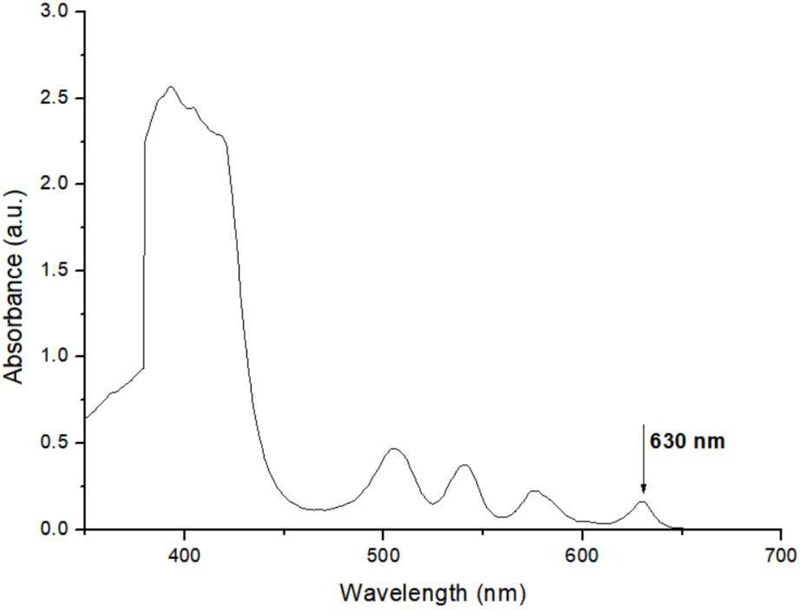
Absorption spectrum of PpIX. It displays a strong peak near 400 nm and weak peaks after 500 nm. Beyond 650 nm, no peak is observed.
2. ARNO-ID degradation
Figure 2 illustrates the results of RNO-ID degradation as time progressed. For 405 nm laser-treated specimens, the peak absorbance of RNO-ID at 440 nm decreased by approximately 13-30%, depending on the inclusion of PpIX. When 2 ppm PpIX was added, the peak absorbance decreased almost linearly (R = -0.97) with time. In contrast, in the control and 660 nm laser-treated groups, RNO-ID absorbance showed no significant change compared to the degradation induced by the 405 nm laser.
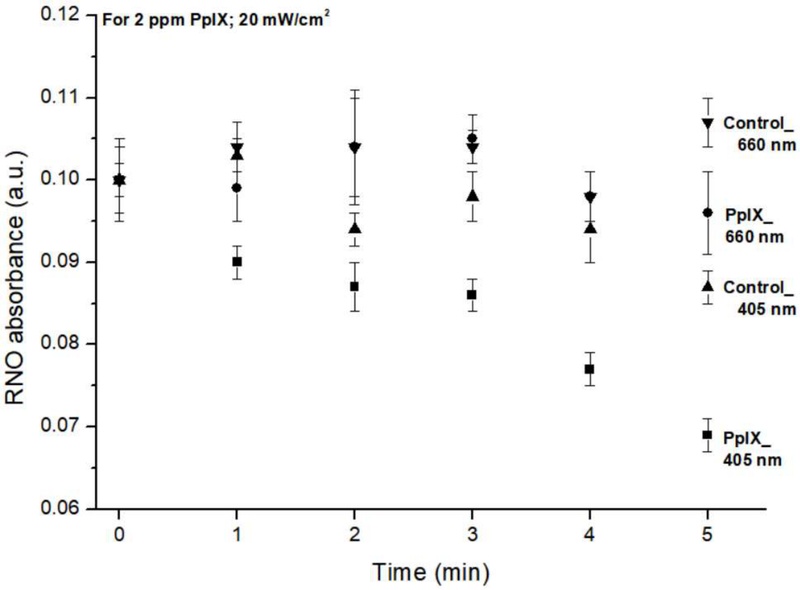
Evaluation of RNO-ID absorbance change at 440 nm as a result of degradation by the produced singlet oxygen.
3. Antibacterial tests
Table 1 presents the results of antibacterial tests, specifically the elimination of S. mutans, under various conditions. Specimens treated with 1-3 ppm PpIX alone showed elimination rates ranging from 2.5% to 22.2%. In contrast, additional treatment with a 405 nm laser resulted in the complete elimination of S. mutans specimens across all tested light intensities. However, in the case of 660 nm laser treatment, specimens exhibited outcomes similar to those treated with PpIX only. Furthermore, the elimination rate showed a slight but statistically significant increase as the light intensity increased (<0.05)

Results (Log CFU/mL) of antibacterial test under different combination conditions
4. Live/dead staining
Figure 3 displays the microscope images of the treated specimens, stained with Calcein-AM/PI. The control group (treated with PpIX only) and specimens treated with a 660 nm laser exhibit a predominance of green fluorescence after Calcein-AM staining. In contrast, 405 nm laser-treated specimens primarily show red fluorescence following PI staining.
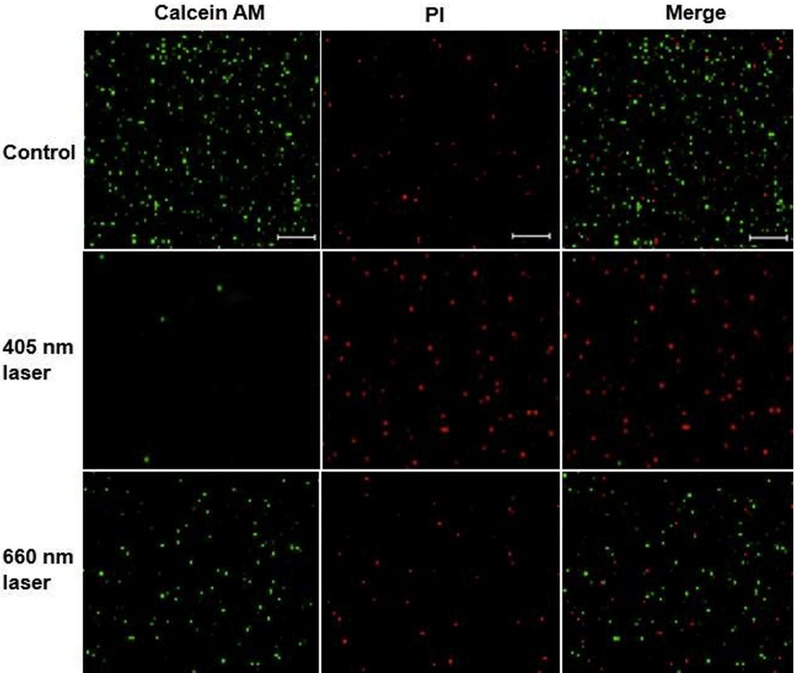
Fluorescence images of the treated specimens with different conditions after Calcein AM and PI staining. Live and dead cells are viewed as green and red points, respectively (scale bar: 5 µm).
Discussion
Preventing dental caries through daily tooth brushing and flossing is often considered a simple, easy, and minimal routine. However, despite such daily routines, the incidence of incipient carious lesions remains inevitable in many cases due to various complex factors. The present study investigated the elimination of S. mutans by reactive oxygen species (ROS) produced during the brief interaction between a low-concentration photosensitizer (PS) and visible light. The S. mutans tested was completely eliminated by a 405 nm laser at an intensity of 10-30 mW/cm2, with only 3 min of irradiation under 1-3 ppm PpIX conditions. Therefore, the hypothesis that S. mutans can be eliminated using a low concentration of PpIX and low-intensity visible light for a short time (less than 5 min) can be accepted.
PpIX is a heterocyclic organic compound that is present in living cells in small amounts as an intermediate in the heme biosynthetic pathway (17). As a photosensitizer (PS), PpIX has numerous applications in cancer treatment via photodynamic therapy (PDT). PDT itself has countless applications in the treatment of cancers or abnormal conditions, utilizing both PS and light (18, 19). When the PS absorbs light, it transitions from the ground singlet state to the triplet state, which can then react with ambient oxygen through two distinct pathways: Type I and Type II. These two pathways lead to the formation of reactive oxygen species (ROS) and singlet oxygen, respectively. Generally, the prevalence of these two pathways depends on various factors such as oxygen concentration, tissue dielectric constant, pH, and the photosensitizer’s structure. As the oxygen concentration within the cell decreases, the Type I pathway begins to prevail (20).
To identify the responsible species in the present study, the p-nitrosodimethylaniline-imidazole (RNO-ID) method was adopted (21). In this method, if the PS is irradiated with light that it can absorb, it may produce either ROS or singlet oxygen. However, since ID, an acceptor/quencher, is converted into a trans-annular peroxide intermediate by singlet oxygen, and if the PS does indeed produce singlet oxygen, then ID subsequently bleaches the RNO sensor. RNO has an absorption peak near 440 nm, and its peak intensity linearly decreases over time. The bleaching of RNO in other words, the decrease in peak intensity at 440 nm is attributed to ID having been affected by singlet oxygen (22). In the production of singlet oxygen, a 660 nm laser was significantly less productive than a 405 nm laser because PpIX exhibits negligibly low absorption at 660 nm. Ultimately, specimens irradiated with a 405 nm laser at intensities of 10-30 mW/cm2 were completely eliminated, whereas those treated with a 660 nm laser showed an outcome similar to that of the control group (only PpIX treated).
In the preliminary tests, a 405 nm laser was directed onto a small beaker containing 1.5 mL of water to assess its low power and safety profile. Even at an intensity of 10 mW/cm2 with 40 min of irradiation, the water temperature (whether with or without 2 ppm PpIX) rose by only 2 ℃. Therefore, laser irradiation for 3 min at an intensity of 10-30 mW/cm2 can be considered safe for application to the oral mucosa and teeth. In the present study, PpIX was mixed with S. mutans and subsequently subjected to laser irradiation. However, in a real clinical situation, spraying PpIX onto the suspected oral mucosa or tooth surface would likely be the protocol, followed by washing with water immediately after laser irradiation. Consequently, if the practitioner follows this process, the applied PpIX would not cause a residual photosensitivity reaction due to interaction with ambient light. In contrast, with intravenous PS injection, residual photosensitivity would persist until the injected PS is completely eliminated from the body (23, 24). Thus, owing to the general location of S. mutans habitat and the exposed lesion of caries, S. mutans can be treated safely and quickly without PS remaining on the treated lesion.
The basic processes that lead to the death of S. mutans are initiated by the spread of the treated photosensitizer (PS) or the produced singlet oxygen into the cell membrane. Inside the cell, the permeated PS interacts with transmitted light and produces singlet oxygen using intracellular oxygen. Owing to the active and extremely strong oxidizing properties of singlet oxygen, cells undergo death via apoptosis and/or necrosis (25, 26). Apoptosis is characterized by cell shrinkage, plasma membrane blebbing, and nuclear fragmentation. In contrast, necrosis involves cell membrane swelling, membrane rupture, and the subsequent release of intracellular contents, which ultimately cause cell death. Necrosis by membrane rupture is probable because PI, used for live/dead staining, passes through damaged plasma membranes. However, the relatively large and positively charged PI cannot enter intact cell membranes. Therefore, the red fluorescence observed in the confocal images is attributable to PI present within the damaged or dead cells. Only red fluorescence for cells treated with 405 nm laser matches well with the result in Table 1 (0 CFU value for 405 nm laser treatments). Depending on various factors, the ratio of cells undergoing apoptosis or necrosis varies (27, 28).
Conclusion
Among the cases evaluated, S. mutans was completely eliminated by 1-3 ppm PpIX after 3 min of 405 nm laser irradiation at an intensity of 10-30 mW/cm2. In contrast, under the same conditions, a 660 nm laser yielded results similar to those of the control group (PpIX treatment only). The elimination was achieved by singlet oxygen, which was produced by light whose emission matched the absorption peak of PpIX. Due to a low temperature rise, 405 nm irradiation for a short duration within the tested intensity range can be safely applied to the oral cavity.
Acknowledgments
This study was supported by a 2-year research grant from Pusan National University.
References
-
Krzyściak W, Jurczak A, Kościelniak D, Bystrowska B, Skalniak A. The virulence of Streptococcus mutans and the ability to form biofilms. Eur J Clin Microbiol Infect Dis. 2014;33:499-515.
[https://doi.org/10.1007/s10096-013-1993-7]

-
Simón-Soro A, Mira A. Solving the etiology of dental caries. Trends Microbiol. 2015;23:76-82.
[https://doi.org/10.1016/j.tim.2014.10.010]
-
Takahashi N, Nyvad B. The role of bacteria in the caries process: ecological perspectives. J Dent Res. 2011;90:294-303.
[https://doi.org/10.1177/0022034510379602]
-
Pitts NB, Zero DT, Marsh PD, Ekstrand K, Weintraub JA, Ramos-Gomez F, Tagami J, Twetman S, Tsakos G, Ismail A. Dental caries. Nat Rev Dis Primers. 2017;25;3:17030.
[https://doi.org/10.1038/nrdp.2017.30]
-
Bowen WH, Burne RA, Wu H, Koo H. Oral Biofilms: Pathogens, Matrix, and Polymicrobial Interactions in Microenvironments. Trends Microbiol. 2018;26:229-42.
[https://doi.org/10.1016/j.tim.2017.09.008]
-
Carey CM. Focus on Fluorides: Update on the Use of Fluoride for the Prevention of Dental Caries. J Evid Based Dent Pract. 2014;14:95-102.
[https://doi.org/10.1016/j.jebdp.2014.02.004]
-
Ten Cate JM, Buzalaf MAR. Fluoride Mode of Action: Once There Was an Observant Dentist. J Dent Res. 2019;98:725-30.
[https://doi.org/10.1177/0022034519831604]
-
Hajishengallis E, Parsaei Y, Klein MI, Koo H. Advances in the microbial etiology and pathogenesis of early childhood caries. Mol Oral Microbiol. 2017;32:24-34.
[https://doi.org/10.1111/omi.12152]
-
Hancock S, Zinn C, Schofield G. The consumption of processed sugar- and starch-containing foods, and dental caries: a systematic review. Eur J Oral Sci. 2020;128:467-75.
[https://doi.org/10.1111/eos.12743]
-
Van Acker H, Coenye T. The Role of Reactive Oxygen Species in Antibiotic-Mediated Killing of Bacteria. Trends Microbiol. 2017;25:456-66.
[https://doi.org/10.1016/j.tim.2016.12.008]
-
Ghorbani J, Rahban D, Aghamiri S, Teymouri A, Bahador A. Photosensitizers in antibacterial photodynamic therapy: an overview. Laser Ther. 2018;27:293-302.
[https://doi.org/10.5978/islsm.27_18-RA-01]
-
Abrahamse H, Hamblin MR. New photosensitizers for photodynamic therapy. Biochem J. 2016;473:347-64.
[https://doi.org/10.1042/BJ20150942]
-
Li B, Lin L, Lin H, Wilson BC. Photosensitized singlet oxygen generation and detection: Recent advances and future perspectives in cancer photodynamic therapy. J Biophotonics. 2016;9:1314-25.
[https://doi.org/10.1002/jbio.201600055]
-
Gunaydin G, Gedik ME, Ayan S. Photodynamic Therapy-Current Limitations and Novel Approaches. Front Chem. 2021;9:691697.
[https://doi.org/10.3389/fchem.2021.691697]
-
Plotino G, Grande NM, Mercade M. Photodynamic therapy in endodontics. Int Endod J. 2019;52:760-74.
[https://doi.org/10.1111/iej.13057]
-
Yoshida A, Sasaki H, Toyama T, Araki M, Fujioka J, Tsukiyama K, Hamada N, Yoshino F. Antimicrobial effect of blue light using Porphyromonas gingivalis pigment. Sci Rep. 2017;7:5225.
[https://doi.org/10.1038/s41598-017-05706-1]
-
Sachar M, Anderson KE, Ma XC. Protoporphyrin IX: the Good, the Bad, and the Ugly. J Pharmacol Exp Ther. 2016;356:267-75.
[https://doi.org/10.1124/jpet.115.228130]
-
Lai HW, Nakayama T, Ogura SI. Key transporters leading to specific protoporphyrin IX accumulation in cancer cell following administration of aminolevulinic acid in photodynamic therapy/diagnosis. Int J Clin Oncol. 2021;26:26-33.
[https://doi.org/10.1007/s10147-020-01766-y]
-
McNicholas K, MacGregor MN, Gleadle JM. In order for the light to shine so brightly, the darkness must be present-why do cancers fluoresce with 5-aminolaevulinic acid? Br J Cancer 2019;121:631-9.
[https://doi.org/10.1038/s41416-019-0516-4]
-
Castano AP, Demidova TN, Hamblin MR. Mechanisms in photodynamic therapy: part two-cellular signaling, cell metabolism and modes of cell death. Photodiagnosis Photodyn Ther. 2005;2:1-23.
[https://doi.org/10.1016/S1572-1000(05)00030-X]
-
Chu X, Li K, Guo H, Zheng H, Shuda S, Wang X, Zhang J, Chen W, Zhang Y. Exploration of Graphitic-C3N4 Quantum Dots for Microwave-Induced Photodynamic Therapy. ACS Biomater Sci Eng 2017;3:1836-44.
[https://doi.org/10.1021/acsbiomaterials.7b00110]
-
Herman J, Neal SL. Efficiency comparison of the imidazole plus RNO method for singlet oxygen detection in biorelevant solvents. Anal Bioanal Chem. 2019;411:5287-96.
[https://doi.org/10.1007/s00216-019-01910-2]
-
Chen TG, Zhang XQ, Ge JF, Xu YJ, Sun R. Thiocarbonyl photosensitizer, a feasible way to eliminate the photosensitizer residues in photodynamic therapy. Spectrochim Acta A Mol Biomol Spectrosc 2022;270:120783.
[https://doi.org/10.1016/j.saa.2021.120783]
-
Yuan B, Wu H, Wang H, Tang B, Xu JF, Zhang X. A Self-Degradable Supramolecular Photosensitizer with High Photodynamic Therapeutic Efficiency and Improved Safety. Angew Chem Int Ed Engl. 2021;60:706-10.
[https://doi.org/10.1002/anie.202012477]
-
Kwiatkowski S, Knap B, Przystupski D, Saczko J, Kędzierska E, Knap-Czop K, Kotlińska J, Michel O, Kotowski K, Kulbacka J. Photodynamic therapy – mechanisms, photosensitizers and combinations. Biomed Pharmacother. 2018;106:1098-1107.
[https://doi.org/10.1016/j.biopha.2018.07.049]
-
Mehraban N, Freeman HS. Developments in PDT sensitizers for increased selectivity and singlet oxygen production. Mater 2015;8:4421-56.
[https://doi.org/10.3390/ma8074421]
-
Lowe SW, Lin AW. Apoptosis in cancer. Carcinogenesis. 2000;21:485-95.
[https://doi.org/10.1093/carcin/21.3.485]
-
Sobhani N, Samadani AA. Implications of photodynamic cancer therapy: an overview of PDT mechanisms basically and practically. J Egypt Natl Canc Inst. 2021;33:34.
[https://doi.org/10.1186/s43046-021-00093-1]