
Comparative analysis of translucency and flexural strength in heterogeneous and homogeneous multilayered dental zirconia

Abstract
The purpose of this study was to evaluate the translucency, birefringence, biaxial flexural strength, and Vickers hardness of multilayered dental zirconia with varying yttria contents and structural designs (heterogeneous vs. homogeneous). Two control groups of 3 mol% yttria-stabilized tetragonal zirconia polycrystal (3Y-TZP) (IPS e.max ZirCAD [IPS] and Zirtooth Fulluster [ZTF]) and three experimental groups of multilayered zirconia were selected. The experimental groups consisted of one heterogeneous type (Zirtooth Multiluster [ZTM]) and two homogeneous types (Zirtooth MultiNeo [ZTN] and Zirtooth UltraLuster [ZTU]). Translucency was measured using a spectrophotometer, and birefringence was analyzed to evaluate optical isotropy. Biaxial flexural strength and Vickers hardness were tested according to International Organization for Standardization (ISO) 6872 standards. Microstructure and crystal phases were analyzed using scanning electron microscopy (SEM) and X-ray diffraction (XRD). The homogeneous ZTU group exhibited the significantly highest translucency and lowest birefringence (p<0.05). The ZTN group showed the highest biaxial flexural strength (1741.62±138.55 MPa). There were no significant differences in Vickers hardness among the groups. Within the limitations of this study, the homogeneous 4 mol% yttria-partially stabilized zirconia (4Y-PSZ)-based ZTN group demonstrated superior mechanical strength, making it suitable for high-stress posterior restorations. The ZTU group showed excellent translucency and optical isotropy, indicating its suitability for anterior esthetic restorations.
초록
본 연구의 목적은 이트리아 함량과 구조적 설계(이종 조성 대 동종 조성)를 달리한 다층 구조 치과용 지르코니아의 투광도, 복굴절, 이축 굴곡 강도 및 비커스 경도를 평가하는 것이다. 본 연구에서는 두 종류의 3 mol% yttria-stabilized tetragonal zirconia polycrystal (3Y-TZP) 대조군(IPS e.max ZirCAD [IPS], Zirtooth Fulluster [ZTF])과 세 종류의 다층 구조 지르코니아 실험군을 선정하였다. 실험군은 이종 조성 구조인 Zirtooth Multiluster (ZTM)와 동종 조성 구조인 Zirtooth MultiNeo (ZTN), Zirtooth UltraLuster (ZTU)로 구성되었다. 분광광도계를 이용하여 투광도를 측정하였으며, 광학적 등방성을 평가하기 위해 복굴절을 분석하였다. 이축 굴곡 강도와 비커스 경도는 ISO 6872 규격에 의거하여 측정하였다. 주사전자현미경(SEM)과 X선 회절 분석(XRD)을 통해 미세구조와 결정상을 분석하였다. 그 결과, 동종 조성인 ZTU 그룹이 가장 높은 투광도와 가장 낮은 복굴절을 나타냈다 (p<0.05). ZTN 그룹은 가장 높은 이축 굴곡 강도(1741.62±138.55 MPa)를 보였다. 비커스 경도는 그룹 간 통계적으로 유의한 차이가 없었다. 본 연구의 한계 내에서, 동종 조성의 4Y-PSZ 기반 ZTN 그룹은 우수한 기계적 강도를 보여 높은 교합력이 가해지는 구치부 수복에 적합하다. ZTU 그룹은 뛰어난 투광도와 광학적 등방성을 나타내어 심미적인 전치부 수복에 적합한 것으로 판단된다.
Keywords:
Biaxial flexural strength, Birefringence, Dental zirconia, Multilayered structure, Translucency키워드:
다층 구조, 복굴절, 이축 굴곡 강도, 치과용 지르코니아, 투광도Introduction
Zirconia has been widely used in dentistry due to its superior mechanical properties and biocompatibility (1, 2). However, conventional 3 mol% yttria-stabilized tetragonal zirconia polycrystals (3Y-TZP) have been limited in esthetically demanding anterior regions due to their inherent opacity caused by light scattering at the grain boundaries of the birefringent tetragonal phase. Recently, to overcome this opacity, high-translucency zirconia containing increased yttria content (4 mol% or 5 mol% yttria-partially stabilized zirconia; 4Y-PSZ, 5Y-PSZ) has been introduced (3, 4). This increased yttria content stabilizes a higher proportion of the cubic phase, which is optically isotropic, thereby enhancing translucency, although this often comes with a trade-off in mechanical strength due to the lack of transformation toughening.
Furthermore, to facilitate the fabrication of monolithic restorations that resemble natural dentition without veneering porcelain, multilayered zirconia blocks have been developed to mimic the natural shade gradient of human teeth from the cervical to the incisal area (5).
Current multilayered zirconia can be categorized into two structural designs: “heterogeneous” structures (often referred to as hybrid), which vary the yttria content across layers (e.g., 3Y-TZP in the cervical layer for strength and 5Y-PSZ in the incisal layer for esthetics), and “heterogeneous” structures (single-composition), which maintain a constant yttria content but vary the pigment concentration (6, 7). Theoretically, the heterogeneous design aims to combine the high strength of 3Y-TZP with the high translucency of 5Y-PSZ. However, concerns remain regarding potential residual stresses caused by the mismatch in thermal expansion coefficients and sintering shrinkage between layers of different compositions.
While previous studies have primarily focused on characterizing the properties of individual layers within multilayered blocks (8), from a clinical perspective, the overall behavior of the restoration depends on the integrated performance of the entire block structure. Therefore, it is crucial to investigate whether the “heterogeneous” design, which structurally varies yttria content, offers a distinct advantage over the optimized “heterogeneous” design in terms of overall optical and mechanical balance. There is currently a lack of comprehensive research directly comparing these structural designs (heterogeneous vs. homogeneous) under identical experimental conditions (9).
Therefore, the purpose of this study was to evaluate the translucency, birefringence, biaxial flexural strength, and Vickers hardness of heterogeneous and homogeneous multilayered zirconia blocks. The null hypothesis was that there would be no significant differences in optical and mechanical properties between the heterogeneous multilayered zirconia and the homogeneous multilayered zirconia groups.
Materials and Methods
1. Group Selection
Five types of zirconia blocks were selected for this study. The sample consisted of two control groups of 3 mol% yttria-stabilized tetragonal zirconia polycrystal (3Y-TZP) and three experimental groups of multilayered zirconia with varying structural designs (heterogeneous and homogeneous). Detailed specifications, including product names, codes, manufacturers, compositions, and lot numbers, are listed in Figure 1 and Table 1.
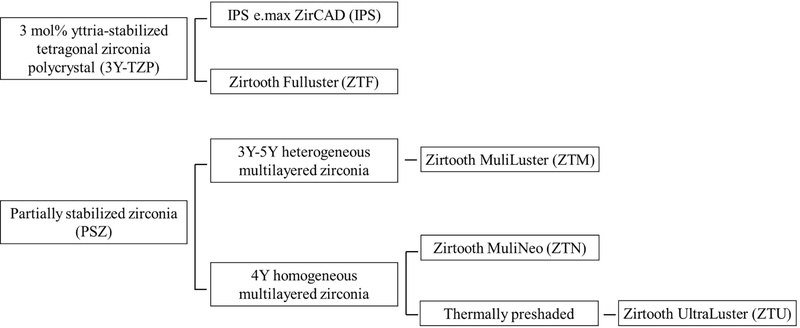
Schematic diagram of the zirconia blocks used in this study. IPS and ZTF (3Y-TZP), ZTM (3Y-5Y heterogeneous multilayered zirconia), ZTN (4Y homogeneous multilayered zirconia), and ZTU (Thermally preshaded 4Y homogeneous multilayered zirconia). A total of 60 specimens were used for each test (translucency, flexural strength), with 12 specimens per group (n=12).

List of zirconia materials used in this study
2. Specimen Preparation
Disc-shaped specimens (12 mm in diameter, 2 mm in thickness) were fabricated using a CAD/CAM system (RainbowTM Mill, Dentium, Seoul, Korea). Sintering was performed according to each manufacturer's instructions(11), and final specimen dimensions were verified to ensure compliance with ISO 6872 standards. The final sample size was determined to be 12 per group based on a power analysis using G*Power software.
3. Optical Properties
Translucency was evaluated by measuring total transmittance (Tt) using a spectrophotometer (Cary 5000, Agilent Technologies, Santa Clara, CA, USA) in the 360-740 nm range under CIE D65 illumination (12). Birefringence was measured using a birefringence analyzer (NMV-280, Suzhou PTC, Kunshan, China) at 570 nm to evaluate optical isotropy (13).
4. Mechanical Properties
Biaxial flexural strength was measured using a piston-on-three-ball test (Instron 3345, Norwood, MA, USA) at a crosshead speed of 1.0 mm/min according to ISO 6872(14). The fracture load was recorded, and flexural strength (MPa) was calculated. Vickers hardness was measured using a microhardness tester (HM-200, Mitutoyo, Kawasaki, Japen) with a load of 9.8 N for 10 s.
5. Statistical Analysis
Data were analyzed using IBM (Armonk, NY, USA) SPSS Statistics 25.0. Normality and homogeneity of variances were verified. One-way ANOVA followed by Tukey’s HSD post hoc test was performed to determine significant differences among groups (α =0.05). Weibull analysis was conducted to evaluate the reliability of flexural strength.
Results
1. Optical Properties
At 550 nm, translucency showed significant differences among groups (p<0.001). The ZTU group exhibited the highest transmittance, followed by ZTM, ZTN, ZTF, and IPS (Table 2, Figure 2). In birefringence measurements, the ZTU group showed the lowest retardation values and birefringence index (Δn), indicating high optical isotropy (Table 3). Conversely, IPS and ZTF were opaque, making birefringence measurement impossible (Figure 3).
Mean transmittance values and statistical groupings at 550 nm
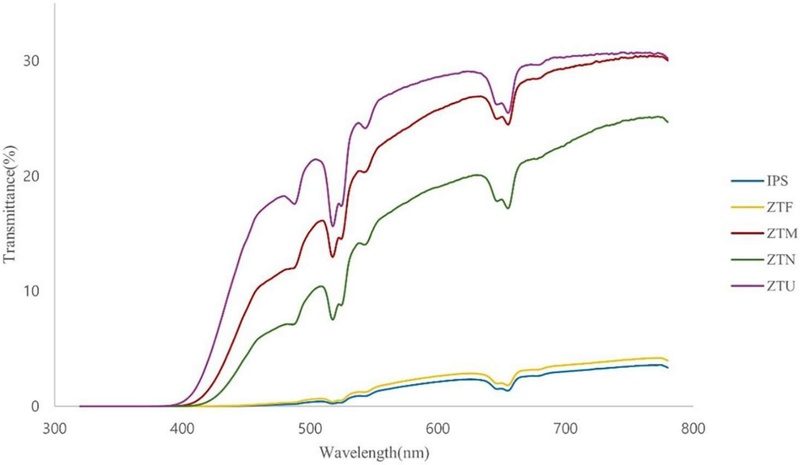
Spectral transmittance curves of zirconia specimens. Transmittance (%) was measured across wavelengths from 300 to 800 nm. The ZTU group exhibited the highest transmittance across the entire visible spectrum, followed by ZTM and ZTN. In contrast, the 3Y-TZP control groups (IPS and ZTF) showed significantly lower light transmission.
Birefringence measurements for 3Y-TZP (IPS, ZTF) and multilayered zirconia blocks (ZTM, ZTN, ZTU)
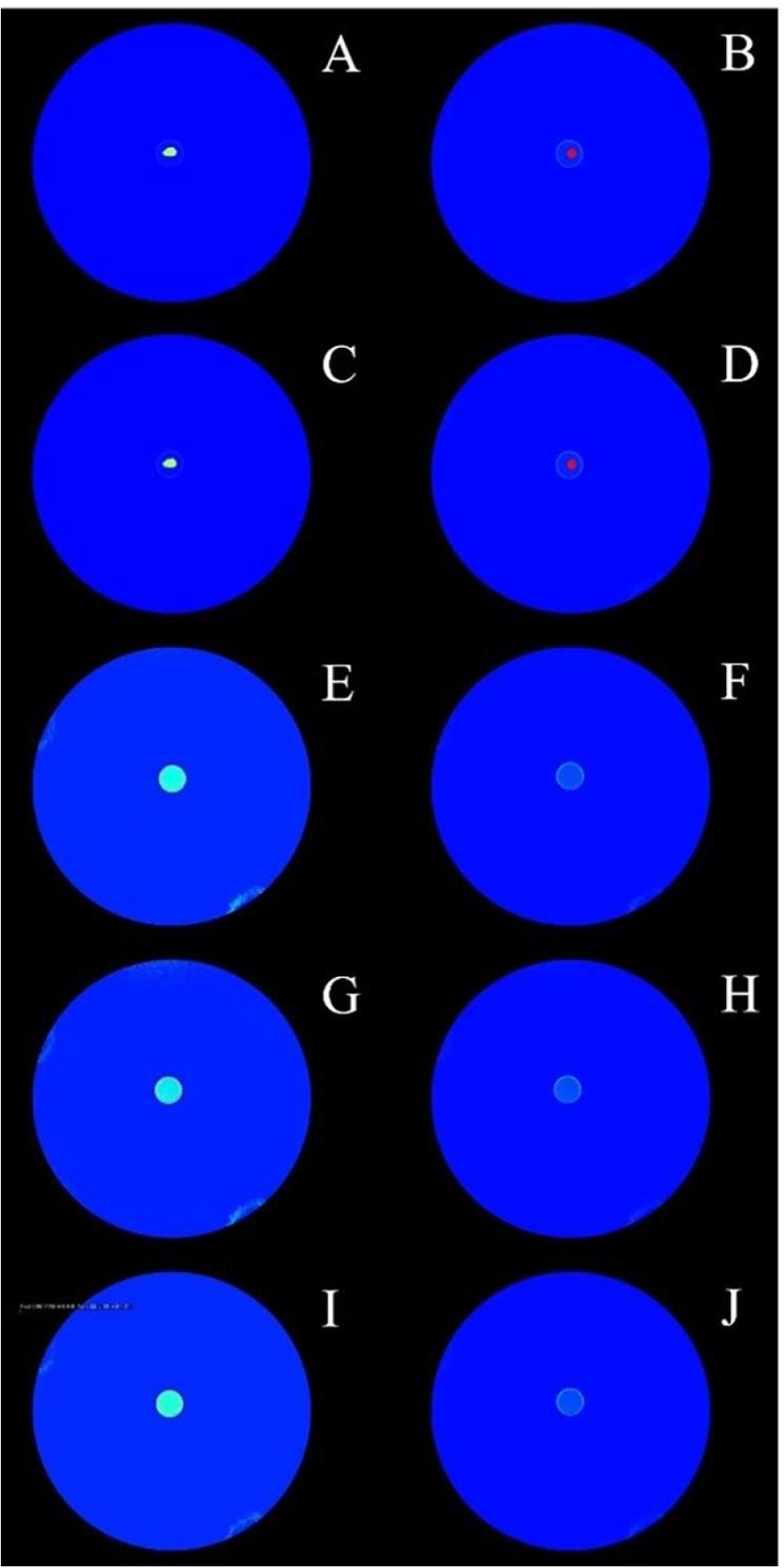
Representative polarized light microscopy images of zirconia specimens from each group. (A-B) IPS e.max ZirCAD and (C-D) Zirtooth Fulluster (3Y-TZP) show dark fields due to limited light transmission caused by high opacity. (E-F) Zirtooth MultiLuster and (G-H) Zirtooth MultiNeo exhibit birefringence patterns indicative of optical anisotropy. (I-J) Zirtooth UltraLuster displays a relatively uniform interference pattern, confirming its superior optical isotropy and high translucency compared to other groups.
2. Mechanical Properties
The ZTN group exhibited the highest biaxial flexural strength (1741.62±138.55 MPa), while the IPS group (1264.25±99.86 MPa) and ZTM group (1124.90±225.41 MPa) showed relatively lower values (Table 4, Figure 4). The Weibull modulus (m) for each group was as follows: ZTN (m=18.0), IPS (m=16.7), ZTF (m=14.5), ZTU (m=9.3), and ZTM (m=8.5). The ZTN group exhibited the highest reliability, whereas the ZTM and ZTU groups showed relatively wider dispersion in strength values (Figure 5). For Vickers hardness, the ZTU group showed the highest value, but no statistically significant differences were found among all groups (p>0.05) (Table 5, Figure 6).
Descriptive statistics of biaxial flexural strength (MPa)
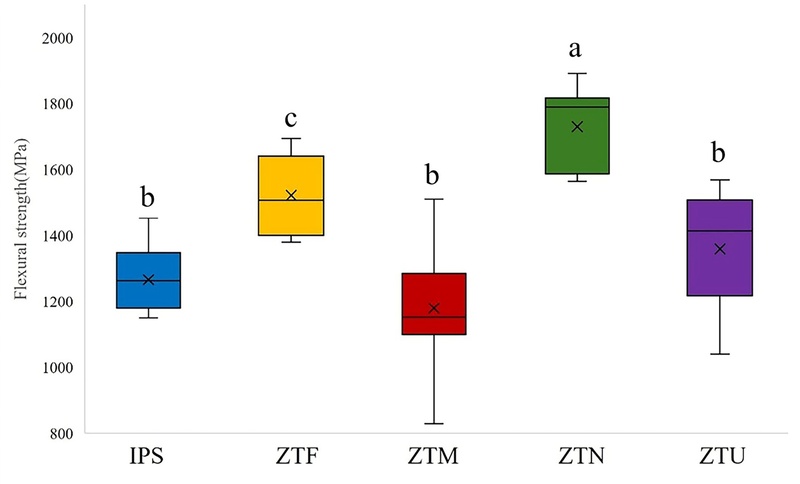
Boxplot of biaxial flexural strength for each zirconia group. The horizontal line within each box represents the median value. The ZTN group exhibited the significantly highest flexural strength among all groups. Notably, the ZTF group showed higher strength compared to the IPS control group, despite having the same yttria content.
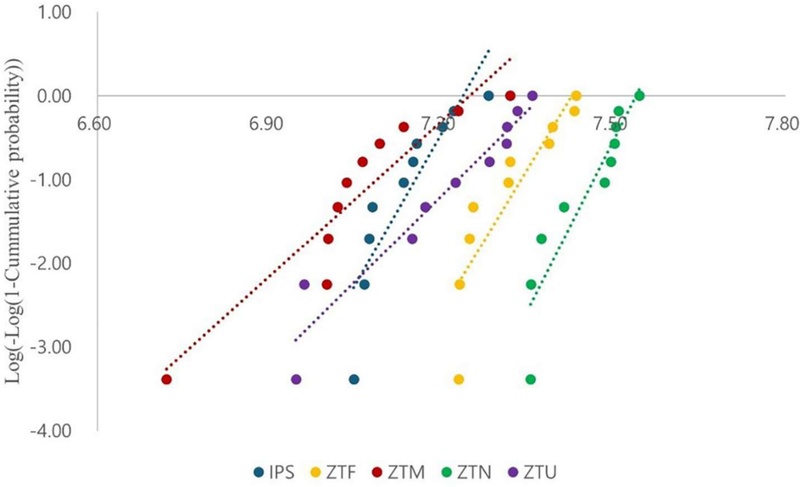
Weibull distribution plot of biaxial flexural strength for all groups. The Weibull modulus (m) for each group was as follows: ZTN (m = 18.0), IPS (m = 16.7), ZTF (m = 14.5), ZTU (m = 9.3), and ZTM (m = 8.5). The ZTN group exhibited the highest reliability (steepest slope), whereas the ZTM and ZTU groups showed relatively wider dispersion in strength values.
Descriptive statistics of Vickers hardness
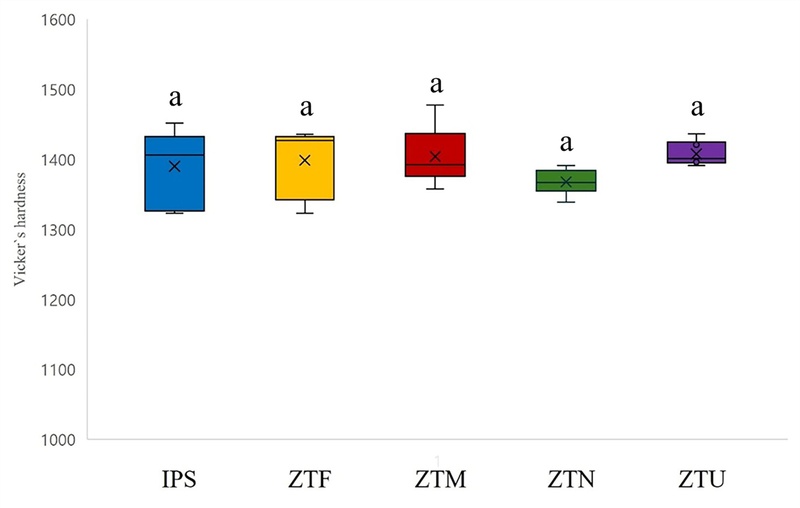
Boxplot of Vickers hardness for each zirconia group. The horizontal line within each box indicates the median value. Unlike flexural strength, statistical analysis revealed no significant differences in hardness values among the five groups ($P > .05$). This suggests that surface hardness was comparable across all materials regardless of yttria content or structural design.
3. Surface and Structural Analysis
SEM images revealed that the ZTU group had the most dense and homogeneous microstructure, whereas the IPS group showed relatively uneven grains and voids (Figure 7). EDS analysis confirmed Zr and O as major components with varying Y contents (Table 6). XRD analysis showed that ZTM, ZTN, and ZTU groups were predominantly tetragonal, while IPS and ZTF groups contained small amounts of monoclinic phase (Figure 8).
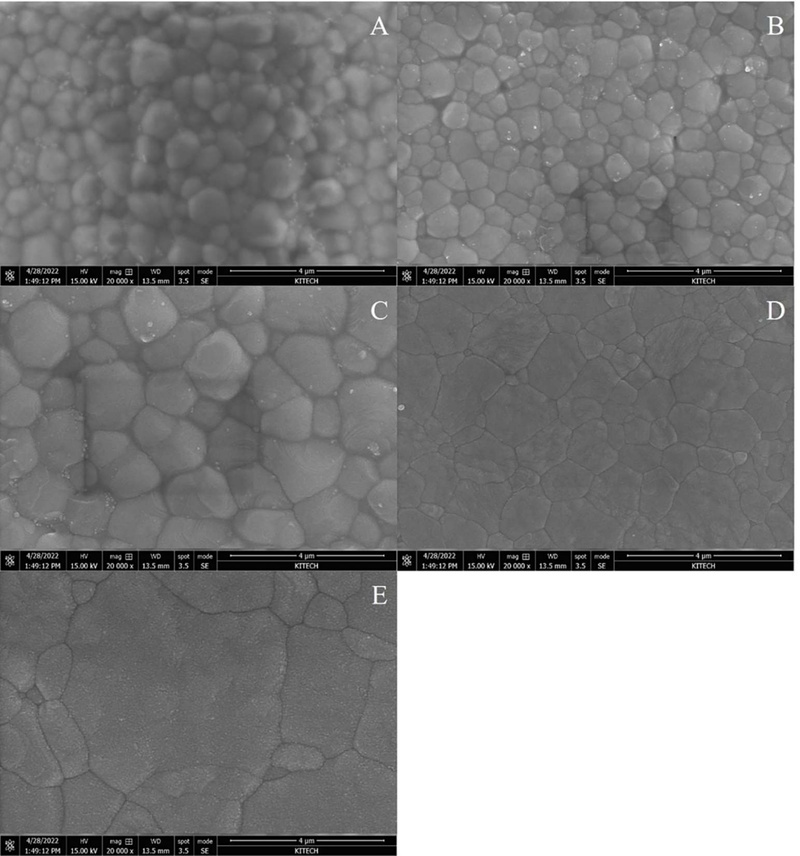
Representative SEM images of the zirconia specimens(×20,000). (A) IPS exhibits a relatively porous structure with uneven grains compared to the denser morphology of (B) ZTF. (C) ZTM and (D) ZTN show compact grain arrangements. (E) ZTU displays the most homogeneous microstructure with distinct grain growth, contributing to its superior optical properties.
Elemental composition analyzed by energy-dispersive X-ray spectroscopy
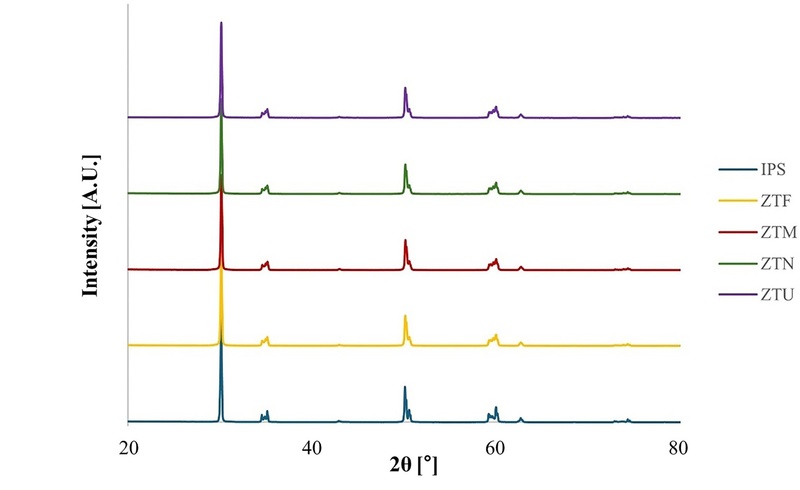
X-ray diffraction (XRD) patterns. Intense tetragonal peaks (t) were observed for ZTM, ZTN, and ZTU, confirming their stabilized polycrystalline structure. Meanwhile, the IPS and ZTF groups exhibited dominant tetragonal peaks along with minor peaks corresponding to the monoclinic phase (m).
Discussion
This study integrated the evaluation of optical and mechanical properties of multilayered zirconia blocks with different structural designs. The null hypothesis was rejected as significant differences were found among the groups.
In the optical evaluation, the ZTU group (heat-treated homogeneous 4Y-PSZ) showed the highest translucency. This can be attributed to the high content of the cubic phase, which is optically isotropic (15, 16). In contrast, the tetragonal phase exhibits optical anisotropy (birefringence), leading to light scattering at grain boundaries and reduced translucency (13, 17). Our birefringence results confirmed this, with the ZTU group showing the lowest retardation values, indicating superior optical isotropy (Table 3).
Regarding mechanical properties, the ZTN group (homogeneous 4Y-PSZ) exhibited the highest flexural strength (Table 4). This is likely due to the transformation toughening mechanism of the tetragonal phase, which arrests crack propagation (18, 19). Interestingly, the heterogeneous ZTM group, which contains a 3Y-TZP layer, showed intermediate strength. This might be due to residual stresses caused by the mismatch in sintering shrinkage between layers with different yttria contents (6, 20). Furthermore, it should be noted that the specimens in this study were fabricated from the center of the blocks to strictly comply with ISO 6872 standards for dimension and uniformity. Consequently, the high-strength lower layer (3Y-TZP) and the highly translucent upper layer (5Y-PSZ) may not have been fully represented in the ZTM specimens, which likely consisted mainly of the transition layers. In a clinical setting, a full-contour crown would utilize the entire gradient, potentially benefiting from the superior strength of the cervical 3Y-TZP layer. Therefore, the mechanical advantage of the strength-gradient design in ZTM might be underestimated in this study compared to actual clinical applications (8).
The control group IPS (3Y-TZP) showed significantly lower strength compared to ZTF (3Y-TZP) and ZTN (4Y-PSZ). This discrepancy, despite identical yttria content between IPS and ZTF, can be explained by microstructural differences observed in the SEM analysis (Figure 7). The IPS group exhibited relatively uneven grain sizes and a higher frequency of micro-voids compared to the densely sintered microstructure of ZTF. These micro-voids likely acted as stress concentration points, initiating crack propagation and reducing overall flexural strength. This suggests that modern manufacturing processes, such as improved powder homogeneity and sintering protocols, play a more critical role in determining mechanical properties than yttria content alone (1, 21). Recent studies have also reported that new generations of zirconia exhibit improved properties due to optimized microstructures (22, 23).
The ZTU group demonstrated lower strength than ZTN but comparable hardness. The additional heat treatment in ZTU likely promoted grain growth, which can reduce flexural strength but improve surface density and hardness (24, 25). Although high hardness is beneficial for wear resistance, it requires careful polishing to prevent antagonist wear (26).
From a clinical perspective, the selection of monolithic zirconia blocks should be guided by the specific mechanical and optical requirements of the restoration site. The findings of this study suggest that optimized homogeneous blocks may offer more predictable clinical outcomes than heterogeneous designs. Specifically, the ZTN group, characterized by high flexural strength and reliability (high Weibull modulus), is recommended for high-load-bearing posterior regions, whereas the ZTU group, with its superior translucency and optical isotropy, is the material of choice for anterior regions requiring high esthetics (27). Although heterogeneous blocks (ZTM) attempt to combine these properties, the specialized performance of homogeneous blocks appears more advantageous for meeting specific clinical indications. Future studies should investigate the long-term fatigue behavior and low-temperature degradation (LTD) of these materials to ensure clinical longevity (28, 29).
Conclusion
Within the limitations of this study, the following conclusions were drawn:
- 1. The conventional 3Y-TZP block (IPS) showed significantly lower translucency and strength compared to modern multilayered zirconia blocks.
- 2. The heterogeneous multilayered block (ZTM) did not show superior mechanical performance compared to the optimized homogeneous blocks.
- 3. The homogeneous 4Y-PSZ-based ZTN group is recommended for high-stress applications due to its superior strength, while the ZTU group is suitable for esthetic restorations due to its high translucency and optical isotropy.
Acknowledgments
본 결과물은 2025년도 교육부 및 강원특별자치도의 재원으로 수행된 지역혁신중심 대학지원체계(RISE) 글로컬대학 30의 결과입니다(2025-RISE-10-004). This research was supported by the Regional Innovation System & Education(RISE) Glocal University 30 Project program, funded by the Ministry of Education(MOE) and the Gangwon State(G.S.), Republic of Korea.(2025-RISE-10-004)
References
-
Cesar PF, Miranda RBP, Santos KF, Scherrer SS, Zhang Y. Recent advances in dental zirconia: 15 years of material and processing evolution. Dent Mater. 2024;40(5):824-36.
[https://doi.org/10.1016/j.dental.2024.02.026]

-
Denry I, Kelly JR. State of the art of zirconia for dental applications. Dent Mater. 2008;24(3):299-307.
[https://doi.org/10.1016/j.dental.2007.05.007]
-
Zhang Y, Lawn BR. Novel zirconia materials in dentistry. J Dent Res. 2018;97(2):140-7.
[https://doi.org/10.1177/0022034517737483]
-
Hjerppe J, Özcan M. Zirconia: more and more translucent. Curr Oral Health Rep. 2023;10:203-11.
[https://doi.org/10.1007/s40496-023-00344-1]
-
Gomes PL, dos Santos C, Fernandes AM, Amarante JEV, dos Santos HES, Elias CN. Mechanical and optical properties of multilayer yttria-stabilized zirconia for dental prostheses. J Mater Res Technol. 2024;31:760-71.
[https://doi.org/10.1016/j.jmrt.2024.06.066]
-
Inokoshi M, Liu H, Yoshihara K, Yamamoto M, Tonprasong W, Benino Y, et al. Layer characteristics in strength-gradient multilayered yttria-stabilized zirconia. Dent Mater. 2023;39(4):430-41.
[https://doi.org/10.1016/j.dental.2023.03.015]
-
Kolakarnprasert N, Kaizer MR, Kim DK, Zhang Y. New multi-layered zirconias: Composition, microstructure and translucency. Dent Mater. 2019;35(5):797-806.
[https://doi.org/10.1016/j.dental.2019.02.017]
-
Strasser T, Wertz M, Koenig A, Koetzsch T, Rosentritt M. Microstructure, composition, and flexural strength of different layers within zirconia materials with strength gradient. Dent Mater. 2023;39(5):463-8.
[https://doi.org/10.1016/j.dental.2023.03.012]
-
Kang CM, Peng TY, Wu YA, Hsieh CF, Chi MC, Wu HY, et al. Comparison of optical properties and fracture loads of multilayer monolithic zirconia crowns with different yttria levels. J Funct Biomater. 2024;15(8):228.
[https://doi.org/10.3390/jfb15080228]
-
Maharishi A, McLaren EA, White SN. Color- and strength-graded zirconia: Strength, light transmission, and composition. J Prosthet Dent. 2024;131(6):1236.e1-9.
[https://doi.org/10.1016/j.prosdent.2024.03.015]
-
Sawangsri K, Makowka S, Bencharit S, Kim H. Effect of sintering cycle on the strength and translucency of multilayered zirconia. J Prosthet Dent. 2024 Sep 27.
[https://doi.org/10.1111/jopr.13956]
-
Sulaiman TA, Abdulmajeed AA, Donovan TE, Ritter AV, Vallittu PK, Närhi TO, Lassila LV. Optical properties and light irradiance of monolithic zirconia at variable thicknesses. Dent Mater. 2015;31(10):1180-7.
[https://doi.org/10.1016/j.dental.2015.06.016]
-
Klimke J, Trunec M, Krell A. Transparent tetragonal yttria-stabilized zirconia ceramics: influence of scattering caused by birefringence. J Am Ceram Soc. 2011;94(6):1850-8.
[https://doi.org/10.1111/j.1551-2916.2010.04322.x]
-
Alghazzawi TF, Janowski GM, Eberhardt AW. An experimental study of flexural strength and hardness of zirconia and their relation to crown failure loads. J Prosthet Dent. 2024;131(2):320-8.
[https://doi.org/10.1016/j.prosdent.2022.04.005]
- Dash A, Kim BN, Klimke J, Vleugels J. Transparent tetragonal-cubic zirconia composite ceramics densified by spark plasma sintering and hot isostatic pressing. J Eur Ceram Soc. 2018;38(15):5171-7.
-
Zhang Y. Making yttria-stabilized tetragonal zirconia translucent. Dent Mater. 2014;30(10):1195-203.
[https://doi.org/10.1016/j.dental.2014.08.375]
-
Chevalier J, Gremillard L, Virkar AV, Clarke DR. The tetragonal-monoclinic transformation in zirconia: Lessons learned and future trends. J Am Ceram Soc. 2009;92(9):1901-20.
[https://doi.org/10.1111/j.1551-2916.2009.03278.x]
-
Garvie RC, Hannink RHJ, Pascoe RT. Ceramic steel? Nature. 1975;258(5537):703-4.
[https://doi.org/10.1038/258703a0]
-
Matsui K, Hosoi K, Feng B, Yoshida H, Ikuhara Y. Ultrahigh toughness zirconia ceramics. Proc Natl Acad Sci U S A. 2023;120(27):e2304498120.
[https://doi.org/10.1073/pnas.2304498120]
-
Jerman E, Lümkemann N, Eichberger M, Zoller C, Nothelfer S, Kienle A, Stawarczyk B. Evaluation of translucency, Marten’s hardness, biaxial flexural strength and fracture toughness of 3Y-TZP, 4Y-TZP and 5Y-TZP materials. Dent Mater. 2021;37(2):212-22.
[https://doi.org/10.1016/j.dental.2020.11.007]
-
Johansson C, Larsson C, Papia E. Biaxial flexural strength and surface characterization of multilayer zirconium dioxide after polishing, glazing and clinical adjustments. J Mech Behav Biomed Mater. 2025;166:106930.
[https://doi.org/10.1016/j.jmbbm.2025.106930]
-
Bruhnke M, Awwad Y, Müller WD, Beuer F, Schmidt F. Mechanical properties of new generations of monolithic, multi-layered zirconia. Materials (Basel). 2022;16(1):276.
[https://doi.org/10.3390/ma16010276]
-
Cho MH, Seol HJ. Optical properties, microstructure, and phase fraction of multi-layered monolithic zirconia with and without yttria-gradient. Materials (Basel). 2022;16(1):41.
[https://doi.org/10.3390/ma16010041]
-
Alshahrani AM, Lim CH, Wolff MS, Janal MN, Zhang Y. Current speed sintering and high-speed sintering protocols compromise the translucency but not strength of yttria-stabilized zirconia. Dent Mater. 2024;40(4):664-73.
[https://doi.org/10.1016/j.dental.2024.02.012]
-
Cho MH, Seol HJ. Impact of speed sintering on translucency, opalescence and microstructure of dental zirconia with a combination of 5 mol% and 3 mol% yttria-stabilized zirconia. Materials (Basel). 2024;17(21):5148.
[https://doi.org/10.3390/ma17215148]
-
Porto TS, Schmid LM, Henriques B, Özcan M, Souza ROA. Brittleness index and its relationship with materials mechanical properties: Influence on the machinability of CAD/CAM materials. J Mech Behav Biomed Mater. 2019;93:50-6.
[https://doi.org/10.1590/1807-3107bor-2019.vol33.0026]
-
Monção AMS, dos Santos EMB, Gomes PL, Amarante JEV, de Freitas BX, Santos C. Effect of Y2O3 content on the mechanical and optical properties of zirconia-based dental ceramics. Cerâmica. 2023;69(392):278-87.
[https://doi.org/10.1590/0366-69132024703923512]
-
Ha SR, Choi YS. Effect of hydrothermal aging on dental multilayered zirconia for monolithic restorations: An in vitro study. Ceram Int. 2021;47(12):17057-68.
[https://doi.org/10.1016/j.ceramint.2021.03.013]
-
Cotič J, Kocjan A, Panchevska S, Kosmač T, Jevnikar P. In vivo ageing of zirconia dental ceramics - Part II: Highly-translucent and rapid-sintered 3Y-TZP. Dent Mater. 2021;37(3):454-63.
[https://doi.org/10.1016/j.dental.2020.11.019]